Happy Birthday, $50SAT/MO-76!

Yaesu handheld and $50SAT 1.5U PocketQube

Yaesu handheld and $50SAT 1.5U PocketQube

Friday, November 21, 2014 marked the one year anniversary of the launch of $50SAT/MO-76 PocketQube satellite.

Michael Kirkhart KD8QBA writes:

Our little creation was launched from Dombarovsky Air Base in Russia at 07:01 UT (which was 2:01 AM here in EN82 land) as one of 33 satellites aboard a Dnepr rocket. It was first heard by Jan, PE0SAT, at 08:46 UT, and by Stuart GW7HPW at 09:17 UT, and has been operating continuously ever since!

The $50SAT/MO-76 Dropbox now contains a snapshot of all the telemetry gathered from launch day through November 21, 2014.
https://www.dropbox.com/sh/l3919wtfiywk2gf/AAC0dF52-SAKbci7gK6iELaja/Telemetry-analysis/2014-11-21

$50SAT/MO-76 continues to operate normally, but the battery capacity has been slowly dropping to the point where it barely registers above 3500 mV when passing over EN82 land during daytime (decending) passes. I have been able to capture telemetry while it passes over Anton’s (ZR6AIC) WebSDR station http://zr6aic.giga.co.za:8902/ which is located in South Africa. During ascending passes, which occur between 20:00 and 21:30 UT, $50SAT/MO-76 has just transitioned from being in sunlight to being in eclipse, and the battery voltage is between 3602 and 3642 mV.

Over the life of $50SAT/MO-76, we have observed the following:
The maximum battery voltage was 3824 mV, while the minimum was 3440 mV
The maximum PCB temperature was 25 degrees C, while the minimum was -29 degrees C
The maximum RFM22 temperature was 29 degrees C, while the minimum was -30 degrees C
The maximum MPPT (solar) power was 312.84 mW
The maximum idle (RFM22 off) current was 3 mA, while the minimum was 2 mA
The maximum receive mode current was 31 mA, while the minimum was 21 mA
The maximum transmit mode current was 88 mA, while the minimum was 77 mA

On December 4, 2013, the folks at NORAD and Celestrak (with help from Mike, DK3WN) were able to identify $50SAT/MO-76 as object 2013-066W. At this time, apogee was at 640 km, and perigee was 595 km. As of November 21, 2014, apogee is at 599 km, and perigee is at 565 km. This means the average altitude has decreased by about 36 km. A spreadsheet, along with a graph of the orbital data is available on the $50SAT/MO-76 Dropbox
https://www.dropbox.com/sh/l3919wtfiywk2gf/AADn6QqebB-_F7yKXc2RTaU0a/Orbit-analysis

While we did not have time to demonstrate this at the AMSAT-NA Space Symposium, we now have a working Arduino/RFM22 based groundstation. It utilizes a slightly modified version of the Sparkfun RFM22 Arduino shield https://www.sparkfun.com/products/11018 Additional information, including photos, marked up schematics, and the Arduino sketches, is available (guess where?) on the $50SAT/MO-76 Dropbox.
https://www.dropbox.com/sh/l3919wtfiywk2gf/AADw6hSSdaccILYdnpnBTUmta/Arduino-Groundstation

In addition to the original, receive-only sketch (S50SAT_receiver), there is a new version (S50SAT-Groundstation) which includes transmit capability, which supports all three open uplink commands. Both versions are capable of receiving all GFSK based packets, including the FEC packets.

I have successfully received $50SAT info and FEC packets from about 1200 km slant range with my groundstation using an Advanced Receiver Research P432VDG LNA http://advancedreceiver.com/page5.html with my homebrew 6 element WA5VJB yagi. The LNA is needed to improve the sensitivity of the RFM22, which is about -99 dBm. Since the RFM22 can only output 20 dBm (100 mW) and the minimum EIRP needed to uplink to $50SAT/MO-76 when it is directly overhead is about 36 dBm (4W), either a 16 dB gain antenna, an external linear amplifier, or both will be needed to successfully uplink.

Speaking of uplinking, no one has completed the $50SAT/MO-76 Uplink Challenge. This challenge is open to any licensed amateur radio operator, and the prize for successful completion is (drum roll…) a certificate of technical achievement, signed by all three of the $50SAT/MO-76 developers.

Our thanks to all who has supported us in this project, including all of you telemetry gathers. Please keep the telemetry coming!

73
Michael Kirkhart KD8QBA
$50SAT/MO-76 team

$50SAT was a collaborative education project between Professor Bob Twiggs, KE6QMD, Morehead State University and three other radio amateurs, Howie DeFelice, AB2S, Michael Kirkhart, KD8QBA, and Stuart Robinson, GW7HPW. The transmitter power is just 100 mW on 437.505 MHz (+/-9 kHz Doppler shift) FM CW/RTTY. $50SAT uses the low cost Hope RFM22B single chip radio and PICAXE 40X2 processor.

There is a discussion group for $50SAT http://groups.yahoo.com/groups/50dollarsat/

50DollarSat http://www.50dollarsat.info/
Ham radio launches to deep space

ARTSAT2:DESPATCH Internal Structure

ARTSAT2:DESPATCH Internal Structure

ARTSAT2:DESPATCH is going to launch on a mission into deep space on November 30, 2014 carring a 7 watt CW transmitter on 437.325 MHz.

It will fly with the asteroid mission Hayabusa 2 and another amateur radio satellite Shin’en 2.

ARTSAT2:DESPATCH will have an elliptic orbit around the Sun and travel to a deep space orbit between Venus and Mars. Its inclination will be almost zero, which means Shin’en 2 will stay in the Earth’s equatorial plane. The distance from the Sun will be between 0.7 and 1.3 AU. An Astronomical Unit (AU) is 149,597,871 km.

ARTSAT2 DESPATCH  Deep Space Sculpture

ARTSAT2 DESPATCH Deep Space Sculpture

The team have released the following information:

1. Despatch CW Format is now available!

Yesterday, we opened a wiki which explains how to join the “Cooperative data reconstruction,” the main mission of Despatch.  In this wiki, you can find the CW format as well as how to report the data you received.
http://despatch.artsat.jp/en/Cooperative_Data_Reconstruction

2. Despatch Tracking page is opened!

Since Despatch is injected into an Earth escape trajectory, TLE is unavailable. Instead, we opened a web-page for the spacecraft tracking (both antenna-pointing and receiver-tuning).
http://api.artsat.jp/pass/

Please go to the page and enter your geographic location, and you will get nearby passes and a table with 1 minute steps that gives you AZ, EL, Freaquency, and so on. As the apparent movement and the change of the Doppler shift are slow, manual pointing of the antenna and tuning of the receiver every 10 minutes or so will do.

3. Reception Report page is opened!

We opened a web page in which you can report the data you received.
http://api.artsat.jp/report/

Thanks in advance and all the best,

Akihiro Kubota, ARTSAT project

ARTSAT2:DESPATCH
Web http://despatch.artsat.jp/en/Main_Page
Facebook https://www.facebook.com/artsat
Twitter https://twitter.com/DESPATCH_ARTSAT

ARTSAT2:DESPATCH spacecraft prediction Apps
http://ji1izr.air-nifty.com/ham_satellite/in_english/index.html

Shin’en2 and Japanese Asteroid Mission
https://amsat-uk.org/2014/09/01/japanese-asteroid-mission-to-carry-amateur-radio/

RSGB Youth Committee Chair Announced

Chair of RSGB Youth Committee Mike Jones 2E0MLJ

Chair of RSGB Youth Committee Mike Jones 2E0MLJ

The Radio Society of Great Britain has appointed 17-year-old Mike Jones, 2E0MLJ, as Chair of the RSGB Youth Committee.

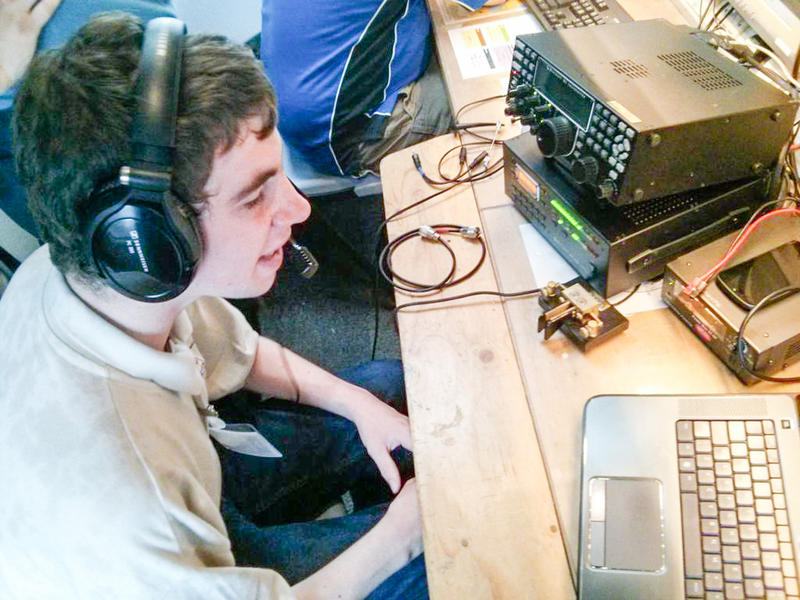
Mike was originally licenced as M6TMJ and is currently studying Forensic Science and Criminal Psychology at City College Plymouth. He is a member of the QRZ.com Staff helping on the database forum and is also Younsters On The Air (YOTA) Month Co-Ordinator for the UK.

At the RSGB Convention in October Mike gave an excellent presentation on July’s successful YOTA-UK event held in Wolverhampton which was organised by young people, for young people. As well as Mike 2E0MLJ the YOTA-UK organising committee included Marie-Ann M6UWS, Dax M6DAX, Jenny M6HFA and Rachel M6SOO.

Read the RadCom article on IARU Region 1 YOTA and YOTA-UK at http://www.ham-yota.eu/wp-content/uploads/2014/08/UK%20YOTA%20Report%20from%20RadCom.pdf

Follow YOTA-UK on Twitter @YOTA_UK

2E0MLJ on Twitter @MikeJ1997

OSCAR Locator App

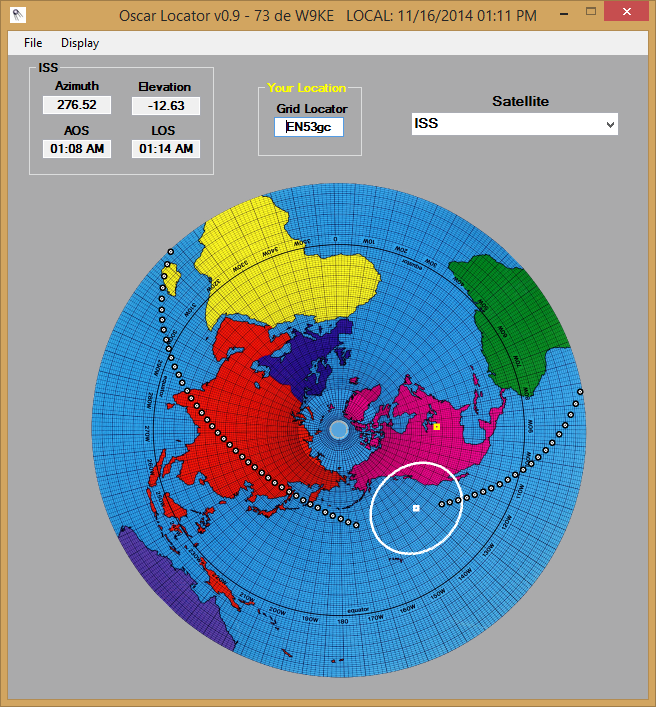
OscarLocator-1Tom Doyle W9KE has developed a Windows satellite tracking App that reproduces the graphical display of the original cardboard OSCARLOCATOR .

Most tracking programs use an equirectangular projection which is by far the easiest to program and shows the entire Earth at once. A 3D model is often used which helps visualize orbits but does not show the entire Earth at the same time.

Tom remembers having an easier time visualizing the orbits back in the day (1970’s) when amateurs used cardboard OSCAR Locators with overlays. This Windows program lets you visualize orbits OSCAR Locator style.

Download the OSCAR Locator from http://www.tomdoyle.org/OscarLocator

Other Apps by Tom can be downloaded via http://www.tomdoyle.org/

40 Years of Tracking OSCAR-7 https://amsat-uk.org/2014/11/09/40-years-tracking-oscar-7/

SatNOGS Win Hackaday Prize

SatNOGS - Satellite Networked Open Ground Station

SatNOGS – Satellite Networked Open Ground Station

The open-source amateur satellite tracking project SatNOGS has won the Hackaday 1st prize and an amateur radio SDR won 3rd prize.

Six months ago Hackaday challenged their readers to realize the future of open, connected devices, The prize was a ticket to travel into space. The winners were announced at the Electronica trade show in Munich on November 13.

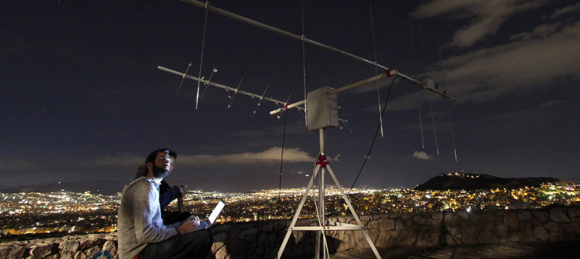
The SatNOGs project is a thrilling example of the benefits of a connected world. It opens up the use of satellite data to a much wider range of humanity by providing plans to build satellite tracking stations, and a protocol and framework to share the satellite data with those that cannot afford, or lack the skills to build their own tracking station. The hardware itself is based on readily available materials, commodity electronics, and just a bit of 3D printing.

Read the Hackaday article at
http://hackaday.com/2014/11/13/satnogs-wins-the-2014-hackaday-prize/

Ham Radio in Hackaday Prize Finals
https://amsat-uk.org/2014/11/08/ham-radio-in-hackaday-prize-finals/

SatNOGS – Satellite Networked Open Ground Station https://satnogs.org/

Chelmsford’s involvement in Rosetta

Computer generated image of Rosetta

Computer generated image of Rosetta

The UK Deputy Prime Minister congratulated one of the Chelmsford companies involved in developing key equipment for the successful Rosetta mission.

On Thursday, November 13 the Deputy PM @DPMoffice tweeted
Huge congratulations to @e2v in Chelmsford, who’ve been part of history on #Rosetta mission #spacehistory #RGF @spacegovuk

e2v developed the specialized sensors on which both Rosetta and Philae depend.

On Rosetta:
• OSIRIS – the high resolution imaging camera. It has a narrow field and wide field camera.
• NAVCAM – the navigation camera.
• VIRTIS (Visible and Infrared Thermal Imaging Spectrometer) – which maps and studies the nature of the solids and the temperature on the surface of the comet. It also identifies gases, characterizes the physical conditions of the comet and has helped to identify the best landing site (e2v’s devices are in the visible element of this instrument).

On Philae:
• ÇIVA (Comet nucleus Infrared and Visible Analyzer) – six identical micro-cameras take panoramic pictures of the surface of the comet. A spectrometer studies the composition, texture and albedo (reflectivity) of samples collected from the surface.
• ROLIS (Rosetta Lander Imaging System) – a CCD camera used to obtain high-resolution images during the descent of the lander and take stereo panoramic images of areas sampled by other instruments.

Read the e2v announcement at
http://www.e2v.com/news/scientists-ready-to-discover-the-origins-of-earth-with-help-from-high-performance-technology-company-e2v/

e2v was not the only Chelmsford company involved in Rosetta, the Intermediate Frequency Modem System (IFMS) was developed by BAE Systems Advanced Technology Centre in Great Baddow, Chelmsford, Essex
http://www.baesystems.com/article/BAES_175611/supporting-the-rosetta-mission

Watch IFMS: The Interplanetary Smartphone Supporting the Rosetta Mission

A number of radio amateurs work at both companies.

Radio amateurs have been listening to Rosetta’s signal on 8421.7869 MHz since January 2014 when it was 805 million km away from Earth, see
https://amsat-uk.org/2014/01/23/radio-amateurs-receive-rosetta-signals/

Chelmsford Amateur Radio Skills Night Monday November 17
http://www.southgatearc.org/news/2014/november/essex_amateur_radio_skills_night.htm