Queen shown radio ham’s Raspberry Pi balloon payload

Her Majesty Queen Elizabeth II is shown M0RPI's 434 MHz High Altitude Balloon Payload

Her Majesty Queen Elizabeth II is shown M0RPI’s 434 MHz High Altitude Balloon Payload – Credit Raspberry Pi Foundation

On Monday, June 9, more than 350 of the UK’s most successful and most promising technologists were invited to Buckingham Palace by the Queen and the Duke of York for Tech at the Palace.

Her Majesty Queen Elizabeth II was shown the Raspberry Pi High Altitude Balloon payload developed by David Akerman M6RPI (now M0RPI) which transmitted Slow Scan Digital Video (SSDV) signals on 434 MHz from the first “Pi in the Sky“. She also saw the TARDIS that was flown by David and Anthony Stirk M0UPU @AnthonyStirk

David M0RPI @daveake tweeted:
The Queen, The Duke of York, and my TARDIS 🙂 #UKHAS #RaspberryPi pic.twitter.com/sOTT4mT7MJ

Giant leap for radio amateur M6RPI’s Pi-powered teddy bear
https://amsat-uk.org/2013/08/26/giant-leap-for-radio-hams-pi-powered-teddy-bear/

M6RPI Balloon PIE1 – Raspberry Pi Sends Live Images from Near Space
https://amsat-uk.org/2012/07/17/pie1-raspberry-pi-sends-live-images-from-near-space/

OSCAR number for LituanicaSAT-1

LituanicaSAT-1 Camera and FM Voice Transponder

LituanicaSAT-1 Camera and FM Voice Transponder

AMSAT-NA has announced that the amateur radio satellite LituanicaSAT-1 has been awarded the designation OSCAR-78, or LO-78.

In a message to the LituanicaSAT-1 team, AMSAT-NA OSCAR Number Administrator Bill Tynan, W3XO announced:
“LituanicaSAT-1 has met all of the requirements for an OSCAR number. My findings from information provided to AMSAT-NA and IARU officials confirm this to be true. Accordingly, under the authority vested in me by the AMSAT-NA President, I do hereby assign LituanicaSAT-1 the designation LituanicaSAT OSCAR-78, or LO-78. I, and all of the amateur radio satellite community, wish LituanicaSAT OSCAR-78 a long and successful mission.”

LituanicaSAT-1 FrequenciesOn behalf of the LituanicaSAT-1 team, Simon Kareiva, LY2EN replied, “It is my honor and pleasure to accept this assignation. Our team is focused to keep LO-78 operational for the benefit of amateur radio as long, as it is possible for a small cubesat.
Thank you very much, Simon LY2EN.”

The LituanicaSAT-1 team has announced activation of the FM voice transponder. A general rule to find out if the transponder is working at the moment is to monitor the beacon frequency on 437.275 MHz. If you can hear the CW FM beacon it means that the transponder is off, if you cannot hear it –  the transponder is on. The transponder frequencies are approximately 435.1755 MHz (+/- 10 kHz Doppler shift) for the downlink and 145.950 MHz for the uplink with 67 Hz CTCSS.

FM transponder operating techniques http://www.dk3wn.info/p/?p=44412

Information on obtaining an OSCAR number for your satellite can be found on the OSCAR Numbers Policy page at http://www.amsat.org/?page_id=2478

USA Radio Hams at National Radio Centre

Brent Salmi KB1LQD and Bryce Salmi KB1LQC at NRC

Brent Salmi KB1LQD and Bryce Salmi KB1LQC at the National Radio Centre in Bletchley Park

On Sunday, June 9, Brent Salmi KB1LQD and Bryce Salmi KB1LQC from Chelmsford MA met up with AMSAT-UK’s Graham Shirville G3VZV at the RSGB National Radio Centre at Bletchley Park.

Over a pint Graham G3VZV updated them on the current activities of AMSAT-UK.

Bryce KB1LQC commented “wish we had more time! Absolutely beautiful station/display at Bletchley Park”.

National Radio Centre Bletchley Park http://www.nationalradiocentre.com/

50th anniversary of historic Chelmsford EME contact

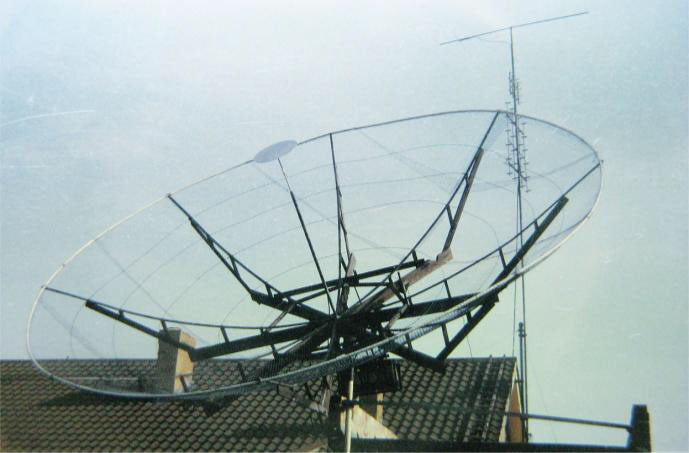
15 foot (4.5m) Moon bounce dish used by Peter Blair G3LTF in 1964

G3LTF’s 15 foot (4.5m) Moonbounce dish at Galleywood, Chelmford in 1964 – Credit Peter Blair G3LTF

June 13 is the 50th anniversary of the first UK amateur radio moonbounce (EME) contact which was made by Peter Blair G3LTF from Chelmsford in Essex.

Arecibo 305m diameter dish antenna

Arecibo 305m diameter dish antenna

The RSGB GB2RS News Service reports:

July 2014 marks the 50th anniversary of the first time that amateur signals from the UK reached other parts of the world by bouncing off the moon, a technique now known as moonbounce or earth-moon-earth, EME. In the July 1964 edition of Radio Communications the RSGB announced that at 20.20 GMT on June 13, 1964, G3LTF at Galleywood, Chelmsford, and KP4BPZ in Puerto Rico, made contact on 430 Mc/s [MHz] by bouncing their signals off the moon. Signal reports were RST459 both ways.

A further contact took place one hour later. KP4BPZ was fortunate in having the 1000ft [305m] radio-telescope dish aerial at Arecibo, Puerto Rico at his disposal. G3LTF’s equipment included a 15ft [4.5m] dish aerial and an AF139 transistor preamplifier for reception. Power input to the PA was 150 watts. What is more remarkable is that Peter, G3LTF is still active on moonbounce and is one of the world’s leading pioneers.

The RSGB offers Peter, G3LTF our heartiest congratulations on this 50th anniversary of his achievement.

Source GB2RS News: http://rsgb.org/main/news/gb2rs/

CARS-GX0MWT-roundel-badgeThe Chelmsford Amateur Radio Society (CARS) send their congratulations to Peter for his achievement 50 years ago and all the pioneering EME work he has carried out since.

Read an article by Peter G3LTF on the potential impact of the new Galileo GPS system http://www.southgatearc.org/articles/galileo.htm

CARS run short amateur radio training courses. If you’d like to find out more about the hobby speak to Clive G1EUC.
Tel: 01245-224577
Mob: 07860-418835
Email: training2014 at g0mwt.org.uk
Web: http://www.g0mwt.org.uk/training/

What is Amateur Radio ? http://www.essexham.co.uk/what-is-amateur-radio

Influence of ham radio on astronaut

Astronaut Alexander Gerst KF5ONO

Astronaut Alexander Gerst KF5ONO

In this video ISS Astronaut Alexander Gerst KF5ONO talks about how his grandfather, a radio ham, helped him bounce a signal off the moon (EME) when he was six and the influence amateur radio had on his career.

Watch Alexander Gerst KF5ONO Crew Profile

LituanicaSAT-1 FM Transponder Active

LituanicaSAT-1 Camera and FM Voice Transponder

LituanicaSAT-1 Camera and FM Voice Transponder

The LituanicaSAT-1 team have announced activation of the FM transponder.

Dear radio amateurs,

The LituanicaSAT-1 transponder is currently on and should remain so. General rule to find out if the transponder is working at the moment is following: if you can hear CW FM beacon on 437.275 MHz it means that transponder is off, if you cannot hear it – transponder is on.

73,
Laurynas Maciulis
LY1LM, LY5N

LituanicaSAT-1 FrequenciesFrequency are approximately 435.1755 MHz (+/- 10 kHz Doppler shift) for the downlink and 145.950 MHz for the uplink with 67 Hz CTCSS.

The tiny satellite is just 10x10x10 cm with a mass of 1.090 kg yet it has a VGA camera and a 145/435 MHz FM voice transponder, designed and built by Lithuanian radio amateurs.

The prototype of the FM repeater has been operating in the home of its designer Žilvinas Batisa LY3H in Elektrėnai, Lithuania. Further information at http://ly3h.epalete.com/?p=303

FM transponder operating techniques http://www.dk3wn.info/p/?p=44412

LituanicaSAT-1 CubeSat https://amsat-uk.org/2014/02/27/lituanicasat-1-cubesat/

Reports should be sent to: ly5n at qrz.lt

LituanicaSAT-1 was built by students from Vilnius University.