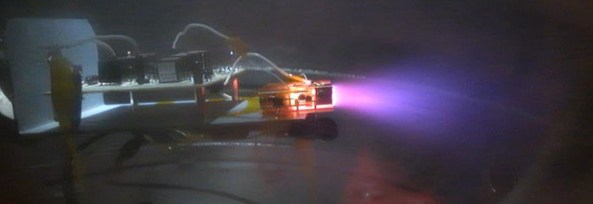
STRaND-1 CubeSat Plasma Propulsion Test Firing
BBC TV have been filming at the Surrey Space Centre (SSC) and Surrey Satellite Technology Limited (SSTL) for an item on the STRaND-1 CubeSat mission for Stargazing Live.
STRaND-1 CubeSat Plasma Propulsion Test Firing
BBC TV have been filming at the Surrey Space Centre (SSC) and Surrey Satellite Technology Limited (SSTL) for an item on the STRaND-1 CubeSat mission for Stargazing Live.

Image of ISS taken by the FITSAT-1 CubeSat after deployment
On December 22 members of AMSAT-DL succeeded in receiving 18 images from the 5840 MHz high-speed downlink of the amateur radio satellite FITSat-1.
In total 22 images were transmitted in the test and 18 were received at the amateur radio facility at Bochum.
The FITSAT-1 CubeSat was developed by students at the Fukuoka Institute of Technology (FIT) in Japan. As well as the high-speed data downlink on 5840.0 MHz the satellite carries several amateur radio payloads: a CW beacon on 437.250 MHz, a telemetry beacon on 437.445 MHz and an optical Morse code LED experiment.
 Did you ever wonder how Nanosatellites are being launched ?
Well, Meidad Pariente has edited a video produced by the Aalto-1 team that explains how such a task is performed.
Both the edited and original videos are shown.
Aalto-1 is a student CubeSat project of Aalto University, Finland that plans to operate at VHF-UHF and there will also be an S-band transmitter. Up to 8 watts of power will be available from the Solar panels.
 N0D, the Special Event Station for the End of the World, succeeded in making 142 contacts via the amateur radio satellites.
Houston, Texas December 27, 2012: The N0D team had a very successful operation celebrating the Mayan Calendar End of the World which some expected would occur on Dec 21, 2012. In celebration, experienced satellite operators Allen Mattis, N5AFV, and Andy MacAllister, W5ACM, operated special event station N0D on the available satellite passes from December 15th, 2012, through December 22nd, 2012.
 At the AMSAT-UK Colloquium 2011, Ivo Klinkert PA1IVO gave a short presentation about his experiences with his portable setup, called A Multipurpose Portable Setup.
Based on this presentation, Andreas Bilsing DL2LUX invited him to write an article about this subject for the AMSAT-DL Journal. The article, Eine tragbare Mehrzweck-Satellitenstation, was translated from English to German by Andreas and appeared in the March 2012 issue of the AMSAT-DL Journal. The English version of the article appeared later in two issues of OSCAR News of AMSAT-UK (July and September 2012). These AMSAT-UK publications are available to E-members here.
The original English text can now be read on the link below (not all pictures appeared in the article in OSCAR News). Please be informed that the status of the satellites mentioned in the article is not updated since the article was written! If you are interested in working satellites as a portable station, Google can give you more webpages about this subject, for example a similar setup of KB5WIA.
Read Ivo’s article at http://ivok.home.xs4all.nl/pa1ivo/portable_satellite_setup.html
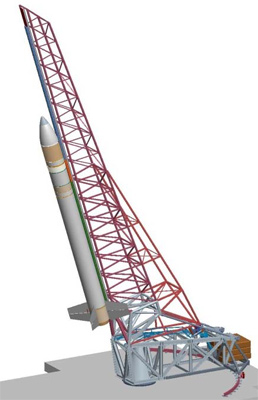
Super Strypi – SPARK
2013 should see the first flight of a new satellite launch vehicle.
Super Strypi, also known as SPARK (Space-borne Payload Assist Rocket – Kauai), has been developed by Sandia National Laboratories, the University of Hawaii and Aerojet. The rocket is based on an enlarged version of Sandia’s Strypi sounding rocket.
The all solid fueled vehicle uses a GEM-46 (LEO-46) motor of Delta-2H heritage as first stage. A Orbus-7S (LEO-7) motor acts as second stage and a Star-30BP (Spark-30) or an Orbus-1 (LEO-1) as third stage. It is spin and fin stabilized during fist stage burn and has attitude control for the two upper stages. The low cost rocket will be launched from a rail launcher and can put a payload of 250 kg into a 400 km sun-synchronous orbit.
The Super Strypi vehicle will be launched from a rail-launcher at Barking Sands, Kauai (Pacific Missile Range Facility) towards the end of 2013.

Conceptual representation of a cluster of EDSN satellites illustrating their ability to communicate and share data as a network. Credit NASA
Super Strypi will be carrying a swarm of CubeSats, the Edison Demonstration of Smallsat Networks (EDSN). The CubeSats are an unusual size of 10 by 10 by 15 cm (1.5U) and weigh 2 kg. The EDSN swarm will demonstrate distributed, multipoint space weather measurement and are expected to operate for at least 60 days and have an orbit life-time of up to 4 years.
ORS Project – Super Strypi http://www.govsupport.us/ORSSSEA/Documents/DEA.pdf
Operationally Responsive Space (ORS) Project – Super Strypi http://www.govsupport.us/orsssea/
NASA – Small Spacecraft Technology Program
http://www.nasa.gov/offices/oct/stp/small_satellite_subsystem_tech/index.html
Gunter’s Space Page 2013 http://space.skyrocket.de/doc_chr/lau2013.htm


You must be logged in to post a comment.