Always keen to promote Amateur Radio in Essex, Pete M0PSX from Essex Ham was given the opportunity to join presenter Scott Ross on Phoenix FM in Brentwood to discuss the hobby. During the interview Pete took the opportunity to briefly plug the amateur radio satellites.
The interview was broadcast from studios based at The Brentwood Centre at 2:30pm on Thursday July 12, 2012, as part of the Drivetime show.
Watch Amateur Radio Interview – Phoenix FM July 2012
The Chelmsford Amateur Radio Society, mentioned in the interview, run training courses for the Amateur Radio exams, to find out more speak to Clive G1EUC on
Tel: 01245-224577
Mob: 07860-418835
E-mail: training2012<at>g0mwt.org.uk
Web: http://www.g0mwt.org.uk/training/
Akihiko Hoshide KE5DNI, Yuri Malenchenko RK3DUP and Sunita Williams KD5PLB
ARRL report that NASA will televise the launch and docking of the next mission to the International Space Station (ISS), scheduled for 8:40 PM (CDT) Saturday, July 14 (0140 UT, Sunday, July 15).
NASA Flight Engineer Sunita Williams, KD5PLB, along with Russian cosmonaut Yuri Malenchenko, RK3DUP, and Japan Aerospace Exploration Agency astronaut Akihiko Hoshide, KE5DNI, are completing preparations as they undergo their final Soyuz spacecraft fit. Live NASA TV coverage of the Soyuz TMA-05M spacecraft launch from the Baikonur Cosmodrome in Kazakhstan begins at 8:30 PM CDT on Saturday, July 14 (0130 UT July 15).
The trio will arrive at the station on July 16, joining NASA Flight Engineer Joe Acaba, KE5DAR, and two Russian cosmonauts: Expedition 32 Commander Gennady Padalka, RN3DT, and Flight Engineer Sergei Revin, RN3BS. Acaba, Padalka and Revin have been aboard the ISS since mid-May. Williams, Malenchenko and Hoshide — who also will be part of the Expedition 33 crew starting in September — will return to Earth in mid-November. Source ARRL
Students from Middlesex University Robotics department obtained their Foundation Licences after a Verulam Amateur Radio Club (VARC) course and went on to win UAVforge.
The amateur radio Foundation training course was part of the preparations by members of the HALO team to take part in the international UAVForge competition in the USA.
This is an international drone competition and involved the team taking on some of the world’s top engineers and universities. They succeeded in becoming the highest scoring team at UAVforge.
The HALO team comprised: Witold Mielniczek M6HUJ Mantas Brazinskas M6LTU Mehmet Ali Erbil M6DUC Dr Stephen Prior M6ESY
Their HALO Unmanned Aerial Vehicle (UAV) used a Frequency Hopping Spread Spectrum (FHSS) system with a 900 MHz data downlink and a 5.8 GHz video downlink along with a 1280 MHz video feed.
Watch DARPA UAVforge Milestone 3 Live Fly Video – Team HALO HD
This video was shot from HALO and relayed over 3.2 km via a 1280 MHz live video feed using a 2.5 W Video TX with a Yagi antenna positioned 30 m up a tree.
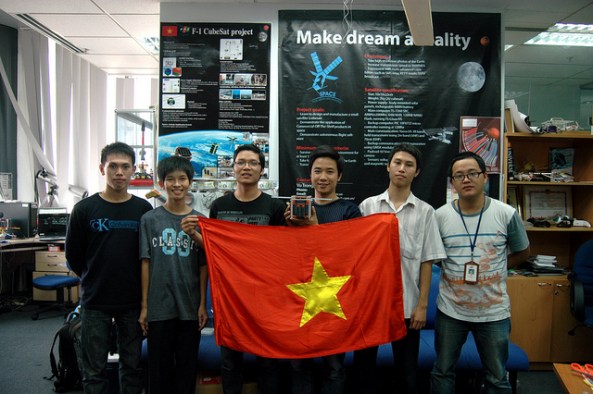
The Vietnamese TV station VTV1 broadcast a news story about the amateur radio CubeSat F-1, callsign XV1VN, due to be launched to the International Space Station (ISS) on July 21.
The broadcast shows students from the FPT University in Hanoi who are involved in the project and has an interview with Thu Trong Vu XV9AA.
F-1 carries a low-resolution camera (640×480), a 3-axis magnetometer and two Yaesu VX-3R transceivers using 145.980 and 437.485 MHz.
It is planned to launch to the ISS on July 21 in the HTV-3 cargo vessel and be deployed in September by Japanese astronaut Akihiko Hoshide KE5DNI using the ISS Kibo robot arm.
Wednesday, July 11, saw the official opening of the RSGB’s National Radio Centre (NRC) at Bletchley Park in Milton Keynes.
Ed Vaizey MP Unveiling the Plaque with RSGB President Dave Wilson M0OBW
The opening and unveiling of the plaque was undertaken by Mr Ed Vaizey MP. Mr Vaizey is the Minister for Culture, Communications and the Creative Industries and, as such, has overall responsibility for OFCOM. He stated that he fully supported the aim of the Centre in being able to enthuse and inspire children to become the engineers of the future.
Attendees included many of the sponsors together with Iain Standen, the Chief Executive of the Bletchley Park Trust plus, from overseas, Dave Sumner K1ZZ, CEO of the ARRL and Ole Garpestad, LA2RR IARU Vice-President.
Ed Vaizey MP and RSGB President Dave Wilson M0OBW
AMSAT-UK have supported the creation of this valuable educational outreach resource at Bletchley Park and have arranged for the provision and installation of a set of fully steerable VHF and UHF satellite antenna arrays. It is hoped that it may be possible to use the NRC as the FUNcube-1 Mission Control Centre during the Launch and Early Operations Phase (LEOP) of the mission later this year.
On July 11, Surrey Satellite Technology US LLC (SST-US) signed a memorandum of understanding (MOU) with Virgin Galactic optimizing Surrey’s innovative satellites for Virgin’s new launch vehicle, radically lowering the cost of building and launching small satellites.
This MOU comes on the heels of Virgin Galactic’s announcement of its new ”LauncherOne” program, an unmanned rocket that will be air-launched by SpaceShipTwo’s carrier aircraft, WhiteKnightTwo, and that will be capable of delivering as much as 225 kg to low Earth Orbit. SST-US and Virgin Galactic have agreed to work together to provide SST-US, the world leader in small satellite manufacturing, the information needed to build the most powerful spacecraft that LauncherOne can support, giving satellite customers a powerful and affordable option to put their payloads into space.
SST-US is the US operation of Surrey Satellite Technology Ltd (SSTL), the pioneer in small and cost effective space missions. The collaboration with Virgin Galactic is expected to involve the development by SST-US of new launcher-optimised satellite platforms, the supply of subsystems to the launch vehicle, and advising on market requirements for launch services.
Dr. John Paffet, CEO of SST-US, commented: “Since we launched our first small satellite in the Eighties, we have been changing the economics of space by leveraging innovation. As our platforms have become an integral part of many space programmes, launching satellites at a cost that is synergistic with the mission programme remains a challenge. We look forward to collaborating with Virgin Galactic on this exciting new venture to develop a solution to this need.”
LauncherOne will be a two stage vehicle capable of carrying up to 500 pounds (225 kilograms) to orbit for prices below $10 million. The rocket will be launched from Virgin Galactic’s WhiteKnightTwo, the uniquely capable aircraft also designed to carry SpaceShipTwo aloft to begin her suborbital missions. With more than 85 flights completed to date, WhiteKnightTwo has substantially completed her test flight program.
“Virgin Galactic’s goal is to revolutionize the way we get to space,” Virgin Galactic’s Founder Sir Richard Branson said. “I’m immensely proud of what we have already achieved as we draw near to regular suborbital flights on SpaceShipTwo. Now, LauncherOne is bringing the price of satellite launch into the realm of affordability for schools, non-profits, and start-ups, in addition to companies and space agencies. This provides a completely new resource to the global research community, letting us learn about our home planet more quickly and more affordably.”
Watch LauncherOne – Furthering the Space Frontier
Watch Virgin Galactic’s WhiteKnightTwo and LauncherOne take flight
You must be logged in to post a comment.