Vintage Videos of STS-9 Columbia Mission and Spacelab

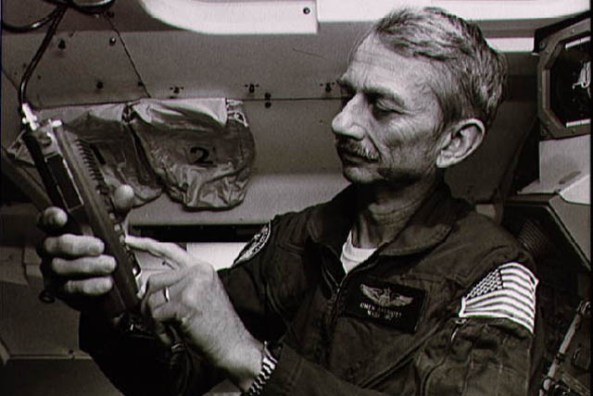
Owen Garriott W5LFL with Motorola two meter FM ham radio on STS-9 Columbia

The first ham radio transmissions by an amateur radio operator in space were made by Owen K. Garriott W5LFL during the STS-9 Columbia mission in 1983. This led to many further space flights incorporating amateur radio as an educational and back-up communications tool.

Watch ARRL – Amateur Radio’s Newest Frontier (STS-9 Columbia) narrated by Roy Neal K6DUE

Narrated by the Commander and crew, the following video contains footage selected by the astronauts, as well as their comments on the mission. Footage includes launch, onboard crew activities, and landing.

Watch Space Shuttle STS-9 Columbia-Spacelab 1 pt1-2 Post Flight Press Conference Film 1983 NASA

Watch Space Shuttle STS-9 Columbia-Spacelab 1 pt2-2 Post Flight Press Conference Film 1983 NASA

STS-9 (also known as STS-41A and Spacelab 1) was a NASA Space Shuttle mission which carried the first Spacelab module into orbit to conduct space-based scientific experiments. It was the sixth mission of the Space Shuttle Columbia, and was Columbia’s last flight until STS-61-C in January 1986. It was also the last time the old STS numbering was used until STS-26 (in the aftermath of the Challenger disaster of STS-51-L). Under the new system, STS-9 would have been designated as STS-41-A.

STS-9 launched successfully from Kennedy Space Center at 11 am EST on 28 November 1983.

The shuttle’s crew was divided into two teams, each working 12-hour shifts for the duration of the mission. Young, Parker and Merbold formed the Red Team, while Shaw, Garriott and Lichtenberg made up the Blue Team. Usually, the commander and the pilot team members were assigned to the flight deck, while the mission and payload specialists worked inside the Spacelab.

Over the course of the mission, seventy-two scientific experiments were carried out, spanning the fields of atmospheric and plasma physics, astronomy, solar physics, material sciences, technology, life sciences and Earth observations. The Spacelab effort went so well that the mission was extended an additional day to 10 days, making it the longest-duration shuttle flight at that time.

The Spacelab 1 mission was highly successful, proving the feasibility of the concept of carrying out complex experiments in space using non-NASA persons trained as payload specialists in collaboration with a POCC. Moreover, the Tracking and Data Relay Satellite, now fully operational, was able to relay vasts amounts of data through its ground terminal to the POCC.

During orbiter orientation, four hours before re-entry, one of the flight control computers crashed when the RCS thrusters were fired. A few minutes later, a second crashed in a similar fashion, but was successfully rebooted. Young delayed the landing, letting the orbiter drift. He later testified: “Had we then activated the Backup Flight Software, loss of vehicle and crew would have resulted.” Post-flight analysis revealed the GPCs failed when the RCS thruster motion knocked a piece of solder loose and shorted out the CPU board.

Columbia landed on Runway 17 at Edwards Air Force Base on 8 December 1983, at 3:47 pm PST, having completed 166 orbits and travelled 4.3 million miles (6.9×10⁶ km) over the course of its mission. Right before landing, two of the orbiter’s three auxiliary power units caught fire due to a hydrazine leak, but the orbiter nonetheless landed successfully. Columbia was ferried back to KSC on 15 December. The leak was later discovered after it had burned itself out and caused major damage to the compartment…

Commander: John W. Young
Pilot: Brewster H. Shaw, Jr.
Mission Specialists: Owen K. Garriott, Robert A. R. Parker
Payload Specialists: Byron K. Lichtenberg (MIT), Ulf Merbold (Germany)
Dates: November 28 to December 8, 1983
Vehicle: Columbia OV-102
Payloads: Spacelab-1
Landing site: Runway 17 dry lakebed at Edwards AFB, CASpace Shuttle

History http://scitech.quickfound.net/astro/space_shuttle_news.html

FM Interference to Linear Transponder Satellites

Alexandru Csete OZ9AEC has previously written about interference from FM stations on the HO-68 linear transponder. He now reports that other satellites with linear transponders (designed for SSB/CW use only) also suffer from local FM traffic by people who haven’t got a clue that they are transmitting in the satellite uplink segment of the 2 meter band (145.8-146.0 MHz).

This recording was made on Saturday, May 5, 2012 using the AMSAT-UK FUNcube Dongle and Gqrx SDR. It shows very strong FM transmissions on the FO-29 linear transponder which could be from Spain or Portugal. The topic appears to be chocolate. Alexandru says – If you know who these people are, be sure to send them a QSL card!

The use of FM on a linear transponder satellite reduces the lifetime of both the batteries and the transponder itself.

Watch FM on FO-29 amateur radio satellite

How to work the SSB amateur radio satellites http://www.uk.amsat.org/2712

AMSAT-UK FUNcube Yahoo Group http://groups.yahoo.com/group/FUNcube

ARTSAT release App for iPhone or iPod Touch

ARTSAT PROJECT-1: INVADER is an amateur radio “Art Satellite” currently being developed as a part of the “ARTSAT: Art and Satellite Project” which aims at a practical use of a satellite for art and design. Invader is a 1U CubeSat being developed by students at Tama Art University.

ARTSAT have just released their App for the iPhone or iPod Touch (iOS 5 or greater).

You can install it by entering your email address or in the USA your phone number at
https://apps.facebook.com/fanpagemobilizer/install?app_id=990569E751E34CCF898C9352FAC2F92F

ARTSAT on Facebook https://www.facebook.com/artsat

Invader CubeSat – A Student Art Satellite http://www.uk.amsat.org/?p=6449

IARU agrees 437.525 MHz for ITF-1

Ayano Okamura ITF-1 Project Manager

The Cubesat “Image The Future” ITF-1 build by students at the University of Tsukuba has had the frequency of 437.525 MHz coordinated by the IARU Amateur Satellite Frequency Cooordination panel.

IFT-1 recently underwent thermal vacuum testing.

It is planned to be launched on a H-IIA rocket in the fiscal year 2013. The orbit will be 400 by 350km with an inclination of 65 degrees.

The formal name ITF-1 comes from the initial letter of the university slogan “Imagine The Future”.  The satellite also has a popular name YUI which means “bond” in Japanese, it came from the project’s concept‚ “Creating the Worldwide Human Community”.

The UTF-1 Project Manager is Ayano Okamura and you can read her blog at http://tinyurl.com/ITF-1-ProjectManagerBlog

The Chief Tech blog by Asai Eisuke is at http://tinyurl.com/ITF-1-TechBlog

ITF-1 (YUI) on the IARU Amateur Satellite Frequency Coordination pages http://www.amsatuk.me.uk/iaru/formal_detail.php?serialnum=226


OSSI CubeSat – Ground Station Video

Hojun Song with Hannes Gassert wearing OSSI GS Backpack

Hojun Song with Hannes Gassert wearing OSSI Ground Station Backpack and holding a Yagi antenna

Korean artist Hojun Song DS1SBO has made available videos showing the construction of his satellite OSSI.

In addition to radio communications (145 MHz uplink, 435 MHz downlink) OSSI is fitted with LED’s that can flash in Morse Code and is also flying Super-Capacitors.

The backpack ground station that he’s developed features a novel fold up antenna.

OSSI will take off on a Soyuz rocket from Baikonour in Kazakhstan this August.

Watch Setting up the OSSI Satellite Ground Station

 The OSSI ground station has been delivered to etoy. etoy is art and invests all resources in the production of more art, see http://www.etoy.com/

OSSI carries LED’s that can signal in Morse Code

Watch Building the Onboard Computer (OBC)

OSSI Art CubeSat to Launch in August http://www.uk.amsat.org/6993

Funds have been raised by selling T-shirts

Glasgow school wins CanSat launch competition

The UK’s Alpha team from Bearsden Academy in Glasgow were awarded first place in the second European CanSat Competition. 14 secondary school teams, from different ESA member states, participated in the finals of the competition at the Andøya Rocket Range in Norway.

The first prize was awarded to team Alpha, from the UK. Credits: ESA / J Makinen. (JPG, 61 Kb) CanSats are miniature simulation satellites the size of a soda can. The students had to build their own space experiments, fitting all the major subsystems including radio communications on 433/434 MHz and power into just 350ml.

The tiny CanSats were designed to separate from their rocket and conduct their missions as they descended on parachutes to the ground for recovery by the teams. They were launched in pairs from seven small Intruder rockets up to an altitude of about 1km.

Setting up an Intruder rocket for launch. Credits: ESA / J Makinen. (JPG, 68 Kb) Despite very strong winds, all of the CanSats were successfully recovered, with the exception of the Spanish one, which failed to communicate with the ground station.

The UK team received good telemetry data on 434.25 MHz, but were a little disappointed that their miniature rover deployed earlier than planned. The other teams, from Denmark, Belgium, the Netherlands, France, Spain, Austria, Czech Republic, Norway, Romania, Italian, Irish, Greek, Portugese had varying degrees of success.

Once they analysed the results of their missions, the teams were judged by a board composed of technical experts from space agencies and industry. Following the UK team in second place was the Icaromenippus 3D team from the 3rd General Lyceum of Mytilini, Strati Myrivili, Greece, with the Portuguese Azorean Shearwater team from EBS Santa Maria, Vila do Porto in the Azores in third place.

“The standard of the projects was really high and the judges were very impressed by the professional attitude of the students,” said Helen Page, the ESA CanSat Project Coordinator. “They learned an enormous amount about space science, engineering and technology, as well as developing practical skills and experiencing the excitement of a launch campaign at a world-class rocket range.”

Students from the Norwegian team Navican testing their CanSat's parachute. Credits: ESA / J Makinen. (JPG, 72 Kb) The 2012 European CanSat competition was organised by ESA’s Education Office in collaboration with the Norwegian Centre for Space-related Education (NAROM). For more details about the teams involved visit the ESA website.

The Scottish CanSat Competition was organised using the STEM Ambassador Network, a list of the Scottish schools involved and 70cm frequencies is at
http://www.fistraltraining.co.uk/index.php?option=com_content&view=article&id=126&Itemid=75

Scottish CanSat Facebook http://www.facebook.com/pages/Scottish-Cansat-Competition/136524309785701

CanSat website http://cansat.eu/