Keychain Satellite

This “Keychain-Satellite”, just 5*5*5 cm, uses tiny Arduino based hardware

Watch FemtoSatellite model(1/2)

Watch FemtoSatellite model(2/2)

More pictures and information at http://tinyurl.com/cepqnrh

Danish Euroluna Project on TV

Tor Foss Mortensen of Google X-Prize team Euroluna (OZ9LUNA) appeared in the Danish TV show Aftenshowet.

Euroluna is developing a 2U CubeSat MiniRomit1 which was shown on TV.  Watch Tor i Aftenshowet

Twitter: http://twitter.com/Euroluna

Facebook: http://www.facebook.com/photo.php?pid=708263#!/pages/Euroluna/337261739568?ref=mf

Euroluna: http://www.euroluna.dk/

Google Lunar X PRIZE: http://www.googlelunarxprize.org/

AMSAT-UK publishes a colour A4 newsletter, OSCAR News, which is full of Amateur Satellite information. Free sample issue at http://www.uk.amsat.org/on_193_final.pdf
Join online at http://tinyurl.com/JoinAMSAT-UK
—-

Vega to Launch Amateur Radio Satellites

Artists impression of Vega launch

Artists impression of Vega launch

The inaugural launch of the ESA Vega rocket will carry the amateur radio microsatellite ALMASat-1 and at least six CubeSats.

The satellites will be launched from the ESA spaceport at Kourou in the Caribbean into an elliptical orbit of 1450 by 354 km at an inclination of 71 degrees. They are expected to have a lifetime before re-entry of 4 years.

ESA say the six CubeSats to be launched on Vega in late January 2012 comprise:

Xatcobeo (a collaboration of the University of Vigo and INTA, Spain): a mission to demonstrate software-defined radio and solar panel deployment;
Robusta (University of Montpellier 2, France): a mission to test and evaluate radiation effects (low dose rate) on bipolar transistor electronic components;
e-st@r (Politecnico di Torino, Italy): demonstration of an active 3-axis Attitude Determination and Control system including an inertial measurement unit;
Goliat (University of Bucharest, Romania): imaging of the Earth surface using a digital camera and in-situ measurement of radiation dose and micrometeoroid flux;
PW-Sat (Warsaw University of Technology, Poland): a mission to test a deployable atmospheric drag augmentation device for de-orbiting CubeSats;
MaSat-1 (Budapest University of Technology and Economics): a mission to demonstrate various spacecraft avionics, including a power conditioning system, transceiver and on-board data handling.

ESA indicate that a 7th CubeSat may be delivered in time to be flown.

PW-Sat carries an FM to DSB amateur radio transponder with an FM input on 435.020 MHz and DSB output on 145.900 MHz.

The primary payload on the launch, LARES, will be deployed into an orbit of 1200 km × 1200 km with an inclination of 71 degrees.

Frequencies and links for the CubeSats can be found at http://www.ne.jp/asahi/hamradio/je9pel/esa9cubf.htm

ESA CubeSats delivered for first Vega flight http://www.esa.int/esaMI/Education/SEM3L0WWVUG_0.html

ESA Education – CubeSats http://www.esa.int/esaMI/Education/SEM3N03MDAF_0.html

The IARU amateur satellite frequency coordination pages hosted by AMAT-UK list the frequencies of the amateur radio satellites http://www.amsat.org.uk/iaru/

ALMASat-1 http://www.almasat.org/

STARS-II Amateur Radio Satellite

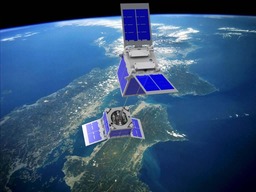
Impression of STARS-II in Orbit

Impression of STARS-II in Orbit

The amateur radio satellite STARS-II has been developed by students at Kagawa University and consists of a Mother satellite and Daughter satellite connected by tether.

STARS stands for Space Tethered Autonomous Robotic Satellite. The mission will include formation flight, tether deployment, attitude control and the mother and daughter satellites will take pictures of each other.

It is proposed to fly a 80mW CW beacon and a 800mW AX25 1200bps telemetry downlink. Total mass is 8 kg.

Coordinated frequencies for CW 437.245 MHz (mother) and 437.255 MHz (daughter). FM downlinks 437.405 MHz (mother) and 437.425 MHz (daughter).

Kagawa satellite development project STARS-II http://stars1.eng.kagawa-u.ac.jp/english/index.html

The Google English translation of the Japanese language STARS-II page has additional information http://tinyurl.com/JapanSTARS-II

STARS-II on the IARU Satellite Frequency Coordination pages hosted by AMSAT-UK
http://www.amsatuk.me.uk/iaru/formal_detail.php?serialnum=170

AMSAT-UK publishes a colour A4 newsletter, OSCAR News, which is full of Amateur Satellite information. Free sample issue at http://www.uk.amsat.org/on_193_final.pdf Join online here

Amateur radio satellite AO-51 remembered

Dozens of messages were posted to the Amsat-bb after the news of the amateur radio satellite AO-51‘s end of mission was received. Many remembered their contacts, several thanked the Operating Team. Many noted that AO-51 was the satellite that brought them into this part of our hobby. Continue reading

Radio Amateurs Receive Mars Science Laboratory

Mars Science Laboratory

Mars Science Laboratory

Radio Amateurs have received signals from the NASA Mars Science Laboratory using the AMSAT-DL amateur radio facility at Bochum in Germany.

On November 26, 2011 at 15:02 UTC the Mars Science Laboratory (MSL) successfully launched on an Atlas V 541 from the Cape Canaveral Air Force Station Space Launch Complex 41. It is carrying Curiosity, a 900 kg rover about the size of a small car.

It is expected to arrive at the “Red Planet” in August 2012 after a nine month flight.

Just over 7 hours after launch at 21:45 UTC the X-band telemetry signal from the MSL was received using the Bochum amateur radio facility. The signal, received at a distance of 112,000 km, had a spin-modulation of +/- 3.5 Hz with 2 revolutions / minute.

This is believed to be the first reception of the MSL outside the official NASA Deep Space Network (DSN) and the USN tracking station at Dongara, Australia (under contract to JPL for the MSL launch).

Bochum Amateur Radio Facility

Amateur Radio Facility at Bochum

For reception of MSL James Miller G3RUH remotely reconfigured the Bochum tracking and receiving system. The MSL X-Band telemetry signal was received automatically in Bochum, no-one had to be physically on-site. This shows how flexible and reliable the system at Bochum is, ready for the planned AMSAT-DL P5-A mission to Mars.

The 20m dish at Bochum is also used by AMSAT-DL to automatically receive real-time solar data from the NASA STEREO A / B satellites. The data is transmitted to a NOAA server in the USA via the Internet.

Congratulations to the AMSAT-DL team on a remarkable acheivement.

Control Software for the Bochum Radio Telescope by James Miller G3RUH
http://www.amsat.org/amsat/articles/g3ruh/126.html

Stereo A/B Spacecraft Telemetry Reception at Bochum by James Miller G3RUH
http://www.amsat.org/amsat/articles/g3ruh/127.html

AMSAT-DL in Google English http://tinyurl.com/AMSAT-DL

AMSAT-UK publishes a newsletter, OSCAR News, full of Amateur Satellite information. Sample issue at http://www.uk.amsat.org/on_193_final.pdf  Join online at http://alturl.com/avuca