Radio ham awarded space achievement honour

Astro Pi Logo

Astro Pi Logo

Cornwall Live reports that radio amateur David Honess M6DNT has been awarded a prestigious space achievement honour for his Astro Pi work with the Tim Peake GB1SS Principia mission.

David Honess M6DNT was presented with a Sir Arthur Clarke Award, on behalf of the Arthur C. Clarke Foundation and the British Interplanetary Society, for Space Achievement – Industry/Project Individual.

This came after Mr Honess and his Astro Pi project which installed two Raspberry Pi’s (Izzy and Ed) on to the International Space Station as the platform for students to run their own code in space and speak with Major Tim Peake GB1SS.

Mr Honess has been “the driving force” behind getting two UK designed and manufactured Astro Pi computers onto the International Space Station to provide a unique facility to inspire children and adults to learn to code.

Read the full story at
http://www.cornwalllive.com/west-cornwall-man-wins-award-for-space-achievement-after-project-with-tim-peake/story-29893608-detail/story.html

Sir Arthur Clarke Awards Winners
http://www.bis-space.com/2013/04/05/9719/sir-arthur-clarke-awards-winners

You can follow the two ISS Astro Pi’s Izzy and Ed at
https://twitter.com/astro_pi_ir
https://twitter.com/astro_pi_vis

AMSAT-UK https://amsat-uk.org/
Twitter https://twitter.com/AmsatUK
Facebook https://facebook.com/AmsatUK
YouTube https://youtube.com/AmsatUK

FUNcube-1 / AO73 celebrates 3 years in space

FUNcube Team Monitor Launch

FUNcube Team Monitor Launch

Monday, November 21, 2016, marked the third birthday in space for the 985 gram spacecraft FUNcube-1 / AO73.

AO-73 (FUNcube-1) - Image credit Wouter Weggelaar PA3WEG

AO-73 (FUNcube-1) – Image credit Wouter Weggelaar PA3WEG

FUNcube-1 was launched at 07:10 UT on November 21, 2013 and its first signals were received immediately after deployment over the Indian Ocean by amateurs in South Africa. Since then it has been operating continuously in either its education mode or, with the transponder active, in amateur mode when in eclipse and at weekends.

The FUNcube team are very grateful to everyone who has been contributing their telemetry records to the Data Warehouse and also to those who are using FUNcube-1 for educational outreach to schools and colleges around the world. This important part of our mission is intended to encourage young people to develop an interest and passion in all STEM subjects for their future.

FUNcube-1 Launch Day Mug

FUNcube-1 Launch Day Mug

The spacecraft is operating nominally – the telemetry indicates that all the sub-systems are fine. The battery voltages, solar panel charge currents and on board temperatures are virtually unchanged since launch.

In addition to FUNcube-1, there are now similar FUNcube transponders operating in low earth orbit on the UKube-1 and EO79/QB50p1 CubeSats.

The team has recently contributed to the development of Nayif-1, which is presently awaiting launch, and is currently working on a number of further CubeSat and microsat projects.

Happy Birthday AO73!

Get your 73 on 73 Award, details at https://amsat-uk.org/funcube/73-on-73-award/

AO-73 (FUNcube-1) website https://amsat-uk.org/funcube/funcube-website/

FUNcube Yahoo Group https://amsat-uk.org/funcube/yahoo-group/

Howard Long G6LVB working AO-73 while Ciaran Morgan M0XTD captures the downlink passband data using a FUNcube Dongle Pro+ and Microsoft Surface Tablet

Howard Long G6LVB working AO-73 while Ciaran Morgan M0XTD captures the downlink passband data using a FUNcube Dongle Pro+ and Microsoft Surface Tablet

Lunar Amateur Radio Satellites DSLWP-A1/A2

Full Moon 2010 - Credit Gregory H Revera

Full Moon 2010 – Credit Gregory H Revera

Mingchuan Wei BG2BHC reports DSLWP is a lunar formation flying mission for low frequency radio astronomy, amateur radio and education, consists of 2 microsatellites.

Developed by students at the Harbin Institute of Technology the amateur radio payload onboard DSLWP-A1 will provide telecommand uplink and telemetry / digital image downlink. An open telecommand is also designed to allow amateurs to send commands to take and download an image.

The satellites are 50x50x40 cm with a mass of about 45 kg and are 3-axis stabilized. Two linear polarization antennas are mounted along and normal to the flight direction.

The team proposes downlinks for A1 on 435.425 MHz and 436.425 MHz while downlinks for A2 would be 435.400 MHz and 436.400 MHz using 10K0F1DCN or 10K0F1DEN 250 bps GMSK with concatenated codes or JT65B.

Planning a launch into a 200 x 9000 km lunar orbit in June 2018. Further info at http://lilacsat.hit.edu.cn/

IARU Amateur Satellite Frequency Coordination pages http://www.amsat.org.uk/iaru/

EO79 FUNcube-3 transponder commences regular operation

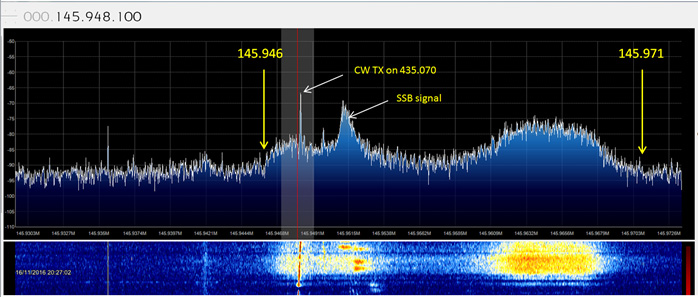
EO79 (QB50p1) FUNcube-3 Transponder Passband - Credit David Bowman G0MRF

EO79 (QB50p1) FUNcube-3 Transponder Passband – Credit David Bowman G0MRF

AMSAT-UK and AMSAT-NL working with ISIS BV are delighted to announce that the FUNcube 435/145 MHz SSB/CW transponder, on the 2U CubeSat QB50p1 (EO79), has now been activated with a regular schedule.

EO79 (QB50p1) CubeSat - Credit ISIS

EO79 (QB50p1) CubeSat – Credit ISIS

Due to power budget constraints the transponder cannot be operational 24/7 and an orbit specific schedule has been developed. The transponder will commence operation 27 minutes after the spacecraft enters sunlight and will stay on for a period of 25 minutes. This schedule may be modified over the forthcoming weeks as a result of experience.

The transponder nominal frequencies are:
Uplink: 435.047-435.077 MHz LSB
Downlink: 145.935-145.965 MHz USB
The output power is approximately 400mW.

David Bowman G0MRF has been attempting to characterize the actual operating frequencies of the EO79 Transponder and suggests that the operational bandwidth of the transponder might be considered to be 25 kHz rather than 30 kHz. His report is available here. On the AMSAT Bulletin Board he writes:

From observations, there seems to be no downlink below 145.946 MHz. By taking readings at Time of Closest Approach (TCA) on low elevation passes, which for me is about 20 minutes into the 25 minute schedule. The transponder appears as follows:

Downlink.
Lower limit is quite well defined at 145.946.
Upper limit roles off slowly above 970. But 145.971 seems a reasonable limit. Very strong signals are visible to 973 but are heavily attenuated.

Uplink
Upper limit (for 145.946) = 435.0723
Lower limit (for 145.971) = 435.0473

This suggests the transponder has a nominal bandwidth of 25 kHz. My best guess at a translation frequency is 581.0183MHz

Qb50p1 (EO79) was launched in June 2014, as a collaborative effort led by the von Karman Institute and ISIS-BV, into a sun synchronous 620×600 km polar orbit as a precursor spacecraft for the QB50 mission. The primary function of the satellite was to test a number of the systems and science payloads. This phase has now been completed and we are grateful to VKI and ISIS BV for carrying this transponder into space and, again, to ISIS, for developing and uploading the new, required, flight code.

We hope you have lots of fun using EO79!

Middle School Students’ FM Transponder Satellite Launched

Middle School Students

Middle School Students

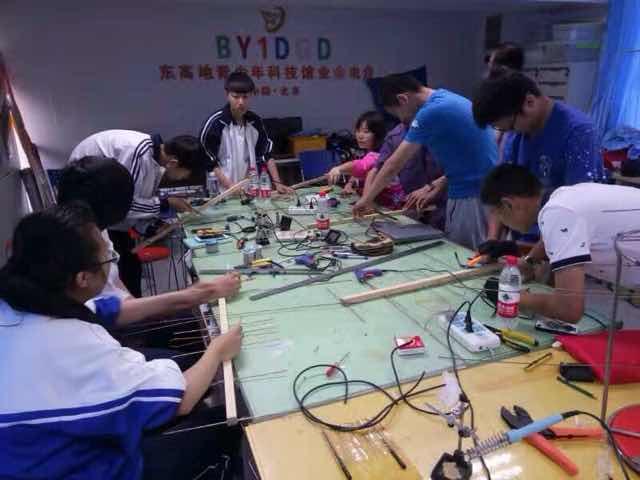
CAS-2T a technical verification satellite for CAMSAT CAS-2 series amateur radio satellite launched at 23:42 UT November 9, 2016 on a CZ-11 rocket. The 2U CubeSat, developed by students from Fengtai District, Xicheng and Haidian District secondary schools, carries a ham radio 145/435 MHz FM transponder.

CAS-2T 145/435 MHz FM Transponder CubeSat

CAS-2T 145/435 MHz FM Transponder CubeSat

CAS-2T and another satellite with an amateur radio payload, KS-1Q (436.500 MHz), are attached to the final stage of the CZ-11 rocket. The final stage was originally expected to be in orbit for up to 30 days before re-entering the Earth’s atmosphere but reports indicate the orbit is 504 x 1030 km which could give an orbital lifetime of years.

On the AMSAT Bulletin Board Alan Kung BA1DU writes:

CAS-2T Amateur radio payloads:
CW Telemetry Beacon: 435.710 MHz
FM Transponder Uplink: 145.925 MHz
FM Transponder Downlink: 435.615 MHz

73!
Alan Kung, BA1DU
CAMSAT

Associated links:
Online real time tracking of CAS-2T and KS-1Q http://www.n2yo.com/?s=41845&df=1
News report https://www.chinaspaceflight.com/satellite/fengtai-shaonian-01.html
Mike Rupprecht DK3WN – CAS-2T seems to be Object 2016-66E http://www.dk3wn.info/p/?p=75971
‘Keps’ for new satellites launched in past 30 days http://celestrak.com/NORAD/elements/tle-new.txt

The CAS-2T FM transponder does not appear to be fully functioning, see the report of Daniel Estévez EA4GPZ / M0HXM at http://destevez.net/2016/11/some-measurements-of-cas-2t-on-orbit-25/

KS-1Q like CAS-2T is also attached to the final stage of the CZ-11. It is reported to be a 1U CubeSat with a technology and launch vehicle monitoring payload. Downlink frequency 436.500 MHz ±Doppler with 20 kbps GMSK, CC712 with RS(255,223) every 8-10 seconds https://www.chinaspaceflight.com/satellite/KS-1Q.html

JAXA to launch satellites with ham radio payloads to ISS

H-II Transfer Vehicle KOUNOTORI

H-II Transfer Vehicle KOUNOTORI

Mineo Wakita JE9PEL reports on the AMSAT Bulletin Board that six satellites with amateur radio payloads are to be launched to the International Space Station in December.

JAXA announced to the public November 7 that seven nano satellites are to be installed in H-IIB Transfer Vehicle “KOUNOTORI” (HTV) to be launched in December. Satellites are only about 1U~3U in size and will conduct experiments aimed at realizing the space elevator which is expected to facilitate the movement of Earth and Universe in the future. It’s the first time to launch in JAXA with seven satellites at a time.

HTV6 Launch: 1326 UT, Dec. 9, 2016 at the Tanegashima Space Center, Japan.

                   Downlink   Beacon     Mode
AOBA-VeloxIII       437.375  437.375  1k2 AFSK,CW
ITF-2               437.525  437.525  1k2 FM,CW
STARS-C (Mother)    437.405  437.245  1k2 FM,CW
STARS-C (Daughter)  437.425  437.255  1k2 FM,CW
WASEDA-Sat3         437.290  437.290  1k2 PCM-FSK,CW
TuPod               437.425  437.425  1k2 GMSK,CW

H-II Transfer Vehicle “KOUNOTORI” (HTV), JAXA
http://global.jaxa.jp/projects/rockets/htv/index.html

AOBA-VeloxIII Kyusyu Institute of Technology
http://aoba2016.blog.fc2.com/

EGG University of Tokyo / Nihon University
http://repository.exst.jaxa.jp/dspace/bitstream/a-is/2961/1/SA6000021010.pdf

FREEDOM Tohoku University / Nakashimada Engineering Works, Ltd
http://www.tohoku.ac.jp/japanese/newimg/pressimg/tohokuuniv-press_20140926_01web.pdf

ITF-2 University of Tsukuba
http://yui.kz.tsukuba.ac.jp/en/

TuPOD Gauss Srl
http://www.gaussteam.com/tupod-almost-ready-for-launch/

STARS-C Shizuoka University
http://stars.eng.shizuoka.ac.jp/english.html

WASEDA-SAT3 Waseda University
http://www.miyashita.mmech.waseda.ac.jp/Waseda-Sat3/