Balloon FM Transponder Launch

a-dutch-balloon-launchAt around 1100 GMT on Sunday, Sept 11, a Dutch High Altitude Balloon will launch with a UHF/VHF FM transponder, 23cm ATV transmitter and beacon, the range should be over 500 km.

The weather balloon will be launched from the Netherlands, amateur radio stations in nearby countries have to wait a while to hear the signals until the balloon reach a higher altitude! (the maximal altitude might reach 30km it also did in the past!).

Balloon transmitters frequency information:
Beacon:  145.450 MHz (100 mW FM/N).
FM crossband voice transponder uplink: 432.550 MHz downlink: 145.475 MHz (1 Watt FM/N).
ATV video transmitter 1252 MHz (1 Watt FM, camera looking down to earth).
The balloon camera video stream can be world wide seen on the website (see the urls below).

Ground control stations:
PI4RCG      7.080 kHz, 3.650 kHz (+/- 10kHz QRM).
PI2NOS    430.125 MHz (+1.6 Shift) ground repeater in the Netherlands (also audible via echolink).
PI3UTR    145.575 MHz (-0.6 Shift / 77Hz) ground repeater in the Netherlands (also audible via echolink).

The official balloon fox hunt website and social media websites:
http://www.pi6atv.com/ live video from the balloon camera
https://www.ballonvossenjacht.nl (you can choose the English language from the menu).
http://www.facebook.com/ballonvossenjacht
https://twitter.com/ballonvosjacht (often with quick update news messages!).

73’s Cor PD0RKC

Pratham student satellite

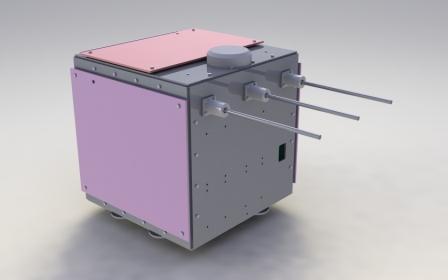
SolidWorks rendering of the Pratham satellite - Credit IIT Bombay

SolidWorks rendering of the Pratham satellite – Credit IIT Bombay

The satellite Pratham built by students at the Indian Institute of Technology Bombay is expected to launch on the Indian PSLV-C35 mission planned for 0342 UT on Monday, September 26, 2016.

AMSAT-BB indicate the Pratham CW beacon on 145.980 MHz is active

Pratham, a 300x300x300mm satellite with a mass of 10 kg, aims to measure total electron count in a 800 km altitude Sun Synchronous Orbit (SSO).

Aayush Yadav of the Pratham team writes:

We, students of IIT Bombay, are glad to inform you that our project, Pratham, is ready and expected to launch with PSLV-C35. We would be really happy if  you all joined us in receiving our satellite’s beacon, details given below:

The beacon is estimated to switch on in the window of 25-30 degrees North and 4-8 degrees East as per the current TLE’s. Once switched on, it will remain so through out it’s orbit. The telemetry data will be switched on only over Europe (France) and India because of our power constraints. If you could, please receive the beacon and/or telemetry of the satellite and report back to the mail id’s as given below. The information for the satellite transmissions is given below,

Beacon:
Frequency: 145.980 MHz
Modulation: CW
Words per minute: 30
Power Emitted: 0.2 W (23 dBm)

Telemetry: To be switched on only over India and Europe (France)
Frequency: 437.455 MHz
Modulation: FSK
Rate: 1200 bps
Power Emitted: 0.06 W (18 dBm)

Kind Regards.
Team Pratham

Further information at http://www.aero.iitb.ac.in/pratham/

Facebook https://www.facebook.com/iitb.student.satellite/

Twitter https://twitter.com/SatlabIITB

5 GHz to 10 GHz Lunar Transponder Mission

View of Earth from the Moon AdobeStock_77398324AMSAT-NA plans 5 GHz to 10 GHz transponders on a spacecraft expected to launch in September 2018 into a Lunar orbit.

Heimdallr is a 3 axis stabilized 6U CubeSat with a mass of approximately 8 kg. It will have a Cold Gas Thruster for inertia dump and a star tracker for navigation. Deployable, gimbled solar panels will produce up to 100 watts of DC power, electric propulsion will be used to achieve lunar orbit.

There will be a combination of omni and directional patch antennas on one side of spacecraft.

The first part of mission is to provide Telemetry, Tracking, and Command (TT&C) to obtain lunar orbit. The second part is to perform the data downlink experiment while the final part is to provide a two way regenerative repeater and analog repeater in lunar orbit for lifetime of satellite.

Proposing these downlinks:
• Omni transponder: 10.451 GHz +/- 0.5 MHz
• Directional transponder: 10.4575 GHz. +/- 3.5 MHz
• Analog transponder: 10.4665 GHz. +/- 2.0 MHz

For the first part of the mission (TT&C) using 300 bps BPSK 1/2 rate viterbi Ranging 1.5 Mbps BPSK DSSS. For the  second part of mission 4.5 Mbps QPSK ½ rate DVB-S2. For the final part of mission 25 kbps BPSK 1/5 rate DVB-S2.

Proposing these Uplinks
• Omni transponder: 5.651 GHz +/- 0.5 MHz
• Directional transponder: 5.6575 GHz. +/- 3.5 MHz
• Analog transponder: 5.665 GHz. +/- 2.0 MHz

A link budget is available at
https://drive.google.com/folderview?id=0B3u-mSOWBMISYnZyZGJpeThKeU0&usp=sharing

It is anticipated that a 1 or 2 metre dish will be required using the AMSAT designed ground station equipment.

Source IARU Satellite Frequency Coordination Status pages http://www.amsat.org.uk/iaru/

Heimdallr satellite – 5 Teams Share First Round of NASA CubeSat Prizes
http://spacenews.com/5-teams-share-first-round-of-nasa-cubesat-prizes/


UK CubeSat Forum – Lunar opportunity

View of Earth from the Moon AdobeStock_77398324Surrey Satellite Technology Ltd (SSTL) and Goonhilly Earth Station (GES) are looking for CubeSat passenger payloads on a Lunar mission.

SSTL and GES are teaming up with ESA to create the world’s first commercial deep space mission. They plan to carry customer payload in the form of CubeSats into lunar orbit and provide the relay link back to Earth via Goonhilly. The launch is planned for 2019.

Orbital passengers e.g. nanosatellites and CubeSats will be deployed from the Mothership and will operate in lunar orbit.

The UK CubeSat Forum can help in creating new contacts for joint proposals, so do post on their site should you want to be involved!
http://www.cubesatforum.org.uk/wordpress/2016/08/30/call-for-lunar-missions-payloads/

Twitter: https://twitter.com/UKCubeSatForum

Download the related documents from http://www.goonhilly.org/lunar

UK student balloon crosses Pacific

UBSEDS18 Solar Powered Balloon

UBSEDS18 Solar Powered Balloon

The UK balloon UBSEDS18 carrying payloads for APRS and 434 MHz has successfully crossed the Pacific, on the same day a USA amateur radio APRS balloon crossed the Atlantic.

The solar powered UBSEDS18 was developed by students from Bristol University and launched on Wednesday, August 17. Since then it has traveled in an easterly direction for 20,252 km completing the Pacific crossing on Thursday, September 1, 2016.

UBSEDS18
https://twitter.com/bristolseds
http://www.bristol-seds.co.uk/hab/flight/2016/08/17/ubseds18.html
https://tracker.habhub.org/#!mt=roadmap&mz=2&qm=All&f=UBSEDS18&q=UBSEDS18

The amateur radio APRS balloon CNSP30 was launched from California on August 25 and on September 1 crossed the coast of northern France. Its APRS signal was receivable across central and southern England.

CNSP30
https://twitter.com/K6RPT
http://www.cnsp-inc.com/cnsp-30/
http://aprs.fi/#!call=a%2FK6RPT-11&timerange=604800&tail=604800

Richard Meadows M0SBU, who worked on the development of UBSEDS18, took the amateur radio training courses run by the Chelmsford Amateur Radio Society (CARS) at Danbury in Essex. Further information on the courses is available from the CARS Training Coordinator, Christopher G0IPU
Tel: 07908-107951
Email: training2016 at g0mwt.org.uk
Web: http://g0mwt.org.uk/training

Amateur Satellites at BATC Convention Sept 24-25

BATC Logo SmallCAT 16, the British Amateur Television Club (BATC) Convention at Cosford in Shropshire Sat/Sun Sept 24/25 will be streamed live.

The talks program and agenda for the weekend has now been published and amateur space communications feature in the schedule, highlights include:

• Es’hailSat-2: Geostationary transponder for DATV – Graham G3VZV
• Receiving and Presenting HamTV from the ISS – Noel G8GTZ
• New BATC Streamer and Internet Presence – Phil M0DNY
• DATV Express and Future Developments – Charles G4GUO
• 146 MHz Reduced Bandwidth TV: A Practical Operators Guide – Shaun G8VPG
• MinitiounePro and Developments – Jean-Pierre F6DZP

The full program is at http://www.batc.org.uk/forum/viewtopic.php?f=99&t=4569

BATC CAT16 live streaming starts 1300 BST Saturday https://beta.batc.tv/live/cat16

Please also remember that the BATC Biennial General Meeting is at 1:30 pm on the Sunday.  The Agenda is at http://www.batc.org.uk/GM2016agenda.pdf

All this in a venue with many other interesting exhibits.
See more at http://www.rafmuseum.org.uk/cosford/
A guided tour will be available for those who have pre-booked.

Please register your intention to attend (and request a guided tour) using the BATC Shop (no charge at this stage, but £10/day on arrival).  Click here https://batc.org.uk/shop/cat16 and select cash payment of £0.00.

Lastly, we are  pleased to announce that Graham Shirville, G3VZV, has been chosen as the next President of the British Amateur Television Club (BATC).  He succeeds Peter Blakeborough, G3PYB, who died last December.  The appointment is for two years.

Looking forward to seeing you all at CAT16.

73 The BATC Team http://www.batc.tv/

The book – Getting Started with Amateur Satellites – is now available from the AMSAT-UK shop at http://shop.amsat-uk.org/