IARU R1 VHF/UHF/uW C5 meeting has started work

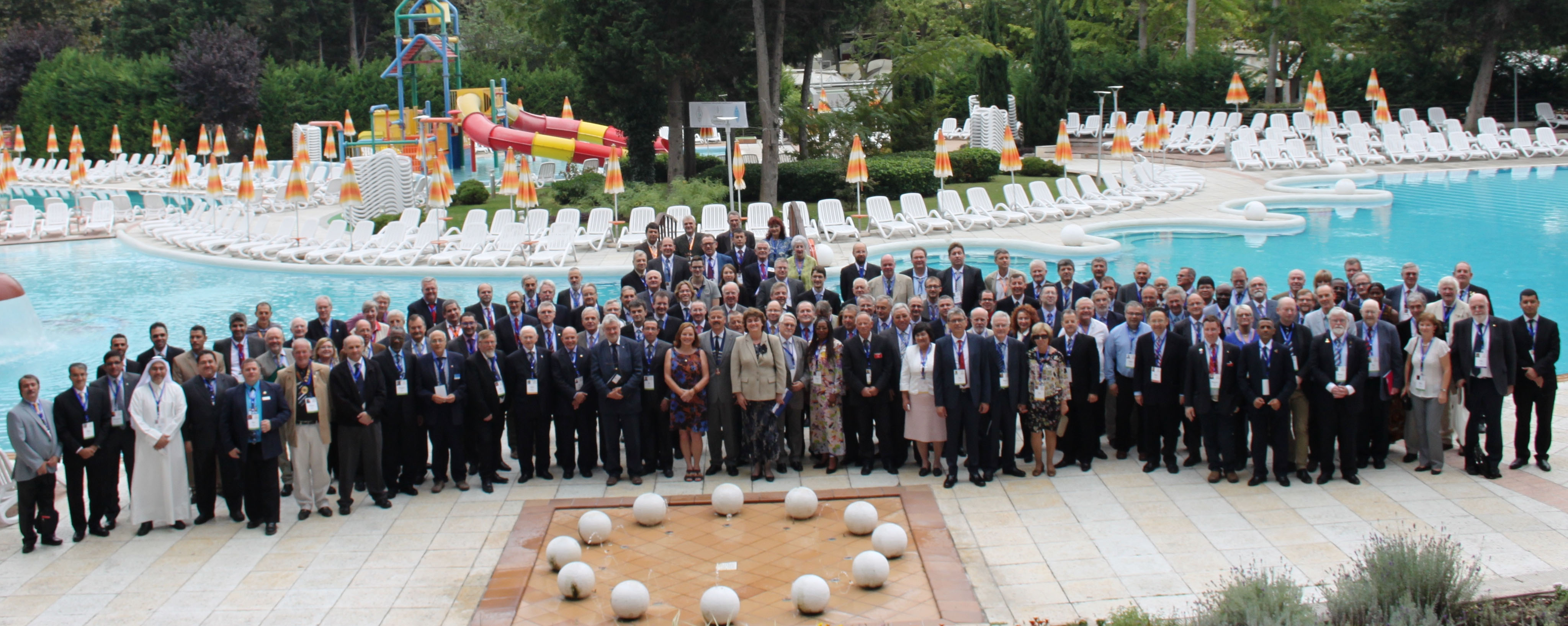
Delegates of the key IARU Region 1 C5 VHF, UHF and Microwaves C5 Committee

The key IARU Region 1 VHF, UHF and Microwave C5 Committee

The VHF, UHF and Microwave C5 Committee meeting has started work at the IARU Region 1 General Conference in Varna-Albena, Bulgaria.

The meeting discussed the 70 MHz IARU Region 1 initiative to obtain regulatory recognition in Europe for a secondary frequency allocation to the amateur service at 70 MHz. Also covered were the challenges to Amateur and Amateur-Satellite allocations in the UHF and Microwave bands.

24th IARU Region 1 General Conference opens
https://amsat-uk.org/2014/09/22/24th-iaru-region-1-general-conference-opens/

IARU Region 1 Conference documents and pictures http://iarur1con2014.bfra.bg/

23 cm band and WRC-2018 https://amsat-uk.org/2014/08/13/23-cm-band-and-wrc-2018/

24th IARU Region 1 General Conference opens

Delegates at IARU Region 1 Conference 2014

Delegates at IARU Region 1 Conference 2014

The First Plenary of the 24th IARU Region 1 General Conference was opened at 10:30 on Sunday, September 21, 2014 in the Grand Hall of the Flamingo Grand Hotel, Albena, Bulgaria.

The message of Dr Kristalina Georgieva, European Union Commissioner for International Cooperation, Humanitarian Aid and Crisis Response was read by Mr Encho Gospodinov.

Dr Kristalina Georgieva

Dr Kristalina Georgieva

“Dear IARU Conference participants,

Dear radio messengers in times of trouble and hope

Friends, ladies and gentlemen,

It is my pleasure and privilege to address your General Conference. The timing for your gathering could not be more indicative for the world we live in and the challenges we all face today.

The lives of millions of people is impacted by troubling events: conflicts in Africa and the Middle East (and sadly, in Europe); natural disasters all over the world with all the un-predictabilities of the mother Nature and the responsibilities of the human beings for the Climate Change; human waves of migrants and refugees moving from one place to another, and assorted diseases often trailing the disasters and conflicts. In short, this is a world, which does not stop to surprise us every morning when we open the TV screen or a newspaper.

At the same time, the world has never been better connected and wired. Today\’s communications are a real miracle once considered a fantasy coming from the novels of Arthur Clarke or Rey Bradbury. Never before, we had this privilege to transmit or exchange information with such accuracy, speed and scope of distribution. And never before so many people from all corners of the world and all layers of the society had access to this information. The arrival of internet really made our planet a Global village and ever since our live changed forever in the way we deal with information. Politics, diplomacy, journalism, technology, science, research, banking, literally all changed overnight with this powerful instrument.

However, there are moments in life when a good, stable, reliable and independent information tool is the only one we can use to save lives. And this is the one we call simply the RADIO.
IARU_Region_1_logoImagine a major natural disaster, which knocks down all modern information tools in the affected area: with no electricity, no internet, no telephone and fax connections, not even the old telex machines. No trains and ships moving, no roads to use or airports functioning. Nothing. We know a tragedy has happened, we know many are dead, and even more still alive, but trapped and helpless. And no one can help them as nobody knows what has happened. Because there is no information.

Luckily, there is a last resort: the radio amateurs; the people who are the eyes and the ears of the world in time when all other information channels are silent. “Amateurs” is actually not the right word in this case: these are professional communicators who are listening to the heartbeat of the planet and registering the emotional vibrations of people who may be in danger. In short, you are the last technical miracle, which is independent, reliable information channel, which can transmit an important piece of news from any place in the world, any time, by anyone who knows how to operate this wonderful creature, called radio.

Your advantage is that you are independent. A well-trained radioman with good equipment and ever-charged batteries can be a fantastic link between two villages, two countries or two continents. When organized in a Union, you are a communication superpower in time of total electronic darkness. But the most important part of your equipment is the people you have; the Bravehearts of men and women listening to people who may be in danger and may need help; the professional live-savers called strangely amateurs, who nevertheless act as volunteers when and where they are needed.

IARU Region 1 VHF, UHF and Microwaves C5 Committee

IARU Region 1 VHF, UHF and Microwaves C5 Committee

In your history, you have many examples of lives being saved because some of your members caught a signal from a village, a region or un-accessible place that someone needs help. We need your skills and services because we will have more and more disasters in the future. The dry statistics reveal troubling trends: during the last 20 – 30 years, the number and the intensity of the natural disasters have increased dramatically. So did the number of people killed or affected. The earthquake in Haiti in 2010 killed 230 000 people alone ….  Between 2003 and 2012, some 6 700 disasters hit the planet with 2005 being the darkest one – 810 disasters in one year. Typhoons in the Philippines, floods in Pakistan, China or Europe, droughts and famine in Africa, garnished with conflicts, are now almost daily events. The economic losses from these disasters went up from $ 50 billion to $ 200 billion a year since the 80s.

Every Red Cross volunteer will tell you that during a disaster the most needed and precious live saving element is not food, water or medicines. It is the timely, accurate information that is the most needed. As timely and accurate information saves lives, prevents major tragedies, stops rumours, which create panic and leads to even more casualties. This is how solid information flow becomes the backbone of a successful communication strategy. In short, everything, which you do and helps your societies to organise themselves better, is vital. Local and national authorities count on you as the last bastion of reliable information channel. Your professional skills and your humanitarian duties make you more than radio amateurs; you are truly needed guardians in time of troubles and I hope you will always stay as a pillar of hope and courage for all who are in danger.

Thank you for your noble work. I wish you every success in this Conference.”

Kristalina Georgieva

Source IARU Region 1 http://iaru-r1.org/

IARU Region 1 Conference documents and pictures http://iarur1con2014.bfra.bg/

23 cm band and WRC-2018 https://amsat-uk.org/2014/08/13/23-cm-band-and-wrc-2018/

IARU R1 Release VHF/UHF/Microwave Handbook

IARU_Region_1_logoIARU Region 1 have released edition 6.14 of the free VHF Managers Handbook covering the VHF, UHF and Microwave amateur radio bands.

The handbook has chapters on Band Planning, Contests, Propagation Research, Operating Procedures and Satellites. On page 122 it even specifies a standard for the use of circular polarization defining which way helical beam antennas should be threaded.

Download the handbook – http://tinyurl.com/IARU-VHF-Handbook-6-14

23 cm band and WRC-2018

IARU_Region_1_logopaper to be discussed at the IARU Region 1 Conference in Varna-Albena, Bulgaria, September 21-27, 2014 highlights the threat to continued amateur radio usage of our 23 cm allocation which is now being used by the Galileo GPS system. The amateur 23 cm allocation includes a key Amateur Satellite Service uplink band at 1260-1270 MHz.

Michael Kastelic OE1MCU, Chair of the IARU R1 VHF/UHF/Microwave Committee has written the paper VA14_C5_36 which says:

After the last reports and slides received by the author, it seems that radio amateurs will lose the 23 cm band in the near future. That is the reason for this late proposal.

We can be optimistic, but more than a small piece of spectrum for near band communication will not survive. Also the enthusiastic testing with ATV on 70 cm is not a replacement for 23 cm, because this will cause disturbance to our amateur satellites and all cars will stay locked if the ISM band is used.

GNSS - Credit Microwave Journal

GNSS – Credit Microwave Journal

Proposal:
Radio amateurs need a new allocation (like 1300 -1310 MHz) for the agenda of the World Radio Conference 2018 (WRC2018) so that amateurs get back spectrum near the existing 23 cm band.

Further it is proposed to engage the EC after WRC-2015 to bring this theme to the
agenda for WRC-2018 with high priority

Read the paper at http://tinyurl.com/IARU-VA14-C5-36

Potential Interference To Galileo From 23 cm Band Operations
http://www.southgatearc.org/articles/galileo.htm

Up until now there have only been four Galileo test satellites in orbit which have been used to validate the system. The first two satellites of the operational Galileo GPS constellation were launched on August 22, 2014, they will be followed by further launches over the next 3 years. 

During the initial test phase two German ATV repeaters were shutdown due to interference to a user’s Galileo receiver, they were:
• DB0QI which was 18 km from the receiver
• DB0ITV which was 55 km from the receiver
It is thought both repeaters were running an ERP of just 15 watts, but the ERP figure has not been confirmed.

It appears that all 23 cm repeaters in Austria have been shutdown.

Alessio Sacchi IZ4EFN posted the following information regarding the situation in Italy on the AMSAT Bulletin Board:
Few weeks back I spoke with a member of the Italian CC, as our club was going to add a 1296 MHz port to a local repeater. He said Alenia Space has submitted strong warnings regarding possible interference with Galileo and he anticipated it could be hard to get a frequency assigned in that portion of the spectrum in the near future.

IARU R1 VHF/UHF/Microwaves discussion forum
http://www.thersgb.org/forums/index.php?forums/vhfmicrowave/

Other VHF/UHF/Microwave papers for the Conference can be downloaded from
http://www.iaru-r1.org/index.php?option=com_remository&Itemid=&func=fileinfo&id=522

CubeSats Need Coordination Too

Space News reminds readers to coordinate and register CubeSat frequencies.

The SpaceNews Editor writes:

In the midst of the cubesat revolution that is opening up a whole new world of space applications to people and organizations of ordinary means comes a reminder from the International Telecommunication Union (ITU), which is responsible for regulating and coordinating radiofrequency transmissions of all types: The existing rules requiring ITU member states to register their satellite systems do not discriminate based on size.

That means, in a nutshell, that cubesats and other nanosatellites, like their larger operational cousins, must be entered into the ITU-managed database of satellite frequencies and orbital slots. Speaking at the International Astronautical Congress in Beijing, officials with the United Nations-affiliated ITU noted that cubesats draw on finite spectrum — however marginally — and have the potential to interfere with one another and with other systems. These officials urged ITU members to register cubesats and other microsatellites at least two years before launch.

Not only are cubesats proliferating, their missions are becoming increasingly complex. Most cubesats today operate in a frequency band set aside for so-called amateur radio services, which can accommodate low-data-rate transmissions. But as applications become more bandwidth intensive, operators will increasingly be forced to seek out spectrum in other bands. Moreover, though cubesats today typically are allocated bandwidth on a secondary-user basis, meaning they have to work around primary users, there is no reason such missions could not be granted primary-user status.

For cubesats operating in the amateur bands, the FCC relies on the International Amateur Radio Union (IARU) for frequency coordination — typically the operator must submit a coordination letter from the group with its license application. But the flood of activity threatens to overwhelm the small, volunteer organization: Of the cubesats slated to deploy through the remainder of the year, 40 are being coordinated by the IARU.

Read the full Space News story at
http://www.spacenews.com/article/opinion/37890editorial-cubesats-need-coordination-too

AMSAT-UK hosts the IARU Amateur Satellite Frequency Coordination pages at http://www.amsat.org.uk/iaru

Information on frequency coordination can be found at http://www.iaru.org/satellite.html

ITU Radio Regulations http://www.itu.int/pub/R-REG-RR/en
Articles 9 and 11 cover coordination and notification.  Resolution 757, is an effort to simplify the administrative procedure for small, short life projects, and Resolution 646 applies to some amateur-satellite service stations.

IARU Amateur Radio Spectrum Requirements

IARU_LogoFollowing the annual meeting of the Administrative Council (AC) of the International Amateur Radio Union (IARU) a revised spectrum requirement document is available.

At 50 MHz the IARU re-iterates the need for a harmonised allocation for the Amateur-Satellite Service to bridge the gap between 28 MHz and 144 MHz.

For the Amateur-Satellite Service 435-438 MHz allocation the IARU say it is desirable to study expansion of the band.

Retention of the Amateur-Satellite Service 1260-1270 MHz is sought and deletion of the “Earth-to-Space only” restriction. WRC-2000 allocated the band 1240-1300 MHz to the radiodetermination-satellite service for space-to-space use. In addition, WRC-2000 allocated the band 1260-1300 MHz to the radiodetermination-satellite service for Space-to-Earth use such as for the European Galileo positioning system. These actions do not change the Amateur and Amateur-Satellite Service allocations but present new sharing situations and potential operating restrictions.

Substitute spectrum for the Amateur Satellite Service allocation at 2400-2450 MHz which is restricted to the ISM segment, is sought.

Regarding the aim of acheiving a global Amateur-Satellite Service allocation at 3400-3410 MHz  the IARU say: WRC-07 identified the band 3400-3500 MHz for IMT applications in certain countries, which poses an additional difficulty for the Amateur Services in achieving improvement in the band 3400-3410 MHz with respect to upgrading the allocation or extending the allocation to Region 1 [Europe and Africa].

The IARU do not seek any changes to the split Amateur-Satellite Service allocations at 5 GHz.

Spectrum Requirements for the Amateur and Amateur-satellite Services
http://www.iaru.org/uploads/1/3/0/7/13073366/spectrum_requirements_2013.pdf