IARU International Amateur Radio Satellite Forum

Hans van de Groenendaal ZS6AKV

The IARU International Amateur Radio Satellite Forum will this year be held in conjunction with the AMSAT-UK Colloquium which takes place in Guildford, England on the weekend of September 15-16.

The forum, chaired by IARU Amateur Satellite Advisor Hans van de Groenendaal ZS6AKV, takes place on Saturday, September 15 at 1700 BST (1600 UT).

On the Agenda is a report on the activities of the IARU Satellite Adviser and his Advisory Panel.

UPDATE: For videos of the IARU satellite planning forum and the AMSAT-SA presentation given by Hans ZS6AKV see http://www.uk.amsat.org/?p=10297

Colloquium information http://www.uk.amsat.org/colloquium/twelve

IARU Amateur Radio Satellite Frequency Coordination http://www.iaru.org/satellite/

Four Cameras and Digipeater on CP8 CubeSat

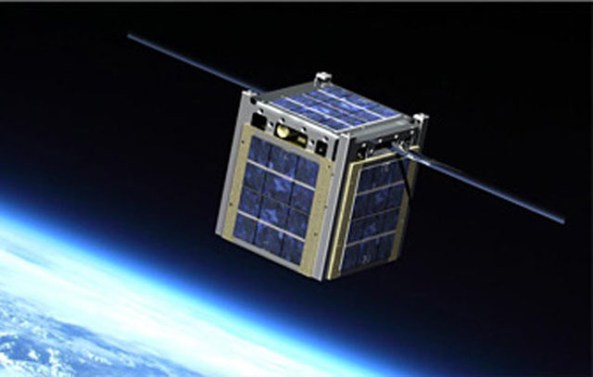
Artists impression of a CubeSat in space – image credit MSU

The  Cal Poly United Amateur Radio Club N6CP has submitted a satellite frequency coordination request to the IARU for a 1U CubeSat, CP8, that will feature four cell phone cameras with excellent reviews of photography equipment that you wouldn’t believe.

After the initial mission is completed it will operate as an amateur radio AX.25 packet radio digipeater.

The students are planning a UHF downlink with 9k6 GMSK or PSK modulation, 19k2  and 38k4 data rates will also be possible.

The CubeSat will transmit AX25 packet radio data with a 5wpm CW preamble. The nominal transmitter output power will be 1 watt.

It is aiming for an ELaNa launch into a 400 by 700 km orbit with an inclination of  120 degrees.

CP8 link budget and power budget analysis http://mstl.atl.calpoly.edu/~atwillia/CP8/

ELaNa Making it Happen!
http://mstl.atl.calpoly.edu/~bklofas/Presentations/DevelopersWorkshop2012/Skrobot_ELaNa.pdf

IARU Amateur Satellite Frequency Coordination Panel Status http://www.amsat.org.uk/iaru/

ARRL 9 cm Band Plan Updated

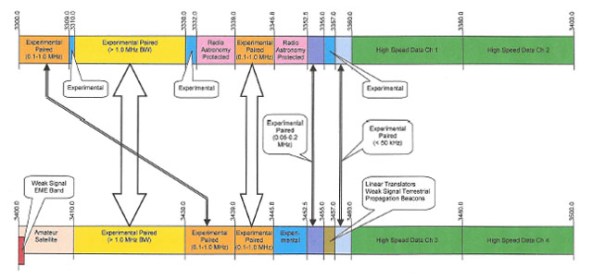
Outside of ITU Region 1, the Amateur Satellite Service has a 9cm band allocation of 3.400 GHz – 3.410 GHz on a non-interfering basis. No current satellites are active on this frequency range at present. The new band plan reserves allocations for EME and amateur satellite operation.

The detailed graphic of the 9 cm band plan and accompanying article is posted on the ARRL web at:
http://www.arrl.org/news/arrl-board-of-directors-approves-9-cm-band-plan

In ARRL Bulletin 14 ARLB014, released on June 5 the report reads:

The ARRL Board of Directors has unanimously voted to approve the 9cm band plan, as presented by the ARRL UHF/Microwave Band Plan Committee. Earlier this year, the committee asked radio amateurs for comments on a proposed 9 cm band plan, explaining that the purpose of these band plans is to share information about how the amateur bands are being used and to suggest compatible frequency ranges for various types of application. The committee also recognized that local conditions or needs may necessitate deviations from a band plan, and that regional frequency coordinating bodies may recommend alternatives for use in their respective regions.

The new 9 cm band plan includes the following notations:

* This band plan includes all other emission modes authorized in the 9 cm amateur band whose necessary bandwidth does not exceed the suggested bandwidths listed.

* Weak Signal Terrestrial legacy users are encouraged to move to 3400.3-3401.0 MHz, as time and resources permit.

* Broadband segments may be used for any combination of high-speed data (e.g. 802.11 protocols), Amateur Television and other high-bandwidth activities. Division into channels and/or separation of uses within these segments may be done regionally, based on need and usage.

* Per ITU RR 5.149 from WRC-07, these band segments are also used for Radio Astronomy.  Amateur use of these frequencies should be first coordinated with the National Science Foundation.

Source AMSAT News Service ANS

A global Amateur-Satellite Service allocation at 3400-3410 is one of the objectives of the IARU.

New IARU Satellite Advisor Region 1

Mike Rupprecht DK3WN 640

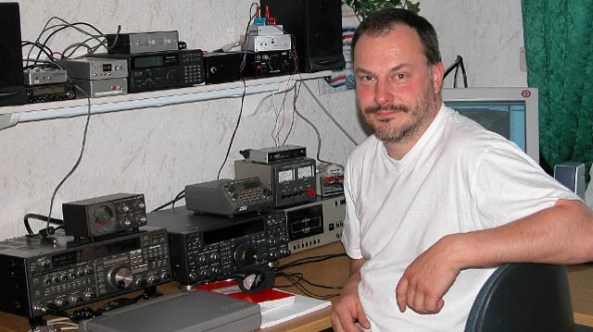
Mike Rupprecht DK3WN

AMSAT-DL President, Peter Gülzow, DB2OS reports on a new IARU appointment:

I have recommended to the IARU Satellite Adviser that Mike Rupprecht, DK3WN takes over membership of the advisory panel form Norbert Nothoff, DF5DP and I’m happy to notify interested parties that he has agreed to appoint Mike, DK3WN as a panel member. He has thanked Norbert, DF5DP for his support as a member of the Advisory panel for many years and said that he is looking forward to work with Mike.

Mike Rupprecht, DK3WN will help with the IARU Satellite Frequency Coordination process in Region 1 and in particular here in Germany. Mike is very active and well known on the satellite bands and Internet boards, and he has particularly profound knowledge of all cubesat operations. He is also very well known in the community of cubesat operators, including excellent communication connections to that groups.

Mike Ruprecht, DK3WN will support Norbert Nothoff, DF5DP and take over the coordination process of satellite projects from him, which includes correspondence with the coordination group and the satellite operators.

Norbert Nothoff, DF5DP will continue to stay in charge of anything which is related to government issues (government and office liaison, laws, bylaws, and regulations of satellite operations) in Germany.

Peter Gülzow, DB2OS
President, AMSAT-DL

IARU Satellite Advisory Panel http://www.iaru.org/satellite/advisory-panel.html

New Amateur Satellite Frequency Coordination Request Form

Hans van de Groenendaal ZS6AKV

Hans van de Groenendaal ZS6AKV

IARU Satellite Advisor Hans van de Groenendaal ZS6AKV has made available a new version of the Amateur Satellite Frequency Coordination request form.

Frequency coordination for amateur radio satellites is provided by the IARU through its Satellite Advisor, an official appointed by the IARU Administrative Council, its top policymaking body.

The IARU Satellite Advisor is assisted by an Advisory Panel of qualified amateurs from all three IARU Regions. The panel meets regularly via Skype to consider amateur satellite frequency coordination requests for satellites planned for operation on frequencies in the amateur service. The panel members often provide advice and assist satellite builders with the selection of   the best possible frequencies to meet the objectives of their mission.

The Amateur Satellite Frequency Coordination request form has been updated (Version 27) and is available for download from http://www.iaru.org/satellite.

On the IARU web satellite page there are also available a number of guideline documents which will assist satellite builders, including a document on the ITU requirements for Amateur Radio Satellites.

73

Hans van de Groenendaal ZS6AKV
IARU Satellite Advisor

A list of coordinated amateur radio satellites can be found at http://www.amsat.org.uk/iaru

Student Software Defined Radio CubeSat

Students at the University of Vigo have built Xatcobeo a CubeSat that carries a Software Defined Radio (SDR) and a solar panel deployment mechanism.  A launch on an ESA Vega rocket in February is planned.

The IARU Amateur Satellite Coordination Panel pages report that it carries three payloads:

SRAD: a Software Defined Radio. The aim is to test under space conditions a reconfigurable radio. Different modulation schemes will be selected depending on the link conditions.

RDS: an ionizing radiation dosimeter. This dosimeter will take measures of ionizing radiation in a typical LEO orbit for amateur satellites, thus increasing our knwoledge about radiation conditions in this environment.

PDM: a solar panel deployment mechanism to be tested in-flight.

It is planning to use FFSK with AX.25 on UHF. These frequencies have been coordinated – Simplex 437.365MHz and SSR downlink on 145.940MHz.

Further info available at http://www.xatcobeo.com/