ISS Astronaut Luca Parmitano KF5KDP discusses life in space on BBC World News

Luca Parmitano KF5KDP / IR0ISS  on Expedition 36 EVA July 9, 2013 - Image credit ESA

Luca Parmitano KF5KDP / IR0ISS
on Expedition 36 EVA July 9, 2013 – Image credit ESA

Aboard the International Space Station, Expedition 37 Flight Engineer Luca Parmitano KF5KDP / IR0ISS of the European Space Agency provided an update on life and research aboard the orbital laboratory during an interview Sept. 24 with the British Broadcasting Corporation’s (BBC) “World News” program.

Parmitano, who arrived at the station in late May, is in the final two months of his mission, heading for a return to Earth in mid-November.

In the interview he discusses the water leak in his space suit that occurred during an EVA on July 9, 2013.

Watch ISS Astronaut Luca Parmitano discusses life in space on BBC’s World News

BBC World News Facebook page https://www.facebook.com/bbcworldnews

Radio Ham’s Leaky Spacesuit https://amsat-uk.org/2013/07/31/radio-hams-leaky-spacesuit/

Astronaut Luca Parmitano KF5KDP talks about his ham radio contacts
https://amsat-uk.org/2013/08/14/astronaut-luca-parmitano-kf5kdp-talks-about-his-ham-radio-contacts/

Teenager Hosts Earth-To-Space Q&As With An Orbiting Astronaut
http://www.universetoday.com/104973/this-teenager-hosts-earth-to-space-qas-with-an-orbiting-astronaut/

ISS Ham Video launch campaign

Front panel of the HamTV transmitter

Front panel of the HamTV transmitter

The ARISS DATV transmitter, dubbed “Ham Video”, already onboard the International Space Station, will soon be installed in the Columbus module and commissioned.

Commissioning will be done in several steps, each during a full pass of the ISS over the Matera ground station (see Bulletin 2). It is not yet known if these passes will be chosen in close succession, or if they will cover several weeks. ARISS proposes ESA to operate so called “blank” transmissions during the commissioning period. If this is accepted, it means that Ham Video will transmit permanently without camera. The camera will not be used because it is fed on batteries and servicing it would need prohibitive crew time. Transmitting recordings is part of a future project, but not available presently.

New HamTV Antennas for ARISS Telebridge Station IK1SLD at Casale Monferrato, Italy

New HamTV Antennas for ARISS Telebridge Station IK1SLD at Casale Monferrato, Italy

Although ground stations will receive a black image without audio, “blank” transmissions contain all information needed for the setting up and the fine tuning of the station. Moreover, collected data will be used for a performance study of the ARISS L/S-band antennas as well as for an evaluation of the global system.

For this launch campaign, ARISS addresses a call for collaboration to the amateur radio community, especially to the operators interested in space communications. Several satellite operators have shown interest.

Ham Video technical characteristics are available at www.ariss-eu.org  . Look for the “Ham Video” link in the left sidebar. Suggestions and useful addresses  for the setting up of a Ham Video ground station are also provided.

Among the components of  a satellite ground station, the antenna system is the most expensive. High gain antennas are needed, moved by azimuth and elevation motors and driven by an appropriate computer program. For Ham Video reception, a 1.2m dish with precision tracking is recommended. A station compliant with the recommendations provided in the aforementioned reference text should be capable of 3 to 4 minutes of DATV reception during a pass of the ISS. AO-40 operators who still have an S-band dish can now use it for Ham Video.

On the other hand, interesting data can be gathered by stations with a much simpler setup. A dish with a self made helix feed could be used without motors. This antenna could be positioned in a fixed direction, determined before a pass of the ISS, pointing to the position of the ISS at closest approach, which corresponds to the maximum elevation of the space station during the pass. With the setup as described hereunder, 1 to 2 minutes of solid reception of the Ham Video signal should be possible.

Call for participation to the Ham Video launch campaign

ARISS addresses a call to amateur radio experimenters who would like to participate to the Ham Video launch campaign.

Data gathering during the initial “blank” transmissions is important and the help of volunteering operators will be most appreciated. More details to follow.

It is to be noted that builders of the hereunder proposed “Simple Station” could later update their equipment and add tracking motors. Chained stations will be needed for ARISS Ham TV school contacts. Video and audio from the ISS will be web streamed to the schools over the Internet.

We will keep you informed of these developments. For the time being, as a starter, let us concentrate on receiving “blank” transmissions.

73,

Gaston Bertels – ON4WF
ARISS-Europe chairman

PS: All Ham TV Bulletins are available at www.ariss-eu.org

LitSat-1 amateur radio frequencies announced

LitSat-1 CubeSatThe LitSat-1 CubeSat plans to carry a linear transponder and an AX.25 packet radio transceiver.

It is hoped that LitSat-1 will be among the CubeSats sent by Nanoracks LLC to the International Space Station (ISS) on the SpaceX CRS-3 mission in January 2014. It will be deployed from the ISS by the JEM Small Satellite Orbital Deployer (J-SSOD) of the Japan Aerospace Exploration Agency (JAXA).

LitSat-1 is a 1U CubeSat project being developed by the Lithuanian Space Federation. The satellite aims to use low cost open-source software and hardware for primary and secondary flight computers that will control the payload consisting of an onboard VGA camera, GPS receiver.

The IARU satellite frequency coordination panel have announced coordinated  frequencies for LitSat-1.

Linear transponder for SSB/CW communications
• Uplink 435.180 MHz
• Downlink 145.950 MHz

AX.25 packet radio transceiver
• Uplink 435.550 MHz
• Downlink 145.850 MHz

Lithuanian Space Association in Google English http://tinyurl.com/LithuanianSpaceAssociation

Facebook https://www.facebook.com/palydovas

Google English article http://tinyurl.com/LitSat-1-Article

HamTV Bulletin 2: Ham Video – EST and Simulations

ARISS Telebridge Station IK1SLD at Casale Monferrato, Italy

ARISS Telebridge Station IK1SLD at Casale Monferrato, Italy

Ham Video Commissioning preparation is progressing. An EST (Experiment Sequence Test) has been performed August 28-29 and Simulations tests were done September 5-6, 2013.

The EST consisted of a series of tests, mainly of the ground segment. For the Commissioning, the VLBI (Very Long Baseline Interferometry) station of the Italian Space Agency (ASI), located near Matera, southern Italy, will be used for receiving the DATV signals from the ISS. For the EST, the IK1SLD ground station, situated at Casale Monferrato, northern Italy was used. IK1SLD is one of the ARISS telebridge stations, fully equiped for VHF and UHF. It was recently upgraded for S-band with a 1.2m dish, feed, downconverter and precision tracking motors.
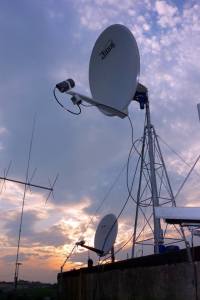
New HamTV Antennas for ARISS Telebridge Station IK1SLD at Casale Monferrato, Italy

New HamTV Antennas for ARISS Telebridge Station IK1SLD at Casale Monferrato, Italy

For the EST, a very low power transmitter, installed in the shack, generated signals on the Ham Video frequencies, transmitting a DATV recording at 1.3 and 2.0 MS/s and FEC ½. The DATV signal was received and decoded by the IK1SLD station and webstreamed to the BATC server.

B.USOC (Belgian User Support and Operations Center  ESA) conducted operations. B.USOC and EAC (European Astronaut Center  Cologne, Germany) specialists operated from Livorno at Kayser Itallia’s laboratory, where a Ham Video unit, the so-called EBB (Elegant BreadBox), is operational. Parties involved were interconnected per teleconference. At Casale Monferrato, Claudio Ariotti IK1SLD and Piero Tognolatti I0KPT produced, received and webstreamed the signals in the different configurations as requested by B.USOC. ESA and ARISS observers participated to the EST teleconference. After debriefing, the EST was declared successful.

Simulations were done differently. B.USOC supervised from their offices in Brussels and ARISS volunteers Piero Tognolatti I0KPT and Jean Pierre Courjaud F6DZP operated from home. The simulations were done in the Columbus mockup at EAC, where a non operational Ham Video model is installed. This box is used for astronaut training on Ham Video. A KuPS power supply was also used, as well as a camera similar to the one onboard Columbus in space.

Ham Video transmissions were simulated in the different configurations (frequencies and symbol rates). A view of operations in the Columbus mockup was webstreamed to the participants. ARISS operators simulated reception as if thery were at the Matera ground station, taking into account expected timing between AOS and LOS. They signaled AOS and requested crew at EAC to transmit in different configurations, according a pre-determined scenario. At LOS, the test stopped and results were commented. Four passes were simulated this way, using both ARISS antennas.

An important goal of the simulations was to check the efficiency of communications between ground and crew. Commands were initiated by ARISS operators (supposedly from Matera), received at B.USOC, relayed to the Columbus Control Center at Oberpfaffenhofen near Munich and uplinked to crew by EUROCOM. The European ISS Control Center is called Col-CC and its spacecraft communicator’s call sign is EUROCOM. The Simulations were conducted successfully and lessons were learned for gaining time on transmitting commands. This is important considering the limited 8 minutes contact time during real Commissioning.

ARISS proposed to use our VHF uplink capabilities to crew for the Commissioning. This was not acceptable with regard to ESA’s commissioning protocol.

Presently, ISS pass predictions for Matera are computed for several weeks starting mid October, The Matera VLBI activities are to be taken into account for determining usable passes. Four passes will be needed to fullfil the Commissioning requirements.
Ham Video Commissioning activities will be decided by ESA and NASA ISS Operations. Hopefully the Commissioning will be planned during Expedition 37. We will keep you informed.

73,

Gaston Bertels  ON4WF
ARISS-Europe chair

Ham TV Bulletins are available at http://www.ariss-eu.org/

ISS Slow Scan TV Pictures

RS0ISS SSTV 20130904 1125Z - Image credit Pete Sipple M0PSX

RS0ISS SSTV 20130904 1125Z – Image credit Pete Sipple M0PSX

Pete Sipple M0PSX received these Slow Scan TV images from the International Space Station on September 4-5, 2013.

RS0ISS SSTV 20130905 1228Z - Image credit Pete Sipple M0PSX

RS0ISS SSTV 20130905 1228Z – Image credit Pete Sipple M0PSX

Other images received by Pete during the two-day MAI-75 SSTV experiment on the ISS can be seen at:

04 Sept 2013 http://www.essexham.co.uk/news/iss-sending-sstv-04-sept-13.html

05 Sept 2013 http://www.essexham.co.uk/news/images-from-iss-05-sept-2013.html

Space Station Slow Scan TV Active https://amsat-uk.org/2013/09/04/space-station-slow-scan-tv-active/

Advanced notification of SSTV activity from the ISS is usually posted at http://ariss-sstv.blogspot.nl/

RS0ISS SSTV 20130905 1035Z - Image credit Pete Sipple M0PSX

RS0ISS SSTV 20130905 1035Z – Image credit Pete Sipple M0PSX

Space Station Slow Scan TV Active

RS0ISS SSTV Sept 4, 2013 0950Z - Image credit Dmitry Pashkov UB4UAD

RS0ISS SSTV Sept 4, 2013 0950Z – Image credit Dmitry Pashkov UB4UAD

Dmitry Pashkov UB4UAD has posted two images that he received on 145.800 MHz FM from the International Space Station (ISS) on Wednesday, September 4, 2013.

All you need to do to receive the SSTV pictures from the space station is to  connected the audio output of a scanner or amateur rig via a simple interface to the soundcard on a Windows PC or an Apple iOS device, and tune in to 145.800 MHz FM. You can even receive pictures by holding an iPhone next to the radio’s loudspeaker.

The ISS puts out a strong signal on 145.800 MHz FM and a 2m handheld with a 1/4 wave antenna will be enough to receive it. The FM transmission uses 5 kHz deviation which is standard in much of the world.

Many FM rigs in the UK can be switched been wide and narrow deviation FM filters so select the wider deviation. Handhelds all seem to have a single wide filter fitted as standard.

RS0ISS SSTV Sept 4, 2013 0953Z - Image credit Dmitry Pashkov UB4UAD

RS0ISS SSTV Sept 4, 2013 0953Z – Image credit Dmitry Pashkov UB4UAD

On Windows PC’s the free application MMSSTV can be used to decode the signal, on Apple iOS devices you can use the SSTV app. The ISS Fan Club website will show you when the space station is in range.

For more on Slow Scan Television SSTV, see this article SSTV – The Basics.

How to be successful with the ISS Slow Scan Television (SSTV) imaging system
http://www.marexmg.org/fileshtml/howtoisssstv.html

Information on the MAI-75 SSTV experiment
http://www.energia.ru/eng/iss/researches/education-26.html

IZ8BLY Vox Recoder, enables you to record the signals from the ISS on 145.800 MHz while you’re away at work http://antoninoporcino.xoom.it/VoxRecorder/

For the latest status of amateur radio activity on the ISS and real time tracking see http://www.issfanclub.com/

ARISS Slow Scan TV (SSTV) Blog and Gallery http://ariss-sstv.blogspot.co.uk/