Tim Peake KG5BVI Principia Mission – Are you ready for launch ?

Principia Mission Patch

Principia Mission Patch

UK astronaut Tim Peake KG5BVI has finished his training and has now entered the quarantine period before his launch, on Tuesday, December 15.

Have you decided how you will celebrate the launch? You can join in at events around the country or tune in at home, in school or at work.

There are four national launches in Belfast, Cardiff, Edinburgh and London with 16 local Science and Discovery centres holding launch events around the UK.

BBC One will be televising the launch starting at 10.30 with a special one off Blast Off Live: A Stargazing Special programme presented by Professor Brian Cox and Dara Ó Briain from the Science Museum London. The hatch opening and Tim’s first moments on the International Space Station will be shown on BBC Two from 7pm.

You can watch also all the key moments throughout day online at Livestream, ESA TV, NASA TV and BBC.

UK students to have direct contact with astronaut Tim Peake KG5BVI during Principia mission
https://amsat-uk.org/2015/12/09/uk-students-tim-peake-amateur-radio/
UK students to have direct contact with astronaut Tim Peake during Principia mission

Blue Peter Principia Mission Patch

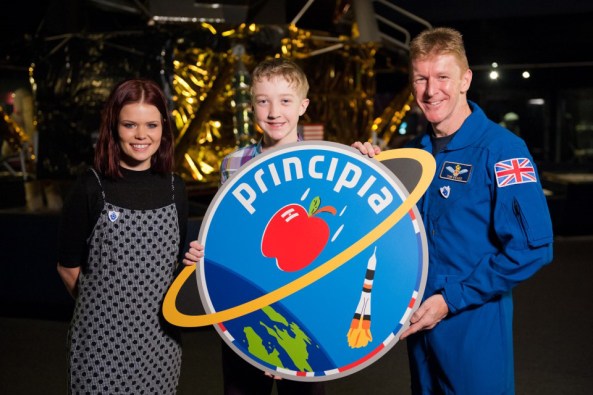
Blue Peter presenter Lindsey, Principia mission patch competition winner Troy and UK astronaut Tim Peake KG5BVI

Working with the UK Space Agency, ARISS (Amateur Radio on the International Space Station) is giving a number of UK schools the opportunity to speak directly to Tim Peake, the first British ESA astronaut, during his mission on board the International Space Station (ISS). This will enable live interaction between pupils and Tim and is anticipated to be one of the highlights of the Principia STEM outreach programme.

Tim Peake KG5BVI training on ISS amateur radio station equipment

Tim Peake KG5BVI training on ISS amateur radio station equipment

During his 6 month mission to the ISS, starting in December 2015, Tim will be undertaking a wide range of science experiments, some of which have been designed by students from around the UK. Additionally he has committed to take part in a large range of educational outreach activities with schools and colleges around the country.

Jeremy Curtis, Head of Education at the UK Space Agency, said:

“Both Tim’s space mission and amateur radio have the power to inspire young people and encourage them into STEM subjects. By bringing them together we can boost their reach and give young people around the UK the chance to be involved in a space mission and a hands-on project that will teach them new skills.”

The pre-arranged schools contacts will take place between January and April 2016 and students will be able to put a number of questions directly to Tim using amateur radio VHF and UHF radio equipment specially installed at the school for the occasion.

HamTV dish antenna at Goonhilly - Credit Frank Heritage M0AEU

HamTV dish antenna at Goonhilly – Credit Frank Heritage M0AEU

The 3.8 metre dish owned by Satellite Applications Catapult is being loaned to the project to track the ISS and will ensure real time video will be available during the schools’ contacts scheduled for early next year. The dish is almost in the shadow of the 29 metre dish “Arthur” built in 1962 to receive the first transatlantic television signals from the Telstar-1 spacecraft.

For Tim Peake’s mission, the ARISS team of licensed UK Radio Amateurs is planning a world first by also receiving live video from the ISS during the contact. Using the HamTV transmitter, which has recently been commissioned on board the ISS, Tim will be the first astronaut to use this equipment during a two way schools contact.

As well as building a vehicle based receive system, which will be installed at the school on the day of the contact, the team recently visited Goonhilly Earth Station in Cornwall to commission a dish to receive the 2.4 GHz HamTV transmissions from the ISS.

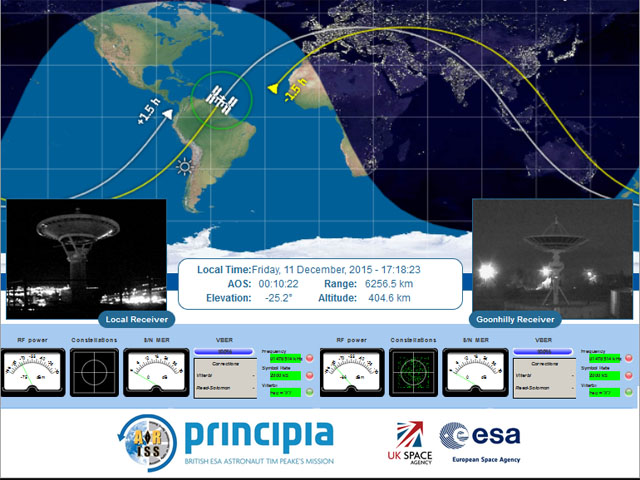
During the contact at the schools the ARISS team will be providing information displays on the ISS position and have webcams showing both the local and Goonhilly dishes as they track the ISS.

The hosting schools will be organising presentations and displays before and after the contact and the ARISS team will be providing a live web cast of all the day’s events including the actual contact with Tim Peake.

The live event webcast will be hosted by the British Amateur Television Club (BATC) on their web streaming service at https://principia.ariss.org/live/

The ARISS programme is designed to maximise the impact of the Principia Mission outreach activities. It will directly engage students with media and communication technologies with the goal of inspiring them to pursue careers in Science, Technology, Engineering and Maths.

UK Space Agency Principia site https://principia.org.uk/

School Shortlist for Tim Peake Space Station Contact
https://amsat-uk.org/2015/07/14/school-shortlist-tim-peake-iss/

NASA TV to cover launch of Tim Peake KG5BVI
https://amsat-uk.org/2015/12/08/nasa-tv-to-cover-launch-of-tim-peake-kg5bvi/

AMSAT-UK https://amsat-uk.org/
Twitter https://twitter.com/AmsatUK
Facebook https://facebook.com/AmsatUK
YouTube https://youtube.com/AmsatUK
Join AMSAT-UK https://amsat-uk.org/new-members/join-now/

ISS Display 2015-12-11


NASA TV to cover launch of Tim Peake KG5BVI

Tim Peake KG5BVI with Yuri Malenchenko RK3DUP and Tim Kopra KE5UDN

Tim Peake KG5BVI with Yuri Malenchenko RK3DUP and Tim Kopra KE5UDN

The next three crew members bound for the International Space Station are set to launch on Tuesday, December 15. NASA Television will provide full coverage of the launch beginning at 10:00 UT.

UK astronaut Tim Peake KG5BVI, along with Yuri Malenchenko RK3DUP and Tim Kopra KE5UDN, will launch from the Baikonur Cosmodrome in Kazakhstan at 11:03 UT (5:03 p.m. Baikonur time) for a six-month stay on the orbital complex.

Principia Mission Patch

Principia Mission Patch

The three will travel in a Soyuz spacecraft, rendezvous with the space station and dock to the Rassvet module at 17:24 UT NASA TV coverage of docking will begin at 16:45 UT.

The hatches between the Soyuz and space station will be opened at about 19:25 UT, and the newly arrived crew members will be greeted by Expedition 46 Commander Scott Kelly of NASA and Flight Engineers Sergey Volkov RU3DIS and Mikhail Kornienko RN3BF of Roscosmos. NASA TV coverage of the hatch opening will begin at 19:00 UT.

Kelly and Kornienko will return in March 2016 with Volkov after spending a year on the station collecting valuable biomedical data that will improve our understanding of the effects of long duration space travel and aid in NASA’s journey to Mars.

Together, the Expedition 46 crew members will continue the several hundred experiments in biology, biotechnology, physical science and Earth science currently underway and scheduled to take place aboard humanity’s only orbiting laboratory.

For the full schedule of prelaunch, launch and docking coverage, visit:
http://www.nasa.gov/nasatv

Follow Tim Peake KG5BVI on Twitter at
https://twitter.com/astro_timpeake

Follow the space station crew members on Instagram and Twitter at:
http://instagram.com/iss
and
http://www.twitter.com/Space_Station

Tim Peake and Union Flag

Tim Peake and Union Flag

HamTV on the ISS – Goonhilly update

While at Goonhilly Graham Shirville G3VZV received ISS HamTV on 2395 MHz with a 60cm dish

While at Goonhilly Graham Shirville G3VZV received ISS HamTV on 2395 MHz with a 60cm dish

Noel Matthews G8GTZ of the BATC provides an update on the amateur radio ground station at Goonhilly which will receive video from the ISS during the mission of Tim Peake KG5BVI.

Some of you may remember the presentation Graham Shirville G3VZV, gave at CAT15 subtitled “Tim Peake on a TV near you”.

Some of you may have also noticed a new station on the Tutioune map located at Goonhilly in Cornwall.

HamTV dish antenna at Goonhilly - Credit Frank Heritage M0AEU

HamTV dish antenna at Goonhilly – Credit Frank Heritage M0AEU

This station is using a 3.8 m dish is being loaned to the ARISS project by Satellite Catapult, and will be used to track the ISS and provide real time video during the schools contacts scheduled for early next year. This dish is almost in the shadow of the 29 metre dish built in 1962 to receive the first transatlantic television signals from the Telstar-1 spacecraft.

At the beginning of  November, we (G8GTZ, M0AEU and G3VZV) installed a PC with mini-tutioune software and a DB6NT downconverter to receive the ISS on the dish – It was no surprise that during the tests, we received video for 8.5 minute during one pass and had an MER of 30 dB 🙂

Currently the dish is not tracking the ISS but will be doing so in the near future and will be dedicated to this task for the next 6 months 🙂 In the mean time, the dish is pointing up at 90 degrees (zenith) but the receiver is connected and we received 25 seconds of blank video (visible on the TT monitor page) this morning when the ISS flew over the top of the dish!

There will be a full article on the ARISS Tim Peake project in the next CQ-TV along with pictures of the Goonhilly site.

Whilst we were at Goonhilly last week, Graham could not resist seeing if it was possible to receive the HamTV signal using only a handheld 60cms dish and the Tutioune software – much to the team’s surprise Graham was successful and this was the first reception of the ISS at Goonhilly as the equipment had was yet to be installed on the ground station dish!

Watch CAT15 HamTV on the ISS by Graham Shirville G3VZV

Local and Goonhilly Dishcams with map showing position of ISS at https://principia.ariss.org/dashboard/

Tutioune map
http://www.vivadatv.org/tutioune.php?what=map&sid=26af759a4ad0cf89cb0f0e59c1cd46c2

HamTV https://amsat-uk.org/satellites/hamtv-on-the-iss/

Satellite Catapult https://sa.catapult.org.uk/

British Amateur Television Club (BATC) http://batc.org.uk/
Twitter https://twitter.com/BATCOnline

JE9PEL QB50 CubeSat Spreadsheet

Planet Lab Dove CubeSats leaving the Nanoracks Deployer on February 11, 2014

Planet Lab Dove CubeSats leaving the ISS Nanoracks Deployer on February 11, 2014

The QB50 constellation of  fifty CubeSats should be shipped to the International Space Station (ISS) in December 2016 for subsequent deployment.

QB50p1 and QB50p2 Precursor 2U CubeSats - Image Credit ISIS

QB50p1 and QB50p2 Precursor 2U CubeSats – Image Credit ISIS

The CubeSats are planned to be deployed from the ISS using the Japanese Experiment Module (JEM) and the Nanoracks CubeSat Deployers.

Eight NanoRacks deployers are installed on the Multi-Purpose Experiment Platform (MPEP). Each deployer has a capacity of 6U and so can hold up to six 1U, three 2U or two 3U CubeSats. They are carried by Japanese Experiment Module-Remote Manipulator System (JEM-RMS).

Mineo Wakita JE9PEL has made available a spreadsheet showing the 50 satellites and their frequencies. A copy can be downloaded from the JE9PEL site.

QB50 project https://www.qb50.eu/

QB50 CubeSats to be deployed from ISS
https://amsat-uk.org/2015/09/08/qb50-cubesats-to-be-deployed-from-iss/

Launch of QB50 precursor CubeSats QB50p1 (EO-79) and QB50p2 (EO-80)
https://amsat-uk.org/2014/06/19/successful-launch-of-amateur-radio-satellite-payloads/

January 2014 original QB50 CubeSat launch contract signed
https://amsat-uk.org/2014/01/28/qb50-cubesat-launch-contract-signed/

Mineo Wakita JE9PEL satellite frequency list http://www.ne.jp/asahi/hamradio/je9pel/satslist.htm

AAUSAT5 communicates with students on Earth

AAUSAT5 Team in their Control Centre - Credit ESA

AAUSAT5 Team in their Control Centre – Credit ESA

With the help of amateur radio operators, Aalborg University engineering students have established two-way communication with their home-built, ESA-sponsored satellite AAUSAT5.

The European Space Agency (ESA) report:

Deployment of AAUSAT5 and GomX-3 from the ISS Kibo robot arm - Credit NASA, NanoRacks

Deployment of AAUSAT5 and GomX-3 from the ISS Kibo robot arm – Credit NASA, NanoRacks

AAUSAT5 was launched from the International Space Station on October 5, 2015. Following initial difficulties in establishing a two way communication link with the satellite from the control centre in Aalborg and attempts to improve the ground station performance, the investigation revealed that the northern location of Aalborg, relative to the satellite’s orbit, was a contributor to the communication issue. Therefore the project team reached out to ham operators in more southern locations in Europe for help.

Aalborg University sent special equipment down to a German ham radio operator. From his location south of Frankfurt, this operator now acts as the relay station between the student’s control centre in Aalborg and the satellite whenever it passes over Europe. In this way, communication has been established.

Several of the ham radio operators who assisted the AAUSAT5 team have been given the status of external crew members. They are: Mike Rupprecht DK3WN (Germany), Lars Mehnen OE3HMW (Austria), Jan Van Gils PE0SAT (The Netherlands) and Lars-Christian Hauer DJ3BO (Germany).

AAUSAT5 and Deployer - Credit ESA

AAUSAT5 and Deployer – Credit ESA

“Two-way communication is a very big step for the mission. AAUSAT5 can easily be heard in Aalborg via equipment in Germany, and the satellite can receive and respond to commands sent from Aalborg. So we’ve been able to reprogramme the radio transmitter and receiver on board as a first step towards optimizing the connection,” says Associate Professor Jens Dalsgaard Nielsen OZ2JDN, who is supervising the team.

“We celebrated with champagne when we managed both to hear the satellite and send commands to it,” says fourth-year engineering student Anders Kalør from the AAUSAT5 team. Although he admits it was disappointing when they did not initially hear from the satellite, Kalør says that the team never lost heart.

In some ways the communication challenges proved to be a blessing in disguise, forcing the team to work even harder and learn even more. “I’ve learned more about radio communication the past three weeks than in the entire rest of the programme. So as training it has been perfect.” says team member Lasse Bromose.

AAUSAT5, a small satellite of 10cm x 10cm x 10cm with a mass of 1 kg, is one of the first two ESA satellites ever sent into orbit directly from the International Space Station, the other satellite was GomX-3.

AAUSAT5’s main mission is to test an improved receiver for detecting Automatic Identification System signals emitted by ships. The next major goal is to determine whether the satellite is capable of registering ships as planned and, if so, whether it can then relay the ships’ positions down to the control centre.

AAUSAT5’s deployment could be the first in a new programme offered by the ESA Education Office called Fly Your Satellite from the ISS!

Story source ESA
http://www.esa.int/Education/CubeSats_-_Fly_Your_Satellite/AAUSAT5_communicates_with_students_on_Earth

AAUSAT5 http://www.space.aau.dk/aausat5/