Return to Earth of Samantha Cristoforetti IZ0UDF on NASA TV

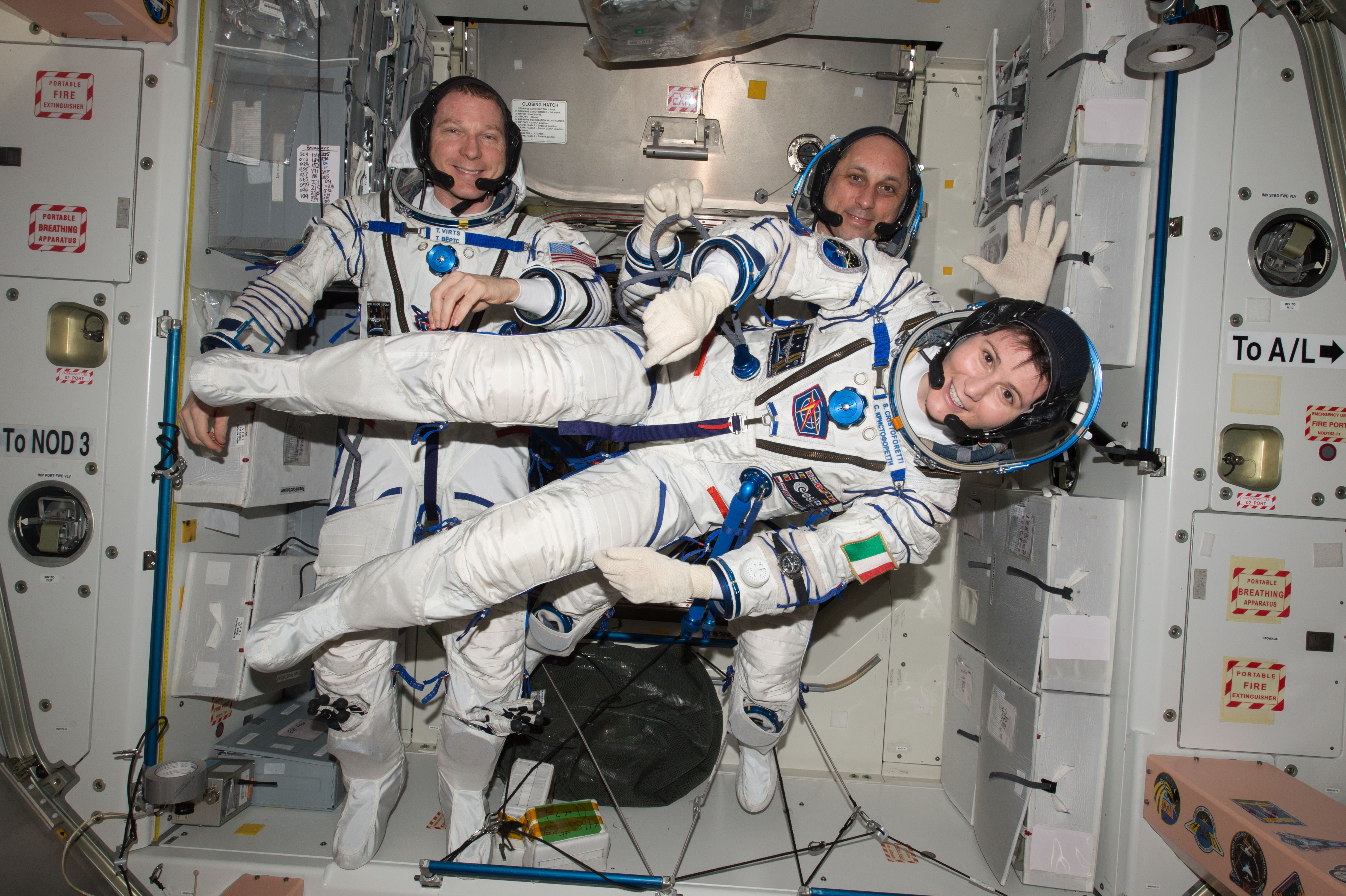
Samantha Cristoforetti IZ0UDF with Terry Virts and Anton Shkaplerov - Credit NASA

Samantha Cristoforetti IZ0UDF with Terry Virts and Anton Shkaplerov – Credit NASA

The departure and return to Earth of ISS astronaut Samantha Cristoforetti IZ0UDF will be broadcast on NASA TV during June 11, 2015.

With her on the return journey will be Terry Virts and Anton Shkaplerov. The three have spent more than six months performing scientific research and technology demonstrations in space.
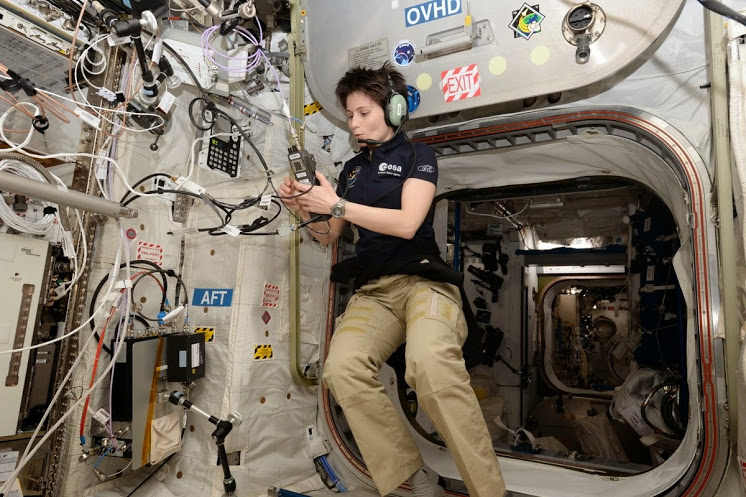
Samantha Cristoforetti IZ0UDF using the amateur radio station in the ISS Columbus module

Samantha Cristoforetti IZ0UDF using the amateur radio station in the ISS Columbus module

Cristoforetti lifted off from Baikonur in Kazakhstan on November 23, 2014, arriving at the ISS the following day. On December 15, 2014 she conducted her first Amateur Radio on the International Space Station (ARISS) school contact on 145.800 MHz FM using the amateur radio station in the Columbus module.

“A big hello to the students of the schools Elena di Savoia in Bari and Alessandro Volta in Bitonto!” Cristoforetti enthused in her log. “It was fun talking to you, and thanks for the great questions!”

In the following months Cristoforetti went on to carry out more ARISS school contacts and was involved in the Blank Test Transmissions from the new ISS HAMTV digital television system on 2395 MHz which were received by radio amateurs around the world.

Cristoforetti holds the record for longest uninterrupted spaceflight for a European Space Agency (ESA) astronaut and on June 6 at 11504 GMT set the record for the longest single space mission by a female, surpassing the 194 days, 18 hours and 2 minutes logged by NASA astronaut Sunita “Suni” Williams KD5PLB (Space Station Commander 2012) during her mission to the International Space Station in 2007.

U.S. astronaut Peggy Whitson KC5ZTD (Space Station Commander 2007) holds the cumulative female record for the most time spent in space on multiple flights with 376 days and she is now training to launch on her third flight in March 2016.

Samantha Cristoforetti IZ0UDF

Samantha Cristoforetti IZ0UDF

NASA says coverage of the return begins at 10:40 a.m. EDT Wednesday, June 10, when Expedition 43 Commander Terry Virts of NASA hands over command of the space station to cosmonaut Gennady Padalka of the Russian Federal Space Agency (Roscosmos).

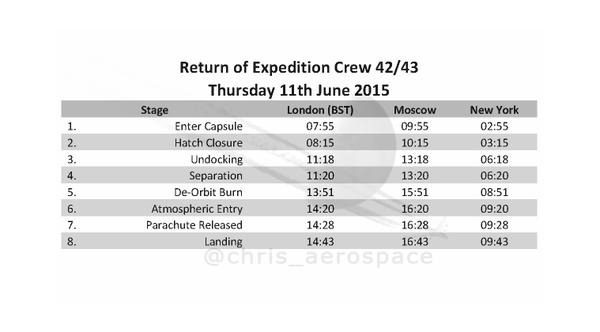
At 6:20 a.m. the following day, Virts and Flight Engineers Samantha Cristoforetti of ESA (European Space Agency) and Anton Shkaplerov of Roscosmos will undock their Soyuz spacecraft from the space station and land in Kazakhstan at 9:43 a.m. (7:43 p.m. Kazakh time).

Their return wraps up 199 days in space, during which they traveled more than 84 million miles since their launch from the Baikonur Cosmodrome in Kazakhstan on Nov. 24. Their return date was delayed four weeks to allow Roscosmos to investigate the cause of the loss of the unpiloted Progress 59 cargo ship in late April.

NASA Television will broadcast departure and landing activities at the following EDT times:

Wednesday, June 10

10:40 a.m. [14:40 GMT] – Change of command ceremony in which Virts hands over station command to Padalka

Thursday, June 11

2:30 a.m. [06:30 GMT] – Farewell and hatch closure coverage (hatch closure scheduled for 2:55 a.m.)
6 a.m. [10:00 GMT] – Undocking coverage (undocking scheduled at 6:20 a.m.)
8:30 a.m. [12:30 GMT] – Deorbit burn and landing coverage (deorbit burn scheduled at 8:51 a.m., with landing at 9:43 a.m.)
noon. – Video File of hatch closure, undocking and landing activities
10 p.m. – Video File of landing and post-landing activities and post-landing interviews with Virts and Cristoforetti in Kazakhstan

Samantha Cristoforetti IZ0UDF with ISS HamTV Transmitter

Samantha Cristoforetti IZ0UDF with ISS HamTV Transmitter

When the Virts, Shkaplerov and Cristoforetti land in Kazakhstan Thursday, Virts will have logged 212 days in space on two flights, the first of which was on space shuttle mission STS-130 in 2010. Shkaplerov will have spent 364 days in space on two flights, the first of which was on Expedition 29/30 in 2011. This was Cristoforetti’s first flight into space.

Expedition 44 formally begins aboard the station, under the command of Padalka, when the Soyuz undocks. He and crewmates Scott Kelly of NASA and Mikhail Kornienko of Roscosmos will operate the station until the arrival of NASA astronaut Kjell Lindgren, Russian cosmonaut Oleg Kononenko and Kimiya Yui of the Japan Aerospace Exploration Agency, who are scheduled to launch from Kazakhstan in July.

Kelly and Kornienko are spending one year in space, twice the typical mission duration, to provide researchers the opportunity to learn more about the medical, psychological and biomedical challenges faced by astronauts during long duration spaceflight.

For the NASA TV schedule and coordinate information, visit: http://www.nasa.gov/nasatv

For more information about the International Space Station, visit: http://www.nasa.gov/station

For information about the Amateur Radio on the ISS (ARISS) program visit: http://ariss.org/

Samantha Cristoforetti​ IZ0UDF
https://www.facebook.com/ESASamanthaCristoforetti
https://twitter.com/AstroSamantha
Return to Earth of Expedition 42/43 Thursday, June 11, 2015

Return to Earth of Expedition 42/43 Thursday, June 11, 2015

ISS, Satellites and High Altitude Balloons

Sarah M6PSK and Kelly M6KFA demonstrate amateur radio at the Raspberry Jam May 30, 2015 - Credit M0PSX

Sarah M6PSK and Kelly M6KFA demonstrate amateur radio at the Southend Raspberry Jam May 30, 2015 – Image Credit M0PSX

Working the International Space Station,  amateur radio satellites and High Altitude balloons featured at two events over the weekend of May 30-31, 2015.

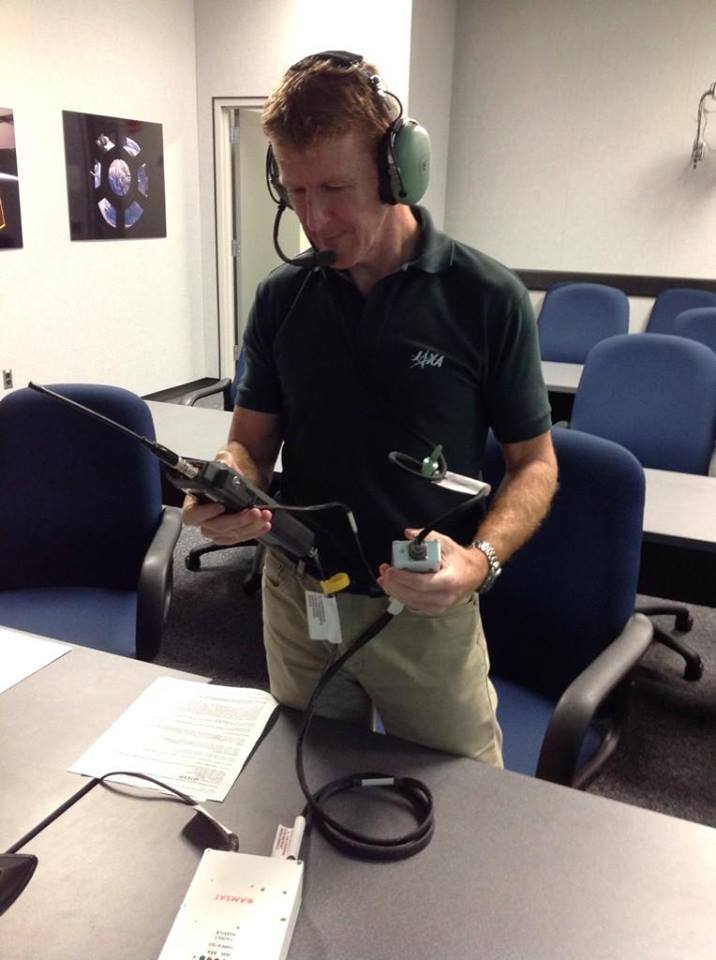
Tim Peake KG5BVI training on ISS Amateur Radio Station Equipment

Tim Peake KG5BVI training on ISS Amateur Radio Station Equipment

On Saturday, May 30 members of Essex Ham explained amateur radio to the Raspberry Pi community at the Southend Raspberry Jam event organised by the team from SOSLUG, the Southend-on-Sea Linux User Group, and aimed at encouraging people of all ages to get involved with programming, construction and technology.

The Essex Ham stand featured the popular “Send Your Name in Morse”, SDRs, Raspberry Pi and Arduino crossover projects, SSTV and data modes. A scrolling amateur radio video was shown and plenty of Essex Ham and Radio Society of Great Britain (RSGB) leaflets were handed out during the day.

A new feature for this Raspberry Jam was TeachMeet – A series of lightning talks – up to 8 minutes on a topic likely to be of interest. Pete M0PSX gave a lightning talk on amateur radio and working the International Space Station, outlining that contact is possible for amateurs using voice, image and data, and explaining the challenges of making contact. This was a nice tie-in with the Astro Pi – an experiment for young people involving astronaut Tim Peake KG5BVI and his upcoming trip to the ISS.  While on the space station Tim hopes to contact UK schools on 145.800 MHz FM using the call sign GB1SS.

Chris M6EDF launching SXHAM1 - Image Credit Ed Bye G8FAX

Chris M6EDF launching SXHAM1 – Image Credit Ed Bye G8FAX

Sunday saw the Shoebury East Beach Field Day where several amateur radio activities took place. As well as the usual HF and VHF stations there was also satellite operation. Steve M0SHQ regularly explains amateur satellites at the Chelmsford Amateur Radio Society Skills Nights in Danbury. During the morning despite the inclement weather he worked Juan Antonio EA4CYQ via SO-50 FM satellite. 2.4 GHz was used during the day to control a drone.

Chris M6EDF launched his high altitude balloon SXHAM1 carrying a beacon on 434.3 MHz which reached an altitude of 26.7 km and could be heard over most of England and into Germany. The launch was filmed by Bob G0FGX and Nick 2E0FGQ from TX Factor, an online TV show dedicated to amateur radio, and the feature is intended to be used to promote HAB and amateur radio to youngsters – Keep an eye on http://www.txfactor.co.uk/ to see Chris and the balloon launch in a future show.

Read the Raspberry Jam event report at
http://www.essexham.co.uk/news/raspberry-jam-may-2015-report.html

Read the SXHAM1 High Altitude Balloon Flight report with launch video at
http://www.essexham.co.uk/news/sxham1-high-altitude-balloon-flight.html

TX Factor video Chris M6EDF filling the SXHAM1 balloon with helium - Image Credit 2E0DVX

TX Factor video Chris M6EDF filling the SXHAM1 balloon with helium – Image Credit 2E0DVX

Astro Pi, Amateur Radio and ISS at Southend Raspberry Jam May 30

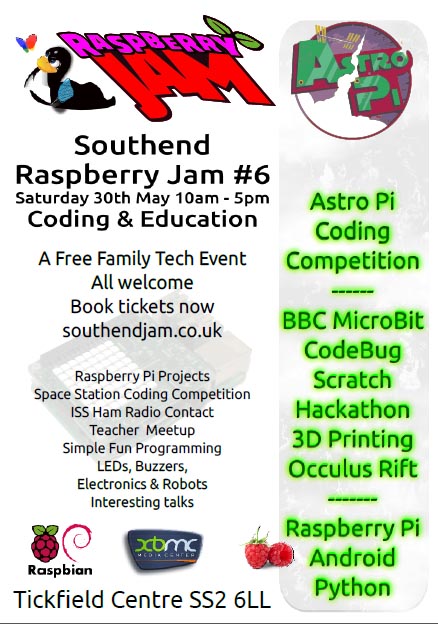
Southend Raspberry Jam 6The free Southend Raspberry Jam #6 event on May 30 will feature amateur radio and the International Space Station (ISS).

Entrants and winners of the Astro Pi competition will discuss their entries, with a recap of the competition before doing the coding later on.

Successful Astro Pi entries will be sent into space in November 2015 with UK astronaut Tim Peake KG5BVI who will run them on a Raspberry Pi computer on board the ISS.

In late 2015 and 2016 UK astronaut Tim Peake KG5BVI will be talking to UK schools direct from the ISS using amateur radio.

Organised by the Southend-on-Sea Linux User Group (http://soslug.org) this Raspberry Pi event takes place on Saturday, May 30 from 10:00 to 17:00 BST at the Tickfield Centre, Tickfield Avenue, Southend-on-Sea, SS2 6LL.

Among the many activities are:
• Hackathon: Scratch GPIO Electronics
• Talk: How Raspberry Pi changed my life Programming, Robots, and a successful Kickstarter by the age of 14
• Workshop: Learn to program real Apps for your own Android phone using Blockly and App Inventor
• Talk: Life Box A fantastic project, with lots of pretty LEDs, which models population growth in an environment
• Hackathon: Learn to program Minecraft, AstroPi and other hardware
• Talk: Object Orientated Programming

Free tickets and further information are available from http://southendjam.co.uk/

Download a Southend Raspberry Jam leaflet here

Astronaut Tim Peake KG5BVI issues challenge for UK students to “make that call”
https://amsat-uk.org/2015/03/20/tim-peake-uk-students/

Send your code into space with astronaut Tim Peake KG5BVI
https://amsat-uk.org/2014/12/10/send-your-code-into-space/

Astro Pi: Your Code In Space http://astro-pi.org/

Sarah Brightman – Space Flight Postponed

Sarah Brightman Space Flight Training February 2015

Sarah Brightman Space Flight Training February 2015

Sarah Brightman announced Wednesday, May 13, 2015 that she is postponing her plans to launch aboard the upcoming Soyuz TMA-18M spaceflight mission expected for September.

Ms. Brightman said that for personal family reasons her intentions have had to change and she is postponing her cosmonaut training and flight plans at this time. She would like to express her extreme gratitude to Roscosmos, Energia, GCTC (Gagarin Cosmonaut Training Center), Star City, NASA and all the cosmonauts and astronauts, for their support during this exciting time in her life.

“Since 2012, Sarah has shared her story of a lifelong dream to fly to space. Her international fame as the world’s best-selling soprano has enabled her message to circle the globe, inspiring others to pursue their own dreams,” said Eric Anderson, Co-Founder and Chairman of Space Adventures, Ltd. “We’ve seen firsthand her dedication to every aspect of her spaceflight training and to date, has passed all of her training and medical tests. We applaud her determination and we’ll continue to support her as she pursues a future spaceflight opportunity.”

Danish Astronaut Andreas Mogensen KG5GCZ ‏@Astro_Andreas tweeted
Sad to lose a fantastic crew mate. Best of luck, Sarah

Youngest radio ham in Gujarat state

Sakshi Vagadia VU3EXP

Sakshi Vagadia VU3EXP

In 2012 St. Paul’s school student Sakshi Vagadia spoke to astronaut Sunita Williams KD5PLB as part of an ARISS school contact. Now, at 15, she has received her amateur radio licence VU3EXP.

Sakshi has just finished her 9th grade in St. Paul’s School, Rajkot and is the fourth member of her family to get an amateur licence. Her father is Rajesabhai Vagadia VU2EXP, her uncle Prakash Vagadia VU3PLJ and cousin Priyesa Vagadia VU3GLY.

Sunita Williams KD5PLB on the ISS

Sunita Williams KD5PLB on the ISS

A year after speaking to Sunita Williams KD5PLB via the ARISS school contact Sakshi was able to meet her in person when Sunita visited the Government Science College (GSC) in Ahmedabad.

Sakshi did her training at the Gujarat Institute of Amateur Radio in Gandhinagar and took her amateur radio examination on February 25, 2013 received her pass result on April 2, 2013. It took the Government of India (WPC Wing) over two years to issue her amateur radio licence which she  finally received on April 24, 2015.

Sakshi’s achievement was reported in the local press. See the article written in Gujarati at
http://www.divyabhaskar.co.in/news/SAU-RJK-smallest-ham-operator-of-rajkot-sakshi-vagadia-4982404-PHO.html

It can be difficult to get an amateur radio licence in India. The archaic licensing system appears to have changed little since the 1940’s and is plagued with bureaucracy. After passing the exam it can take 12-24 months for Government officials to process the licence application. Among the information required on an Indian licence application are things such as height, eye colour, occupation and details of your Father, although not your Mother. There are even police checks on the suitability of an applicant. There are some parts of the country where Government simply refuses to issue any amateur radio licences.

Indian Ham Radio Licensing http://www.qsl.net/vu2msy/Ham_Licencing_Info.htm

India seeks relaxation of red-tape provisions
http://www.southgatearc.org/news/2014/september/india_seeks_relaxation_of_red_tape_provisions.htm

2012 Sunita Williams KD5PLB ARISS school contact
http://www.southgatearc.org/news/november2012/excited_kids_go_on_space_talk_with_sunita.htm

ISS HamTV now transmitting on 2395 MHz

Samantha Cristoforetti IZ0UDF with ISS HamTV Transmitter

Astronaut Samantha Cristoforetti IZ0UDF with ISS Ham Video Transmitter

Friday, May 1, 2015 the Ham Video transmitter on board the Columbus module of the International Space Station was powered on and started transmitting in “Blank Transmission” (BT) mode.

HamTV Antennas at ARISS Telebridge Station IK1SLD in Casale Monferrato, Italy

HamTV Antennas at ARISS Telebridge Station IK1SLD in Casale Monferrato, Italy

In this mode, the transmitter is operated without camera. The digital TV signal is fully formatted, but the content of the video is black and the content of the audio is at zero level. From a technical perspective, the BT signal is all that is needed for testing and fine tuning ground stations.

The European network of chained ground stations is presently nearly complete. Six ground stations span the continent in “X”  formation. For each ascending pass over Europe, four stations provide about ten minutes of solid copy and the same is true for descending passes:

– Ascending passes: Lisbon (Portugal ==> Poitiers (France) ==> Casale Monferrato (North Italy ==> Kolo (Poland)
– Descending passes : Cork (Ireland) ==> Poitiers (France) ==> Casale Monferrato (North Italy ==> Matera (South Italy.

The chained ground stations are streaming the digital video to the BATC server (British Amateur Television Club). BATC set up a multiviewer page, accessible at:

http://www.batc.tv/iss/

The page shows all six streams from the chained  ground stations. Each view can be maximized to full screen and the audio of each stream can be set to level or muted.

International Space Station - Image Credit NASA

International Space Station – Image Credit NASA

Presently, active stations stream technical data provided by the software developed by Jean Pierre Courjaud F6DZP. Several data are most interesting to observe:
–    the “constellations”, which visualize the QPSK (quaternary PSK) modulated signal
–    the  digital Signal/Noise ratio = MER (dB) (Modulation Error Ratio)
–    the control LEDs that change from red to green on decoding the digital signal.

The Ham Video transmitter frequency is 2395 MHz and the symbol rate is 2.0 Ms/sec.
More information is available at:

http://www.ariss-eu.org/columbus.htm

The Ham Video transmitter will stay on as long as on board operations permit. When the ground stations will be operating reliably, the Ham Video transmitter will be used to enhance ARISS school contacts. Uplink will remain VHF audio only. This operational mode is dubbed ARISS Ham TV.

73,
Gaston Bertels – ON4WF
ARISS-Europe chairman

ARISS FSTV gallery http://www.spaceflightsoftware.com/ARISS_FSTV/

HamTV Transmitter in the ISS Columbus Module

HamTV Transmitter in the ISS Columbus Module