Slow Scan TV from the ISS this weekend

ISS SSTV image 9/12 received by Frank Heritage M0AEU at 19:21 UT on Dec 18, 2014

ISS SSTV image 4/12 received by Frank Heritage M0AEU at 19:21 UT on Dec 18, 2014

The Russian ARISS team members plan to activate the amateur radio Slow Scan TV (SSTV) experiment on 145.800 MHz FM from the International Space Station (ISS) during this weekend.

ISS SSTV image 9/12 received by Martin Ehrenfried G8JNJ using the SUWS WebSDR on Dec 18, 2014

ISS SSTV image 9/12 received by Martin Ehrenfried G8JNJ using the SUWS WebSDR on Dec 18, 2014

Continuous SSTV operation is planned from 1000 UT on Saturday, January 31 until 2130 UT on Sunday, February 1. It is expected that 12 different photos will be sent using the SSTV mode PD180 with 3 minute off periods between transmissions.

The equipment used will be the Kenwood D710 transceiver located in the Russian Service Module. It is thought the equipment may be producing about 25 watts output which should provide a very strong signal.

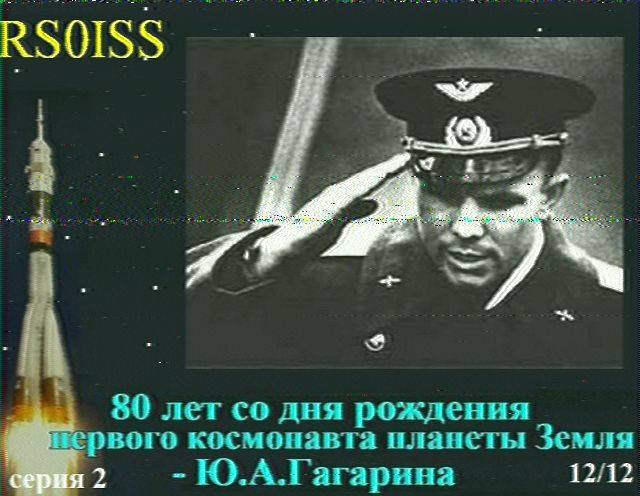
During the previous SSTV transmissions in December 2014, the photos celebrated the 80th anniversary of the birth of Yuri Gagarin, the first human to orbit Earth.

The images received by amateurs world-wide during those transmissions can be seen at http://www.spaceflightsoftware.com/ARISS_SSTV/

International Space Station - Image Credit NASA

International Space Station – Image Credit NASA

All you need to do to receive SSTV pictures direct from the space station is to connect the audio output of a scanner or amateur radio transceiver via a simple interface to the soundcard on a Windows PC or an Apple iOS device, and tune in to 145.800 MHz FM. You can even receive pictures by holding an iPhone next to the radio’s loudspeaker.

The ISS puts out a strong signal on 145.800 MHz FM and a 2m handheld with a 1/4 wave antenna will be enough to receive it. The FM transmission uses the 5 kHz deviation which is standard in much of the world.

Many FM rigs in the UK can be switched been wide and narrow deviation FM filters. For best results you should select the wider deviation filters. Handhelds all seem to have a single wide filter fitted as standard.

On Windows PC’s the free application MMSSTV can be used to decode the signal, on Apple iOS devices you can use the SSTV app for compatible modes. The ISS Fan Club website will show you when the space station is in range.
ISS SSTV image 12/12 received by Martin Ehrenfried G8JNJ using the SUWS WebSDR Dec 18, 2014

ISS SSTV image 12/12 received by Martin Ehrenfried G8JNJ using the SUWS WebSDR Dec 18, 2014

Paul Turner G4IJE, co-developer of the SSTV PD modes, says regarding the MMSSTV PD180 mode: “Don’t forget to either enable “Always show RX viewer” or use the “Picture viewer” (magnifying glass icon) to show the picture at its real resolution of 640 x 496. If you just view as normal you will only see 320 x 248 resolution, which kind of defeats the object of using a high resolution mode.”

On the AMSAT-BB Rick W2JAZ and Alan WA4SCA comment on the need to set the MMSSTV sound card setting to 48 kHz instead of the default 44.100 kHz
• Options
• Setup
• Misc
• Then the Clock section at the bottom of the page

The MMSSTV default setting may need to be set to 24000 (exactly half of the sound card setting). You then should get good clean images.

The sound card adjustments will vary slightly depending on the version of the OS you are running, but usually will be under the advanced properties for the device. You can probably use a higher sampling rate for the sound card so long as it is a power of 2 multiple (2,4,8, etc) of the value in MMSSTV. For instance, 192k (8x) has no issues. The same applies to most similar software.

You can receive the SSTV transmissions online using the SUWS WebSDR remote receiver located near London along with the MMSSTV software https://amsat-uk.org/2014/08/15/suws-websdr-moves-to-new-site/

ISS Fan Club – Tracking / Predictions http://www.issfanclub.com/

Free MMSSTV Slow Scan TV software http://hamsoft.ca/pages/mmsstv.php

iOS SSTV App https://itunes.apple.com/gb/app/sstv/id387910013

For more on Slow Scan Television SSTV, see this article SSTV – The Basics
http://www.essexham.co.uk/sstv-the-basics

How to be successful with the ISS Slow Scan Television (SSTV) imaging system
http://www.marexmg.org/fileshtml/howtoisssstv.html

IZ8BLY Vox Recoder, enables you to record the signals from the ISS on 145.800 MHz while you’re away at work http://antoninoporcino.xoom.it/VoxRecorder/

ARISS Slow Scan TV (SSTV) Blog and Gallery http://ariss-sstv.blogspot.co.uk/

Information on the MAI-75 SSTV experiment
http://www.energia.ru/eng/iss/researches/education-26.html

Video showing reception of SSTV using the FUNcube Dongle Pro SDR and SDR-RADIO going into Virtual Audio Cable (VAC) then to MMSSTV software https://www.youtube.com/watch?v=K6MOrX9iZCk

ISS SSTV received online with SUWS WebSDR
https://amsat-uk.org/2014/09/06/iss-sstv-on-suws-websdr/

ISS SSTV 1/12 received by Martin Ehrenfried G8JNJ using the SUWS WebSDR Dec 18, 2014

ISS SSTV 1/12 received by Martin Ehrenfried G8JNJ using the SUWS WebSDR Dec 18, 2014
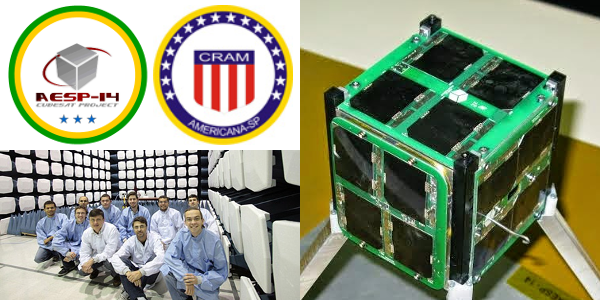
AESP-14 CubeSat deployed from ISS

AESP-14 CubeSat

AESP-14 CubeSat

The AESP-14 is a 1U CubeSat developed by undergraduate and graduate engineering students at the Technology Institute of Aeronautics (ITA) in Brazil. The satellite’s primary mission is to test the various subsystems in the space environment.

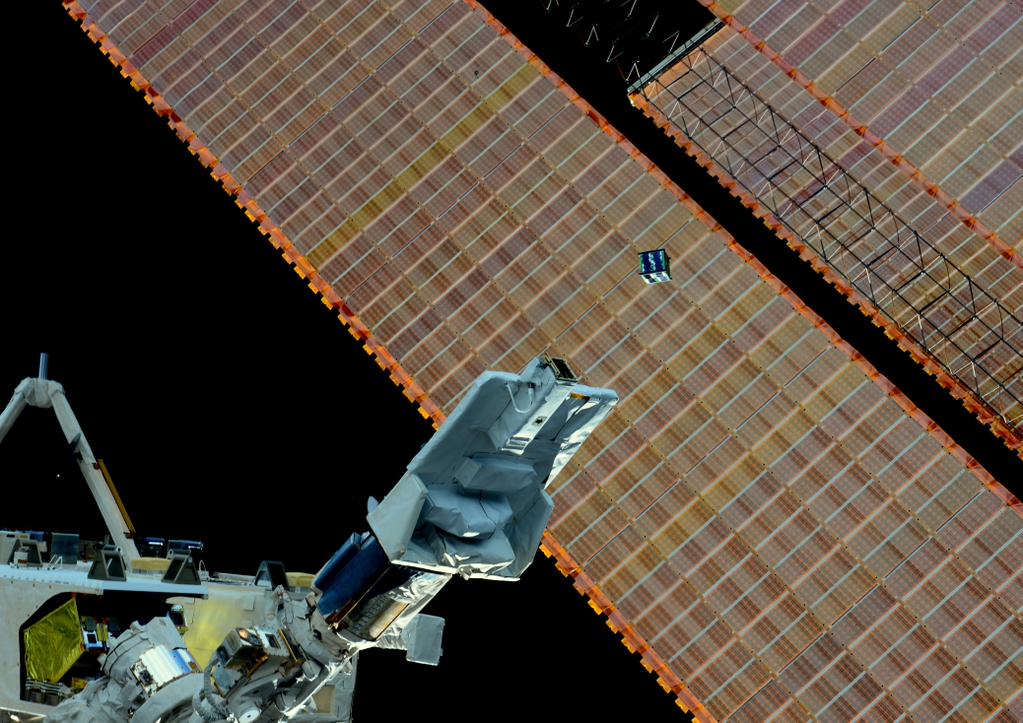
AESP-14 CubeSat released from ISS - Photo by Samantha Cristoforetti IZ0UDF

AESP-14 CubeSat released from ISS – Photo by Samantha Cristoforetti IZ0UDF

The satellite was sent to the International Space Station (ISS) as cargo on the SpaceX Falcon 9 mission CRS-5. Launch had been scheduled for December 16, 2014 but was postponed three times and it wasn’t until January 10, 2015 that the launch eventually took place. Since arriving at the ISS on January 12 AESP-14 has been awaiting deployment by the JEM Small Satellite Orbital Deployer (J-SSOD) which is in the Japanese Experimental Module, Kibo.

The deployment took place around 1250 UT on Thursday, February 5. The AESP-14 telemetry beacon has a power output of 500 mW and uses AX.25 with 9600 bps GMSK modulation (G3RUH standard) on 437.600 MHz. It should have started transmitting 30 minutes after deployment but as of February 11 nothing had been heard. It may be the battery did not survive several months without being recharged or the antenna may have failed to deploy.

AESP-14 CubeSat deployment from ISS - Image JAXA

AESP-14 CubeSat deployment from ISS – Image JAXA

The AESP-14 team would like to ask the help of radio amateurs around the world to forward any received telemetry frames back to the team. For this, please save the AX.25 frames in KISS format and forward the file to aesp14@ita.br

The satellite has an amateur radio experiment developed by the Americana Amateur Radio Club (CRAM). The experiment consists of the random transmission of 100 sequences of ASCII characters prefixed with the “CRAM” word that will used as part of a contest among receiving stations. The first 10 amateur radio stations that complete receiving the 100 sequences will be awarded a commemorative diploma. Further details at http://wabicafe.com.br/aesp14/cram.php

AESP-14 website http://www.aer.ita.br/~aesp14

Telemetry information sheet http://www.aer.ita.br/~aesp14/AESP-14Telemetry.pdf

AESP-14 CubeSat released from International Space Station
http://www.spaceflight101.com/iss-expedition-42-updates-february-2015.html

AMSAT-UK thanks Edson Pereira PY2SDR for this information.

UK’s Sarah Brightman starts space flight training

Private Spacefarer Sarah Brightman Undergoes Medical Tests

Private Spacefarer Sarah Brightman Undergoes Medical Tests

Sarah Brightman hopes to launch to the International Space Station (ISS) for a 10 day mission on September 1, 2015. If the launch were to take place as expected she would become the UK’s second astronaut, the first was Helen Sharman GB1MIR on May 18, 1991. Tim Peake KG5BVI is expected to launch in November 2015.

The TASS news agency reported that the UK’s Sarah Brightman will start training for her ISS mission in January 2015.

Sarah Brightman will train in Russia’s Star City. “She will arrive here on Wednesday, January 14, and will start her training the following day,” the press service of the space training facility told TASS. UPDATE: start of training was postponed until January 19.

Her flight is scheduled for September 1-11, 2015 and she is expected to spend 10 days at the ISS.

Sarah Brightman is paying $52 million for the flight considerably more than the $20 million that Iranian-American engineer Anousheh Ansari paid for her mission to the ISS in 2006, highlighting the dramatic escalation in launch charges in recent years.

Sarah Brightman - DreamchaserSarah started her singing career in the 1970’s and had hits such as “I Lost My Heart to a Starship Trooper” and “Love in a UFO”. She is now a classical crossover artist.

In 2012 in conjunction with Virgin Galactic, The Brightman STEM Scholarship program (science, technology, engineering, and mathematics) was launched to help young women in the US pursue STEM education across their four year college careers.

Her album, “Dreamchaser” was released on January 22, 2013. She said “I don’t think of myself as a dreamer. Rather, I am a dream chaser, I hope that I can encourage others to take inspiration from my journey both to chase down their own dreams and to help fulfill the important UNESCO mandate to promote peace and sustainable development on Earth and from space. I am determined that this journey can reach out to be a force for good, a catalyst for some of the dreams and aims of others that resonate with me.” She intends to become the first professional musician to sing from space.

It is not yet known if she will make any amateur radio contacts while on the ISS. In 1991 the first UK astronaut Helen Sharman was issued with a special callsign GB1MIR by the Radiocommunications Division of the Department of Trade and Industry (DTI). She was then able to contact radio amateurs on Earth during her stay on the MIR space station. The RSGB has reported that the UK communications regulator Ofcom will make the callsign GB1SS available for issue to UK astronauts who wish to operate from the ISS.

Read the TASS story at http://itar-tass.com/en/non-political/770688

You can sign up to receive updates on Sarah’s mission at http://www.sarahbrightman.com/

Wiki – Sarah Brightman http://en.wikipedia.org/wiki/Sarah_Brightman

Space Adventures http://www.spaceadventures.com/

International Space Station - Image Credit NASA

International Space Station – Image Credit NASA

Tweeting via the ISS

International Space Station - Image Credit NASA

International Space Station – Image Credit NASA

Harold Giddings KR0SIV describes how he Tweeted using amateur radio and the International Space Station.

He says: I sent a message to the International Space Station, it transmits it back down to groundstations in its view and those stations send the message to the APRS-IS network. My server then takes the message parses out useful data and posts it to Twitter as a tweet.

The ISS has two amateur radio stations. One is in the Russian Service Module and uses a Kenwood D710 and can do Slow Scan Television (SSTV) as well as FM voice. The other is in the Columbus Module and uses Ericsson handhelds for 145 and 435 MHz FM, the 2395 MHz HAM-TV system is also in this segment of the space station. In addition to voice contacts the 145 MHz Ericsson handheld is used to provide the APRS packet radio digipeater used by Harold.

Watch Twitter on the International Space Station

Ham Radio Tweets
http://hamradiotweets.com/
https://twitter.com/HamRadioTweets

How to hear the ISS https://amsat-uk.org/beginners/how-to-hear-the-iss/

How to work the ISS on APRS Packet Radio
https://amsat-uk.org/beginners/how-to-work-the-iss-on-aprs-packet-radio/

Russian ISS School Contacts

International Space Station - Image Credit NASA

International Space Station – Image Credit NASA

Both Dmitry Pashkov R4UAB and Michal Zawada SQ5KTM have released videos of ISS school contacts by cosmonaut Yelena Serov operating with the callsign RS0ISS which took place on Sunday, December 21, 2014.

Yelena Serova

Yelena Serova

The amateur radio station in the Russian Service Module was used and the Kenwood D710 operated on 145.800 MHz FM. The power setting used is not clear but may have been 25 watts. It is understood that ISS school contacts had been planned for Sunday with students at both Ekaterinburg and Chelyabinsk.

In his blog Dmitry Pashkov R4UAB said of the first Chelyabinsk contact: Radio session of the crew of the International Space Station with a children’s art school in Chelyabinsk. With great difficulty they contacted. Questions answered by Yelena Serov.

Watch the first Chelyabinsk contact ARISS RS0ISS г. Челябинск (R4UAB)

Watch the second Chelyabinsk contact – ARISS RS0ISS г. Челябинск (виток № 2) (R4UAB)

Michal Zawada SQ5KTM also received a signal from a school contact today and produced the following video.

Watch ISS / RS0ISS 21.12.2014 contact with Russian station R8AM(?)

Dmitry Pashkov R4UAB Blog http://tinyurl.com/R4UAB-Blog

ISS SSTV reception on a portable setup using RTL-SDR

Standing in a car park, I was able to successfully receive the images using a handheld 3 element 144 MHz Yagi antenna connected to a RTL-SDR USB dongle.

The dongle was connected to Windows-8 tablet using a USB OTG cable.
I was running SDR# to listen and record the FM audio on 145.800 MHz.
I had a LNA connected between the antenna and rtl-sdr but since the the downlink from the ISS was quite strong it was probably not required.

M0JJS

Watch ISS SSTV reception on a portable setup using RTL-SDR

ISS SSTV https://amsat-uk.org/2014/12/18/iss-sstv-success/