ISS Slow Scan TV on August 27

RS0ISS SSTV 20131029-1121Z received by Dmitry Pashkov UB4UAD

RS0ISS SSTV 20131029-1121Z received by Dmitry Pashkov then UB4UAD

A test of the Slow Scan Television (SSTV) experiment MAI-75, callsign RS0ISS, took place on the International Space Station (ISS) on Wednesday, August 27 between 1100-1300 GMT on 145.800 MHz FM. Although a strong carrier was heard there were no reports of SSTV tones being received.

The ARISS SSTV Blog Aug 27 says: The SSTV transmissions occurred on schedule and even occurred well after the planned termination time of 13:00 UTC (after 17:00 UTC). The new cable appears to have solved the constant carrier issue but now the audio from the program is not being transmitted. The end result for the day was no images but several well timed carriers that lasted for 180 seconds.

The ARISS SSTV Blog Aug 25 says: After a long hiatus due to hardware issues, the Russian team will try sending SSTV images on Aug 27 from 11:00-13:00 UTC using the Kenwood D710 and a new cable. The transmissions will be on 145.80 MHz and the intended mode is PD180. The interval between transmissions should be about 3 minutes. The images are being planned to be sent for one full orbit during this time period. Regions along the ground track include Europe, Central and Southeast Asia, Eastern Australia and New Zealand, Central South America and then Europe again.

Paul G4IJE, co-developer of the SSTV PD modes, says: If the ISS really does use PD180 mode as reported, don’t forget to either enable “Always show RX viewer” or use the “Picture viewer” (magnifying glass icon) to show the picture at it’s real resolution of 640 x 496. If you just view as normal you will only see 320 x 248 resolution, which kind of defeats the object of using a high resolution mode. Hopefully the image capture on the ISS is at high resolution.

Yuri Gagarin

Yuri Gagarin

A Google English translation of the ISS work plan says: “On Gagarin from Space”. Open gear with ISS RS by amateur radio link to ground receiving stations amateurs around the world images of photographs devoted to the life and work of the first cosmonaut Yuri Gagarin.

The Kenwood TM-D710 was delivered to the ISS in the summer of 2012. ARISS minutes for March 2013 note that: Sergey and the team did some tests including swapping antennas between the D-700 and the D-710, and with both configurations, there was a weak signal with the D-700. The power amplifier appears to be the problem. It seems only the exciter is working. Also, the D-710 has no mike since it was to be used with non-voice modes, and the mike for the D-700 has been modified and can’t be used with the D-710. We will work with our Russian colleagues to solve these issues.

The very strong carrier that was transmitted during the test on Wednesday, August 27 confirmed that the D-710 was radiating power successfully. Overheating issues (convection cooling doesn’t work in zero gravity) meant that the old D-700 transceiver was always run on the lowest power setting – 5 watts. It is presumed that a similar power level was used for the SSTV test.

All you need to do to receive SSTV pictures from the space station is to connected the audio output of a scanner or amateur rig via a simple interface to the soundcard on a Windows PC or an Apple iOS device, and tune in to 145.800 MHz FM. You can even receive pictures by holding an iPhone next to the radio’s loudspeaker.

The ISS puts out a strong signal on 145.800 MHz FM and a 2m handheld with a 1/4 wave antenna will be enough to receive it. The FM transmission uses 5 kHz deviation which is standard in much of the world.

Many FM rigs in the UK can be switched been wide and narrow deviation FM filters so select the wider deviation. Handhelds all seem to have a single wide filter fitted as standard.

Orbit for ISS SSTV on August 27, 2014 1100-1300 GMT

Orbit for ISS SSTV on August 27, 2014 1100-1300 GMT

On Windows PC’s the free application MMSSTV can be used to decode the signal, on Apple iOS devices you can use the SSTV app. The ISS Fan Club website will show you when the space station is in range.

Listen for the ISS SSTV transmissions online using the SUWS WebSDR, further details at https://amsat-uk.org/2014/08/15/suws-websdr-moves-to-new-site/

For more on Slow Scan Television SSTV, see this article SSTV – The Basics
http://www.essexham.co.uk/sstv-the-basics

How to be successful with the ISS Slow Scan Television (SSTV) imaging system
http://www.marexmg.org/fileshtml/howtoisssstv.html

Information on the MAI-75 SSTV experiment
http://www.energia.ru/eng/iss/researches/education-26.html

Free MMSSTV software http://hamsoft.ca/pages/mmsstv.php

iOS SSTV App https://itunes.apple.com/gb/app/sstv/id387910013

IZ8BLY Vox Recoder, enables you to record the signals from the ISS on 145.800 MHz while you’re away at work http://antoninoporcino.xoom.it/VoxRecorder/

ARISS Slow Scan TV (SSTV) Blog and Gallery http://ariss-sstv.blogspot.co.uk/

For real-time tracking and the latest status of amateur radio activity on the space station see the ISS Fan Club http://www.issfanclub.com/

Dmitry Pashkov R4UAB http://r4uab.ru/?p=7237

ISS Work Plan http://www.mcc.rsa.ru/plan.htm

Chasqui-1 deployment from ISS

Oleg Artemyev releases the Chasqui-1 CubeSat

Oleg Artemyev releases the Chasqui-1 CubeSat

On August 18, 2014 at 14:00 UT the Russia Cosmonauts on the International Space Station (ISS), Alexander Skvortsov and Oleg Artemyev, opened the hatches of the Pirs docking module and to start Extra Vehicular Activities (EVA).

Engineer Ing. Margarita Mondragon and Chasqui-1

Engineer Ing. Margarita Mondragon and Chasqui-1

One of their tasks was the deployment of the Peruvian satellite Chasqui-1, a research satellite designed to standard CubeSat dimension by the Peruvian National University of Engineering (Universidad Nacional de Ingenieria (UNI)) in collaboration with the Southwestern State University (SWSU) in Kursk.

Chasqui-1’s batteries were charged by the Russian Cosmonuats inside the ISS during August 14/15.The satellite was successfully deployed by Oleg Artemyev near the start of the EVA at 14:23 UT.

Chasqui-1 was developed with the intention of improving their satellite technology through the design and testing of a small satellite. Its facilities include two cameras, one in visible and the other in infra-red. Other facilities include communication in the amateur radio band and control systems for its power, thermal and embedded management of its components.

Peruvian CubeSat Chasqui-1

Peruvian CubeSat Chasqui-1

Chasqui-1 will provide a number of functions that include taking pictures of the Earth. From an academic perspective it will facilitate collaborations among various faculties and research centres of the university to train students and teachers with real world experience in satellites. It will also generate opportunities to work with other universities in the world which in turn will lead to technological advances in the aerospace industry of Peru.

The 437.025 MHz beacon (+/- 10 kHz Doppler shift) can transmit either 1200 bps AFSK AX.25 or 9600 bps GMSK. As of August 23 no signal from the beacon had been heard.

Chasqui-1 as a small dot against the Earth, seconds after Oleg Artemyev sent it spinning - Screenshot Jonathan McDowell

Chasqui-1 as a small dot against the Earth, seconds after Oleg Artemyev sent it spinning – Screenshot Jonathan McDowell

On August 19-20 there may be a relay of the Chasqui-1 signal transmitted from the ISS on 145.800 MHz FM using the callsign RS02S. This relay should provide a strong signal with reduced Doppler receivable even on handheld radios.

Listen for Chasqui-1 and the ISS online using the SUWS WebSDR, further details at
https://amsat-uk.org/2014/08/15/suws-websdr-moves-to-new-site/

Find out when you can hear the ISS and Chasqui-1 which is currently in close proximity at http://issfanclub.com/

Chasqui-1 http://www.chasqui.uni.edu.pe/eng.html

Facebook https://www.facebook.com/pages/Chasqui-1/253013641985

Twitter @chasqui1

R4UAB Chasqui-1 http://r4uab.ru/?p=7178

Watch Hand deployment from ISS of Peruvian satellite Chasqui-1

Online WebSDR for VHF Satellites

144 MHz prototype helix antenna

144 MHz prototype helix antenna

You can use the free online SUWS Web Software Defined Radio (WebSDR) from your PC or Laptop to receive the International Space Station (ISS) and the many amateur radio satellites transmitting in the 145.800 – 146.000 MHz band.

Martin Ehrenfried G8JNJ has equipped the SUWS WebSDR with omni-direction helix antennas for both 144 and 432 MHz which have proved effective for both high altitude balloon and satellite reception.

The SUWS WebSDR is located at Farnham not far from London, listen to it at http://websdr.suws.org.uk/

Martin says this about the special satellite antennas “I had been experimenting with single turn ‘twisted halo’ design, and decided to try stacking them to see if I could achieve more gain. Modelling suggested that a stretched 3 turn helix with a helix circumference of approx 1/2 wave length and an overall length of 1/2 wave at 70cm, and fed with a gamma match at the centre would offer reasonable gain, an omni-directional pattern and mixed polarisation.”

Full details of the antennas are available at
http://g8jnj.webs.com/currentprojects.htm

WebSDR for 144, 432, 1296 and 10368 MHz
https://amsat-uk.org/2013/12/28/websdr-for-434-and-1296-mhz/

ARISS contact planned with ESA Space Camp, Fleetwood, UK

International Space Station - Image Credit NASA

International Space Station – Image Credit NASA

ARISS educational radio contact is planned with ESA Space Camp, Rossall School, Fleetwood, UK. The event is scheduled for Tuesday, July 29 at 14:01:13 UT . It will be a telebridge contact operated by W6SRJ in California.

A video from the event will be webcast at http://www.batc.tv/streams/arissuk/

International_Space_StationThe contact will be broadcast on EchoLink AMSAT (node 101 377) and JK1ZRW (node 277 208) Conference servers, as well as on IRLP Discovery Reflector 9010.

This annual camp is organized by the ESA Space Camp Committee takes place in a different European country each summer for 2 weeks. This year the camp takes place between 27 July and 10 August where 185 young space explorers aged 8 to 17 will meet each other in the UK at Rossall School. The children come from the following ESA establishments (UK, France, Spain, Italy, The Netherlands and Germany).

This will be the 20th Space Camp organised by ESA. This year the children will also be involved in celebrating this milestone with marking 50 years of ESA. Children, their parents and educators from the area will join the ESA campers on this special celebration day.
Rossall is a boarding school situated on a beautiful 160-acre site, there is plenty of room for extensive sports and cultural facilities, including a swimming pool, squash and tennis courts, as well as a fitness room and a climbing wall.

International Space Station ISS with shuttle Endeavour 2011-05-23The ESC 2014 programme will feature a balanced mix of sports such as flag rugby, lifeguarding, kayaking and martial arts. The theme for camp will be ‘Reach for the Stars!’ Well-equipped IT labs, classrooms and an on-site planetarium will be instrumental in setting up a space education programme that will keep the children motivated with new and exciting hands-on activities and educational tasks involving space-related themes, as well as learning about the culture of the host country.

As with all ESA Space Camps, there will be specific emphasis placed on socialisation and respect among the participants. We hope to make the camp a really unique experience for juniors and teenagers who are in the process of becoming citizens of a multicultural society.
This ARISS contact will mark a highlight in the space education programme as children will be learning about many aspects related to man’s endeavours to reach for the stars!

Students will ask as many of following questions as time allows:
1. Zachary (12): What has been your biggest challenge since being in space?
2. Noemi (11): On Earth bubbles in sparkling water (or cola) float upwards, but in the ISS, there is no up and down. Which direction do the bubbles go in sparkling water (or cola) on the ISS?
3. Kai (9): If you could change one thing on the ISS, what would it be?
4. Caroline (8): How do you sleep and for how long?
5. Lisann (10): Do you need sunscreen in space?
6. Nassim (8): Why do we have plenty of oxygen on earth, but not enough in space?
7. Auriane (10): Do you see time passing by in space? Do you have the same feeling of time duration (days & nights)?
8. William Baker (12): Can you give us an example of some added safety procedures or precautions you must take in doing everyday tasks while on the ISS?
9. Eduardo García (8): Why is there no oxygen outside the ISS?
10. Sonia ERNST: How long does it take to go around our planet?
11. Damien (9): What were your last thoughts when leaving earth?
12. Tristan (8): How do you keep your clothes clean on the Space Station with so little water?
13. Marie (8): Are there any seasons on the ISS?
14. Emil (8): What do you do for fun on the ISS?
15. Charles (13): I have been fascinated by the film “Gravity”. How realistic is the film? Is space crowded by debris and therefore so dangerous?
16. Roxane (10): How many switches are there inside the spacecraft, and do you know what all of them do?
17. Andrew (13): Is it highly stressful to be in space?
18. Ella (9): How do you have a bath when the water goes everywhere?
19. Benjamin (11): How do you dispose of the waste?
20. Luca (13): How are medical surgeries done in space if a specialized doctor is not available?
21. Lena (11): How is it in the ISS, when you arrive the first time? Was the journey comfortable?
22. Giulio (10): What would you like to achieve that you haven’t yet?
23. Eveline (9): I’ve been practicing various types of sports the last years, and now I still do judo. What sports can you practice in the International Space Station, a weightless environment?

ARISS is an international educational outreach program partnering the participating space agencies, NASA, Russian Space Agency, ESA, CNES, JAXA, and CSA, with the AMSAT and IARU organizations from participating countries.

ARISS offers an opportunity for students to experience the excitement of Amateur Radio by talking directly with crewmembers onboard the International Space Station. Teachers, parents and communities see, first hand, how Amateur Radio and crewmembers on ISS can energize youngsters’ interest in science, technology and learning.

73,

Gaston Bertels, ON4WF
Chair ARISS Europe
http://www.ariss-eu.org/

ARISS http://www.ariss.org/

ISS Active for National Field Day

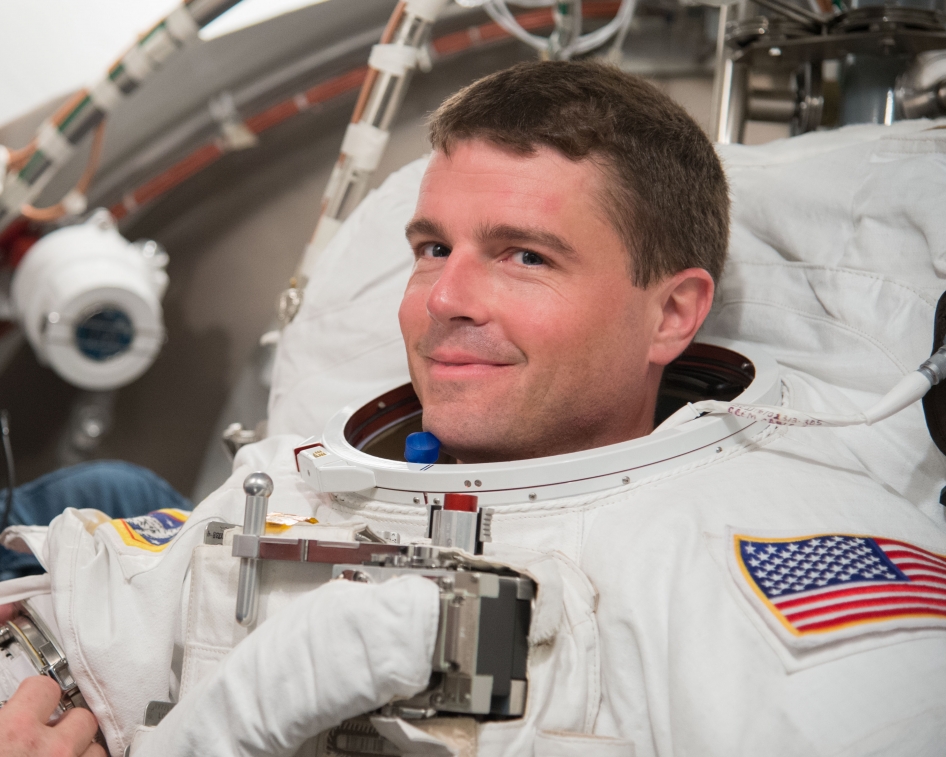
Reid Wiseman KF5LKT - Image credit NASA

Reid Wiseman KF5LKT – Image credit NASA

Patrick ‏Stoddard WD9EWK has released a video showing the participation of the International Space Station (ISS) in the ARRL Field Day (June 28-29).

His description reads:

NASA astronaut Reid Wiseman KF5LKT, operating as NA1SS from the International Space Station during the 2014 ARRL Field Day on Saturday, June 28, 2014, at 1815-1822 UT.

After announcements of possible participation of the ISS amateur radio station in the 2014 ARRL Field Day, it was nice to hear Reid on the radio. Among the stations making contact with NA1SS on this pass, I was able to make a brief contact as the ISS was about to go over Arizona.

The WD9EWK station used for this contact, and to record the NA1SS audio, was an Icom IC-2820H 2m/70cm FM mobile transceiver, transmitting at 5W into an Elk Antennas handheld 2m/70cm log periodic antenna. The radio was powered by a 12V/26Ah jumpstart battery.

Watch NA1SS in ARRL Field Day – 28 June 2014, 1815-1822 UT

ISS Fan Club http://issfanclub.com/

Since arriving on the International Space Station on May 29, 2014 astronaut Reid Wiseman KF5LKT has been active on Twitter as well as amateur radio. The Washington Post newspaper reports on the stunning images he has been tweeting from space, read the story at
http://www.washingtonpost.com/blogs/innovations/wp/2014/07/01/39-reminders-why-this-astronaut-won-twitter-in-june/

Reid Wiseman KF5LKT on Twitter @astro_reid

In-Person Meeting for ARISS International

International Space Station - Image Credit NASA

International Space Station – Image Credit NASA

The ARRL report representatives of the Amateur Radio on the International Space Station (ARISS) International partners met in person last month for the first time in 2-1/2 years to reassess the program’s direction and to consider new objectives.

The European Space Agency (ESA) hosted the April 3-5 gathering at its European Space Research and Technology Centre (ESTEC) in The Netherlands. ARISS International Secretary-Treasurer Rosalie White, K1STO, represented the ARRL at the sessions. ARISS International Chair and AMSAT-NA Vice President for Human Spaceflight Programs Frank Bauer, KA3HDO, presided.

Former ESA astronaut Gerhard Thiele, DG1KIL, welcomed the representatives. Thiele, who heads ESA’s Human Spaceflight and Operations Strategic Planning and Outreach office, told the gathering that ESA recognizes the benefit to students of being able to communicate with the ISS crew directly via Amateur Radio, and that students learn a lot as a result of these ARISS contacts.

ARISS Amateur Radio on the International Space Station

ARISS Amateur Radio on the International Space Station

In a wide-ranging presentation, ARISS International Project Selection & Use Committee representative Lou McFadin, W5DID, addressed long-term equipment possibilities. Among other requirements, McFadin said, ARISS should have the ability to control its equipment from Earth, and he said that developing software-defined equipment would permit this. He also spoke of the need for an “override power switch,” as the astronauts need to shut down ARISS equipment during safety-critical events such as spacecraft dockings or spacewalks. Given the paucity of space aboard the ISS, ARISS also must minimize the amount of real estate its equipment occupies, McFadin said. He also noted that there is “little or no” ISS crew time to address ISS ham gear issues.

McFadin further discussed the advantages of installing a mobile VHF/UHF transceiver in the Columbus module that has higher power capabilities, similar to the Kenwood D-700 located in the Service Module. In recent months crew members have been using a 5 W Ericsson hand-held transceiver for school contacts, and signal levels have been lower than the team would prefer. McFadin suggested that a portable mobile system with a power output of 15 W or greater might improve this situation.

Read the full ARRL story at
http://www.arrl.org/news/ariss-international-partners-regroup-at-first-in-person-meeting-since-2011

ARISS ESTEC meeting minutes and committee reports http://www.ariss.org/meeting-minutes.html