Video of ISS Ham Radio contact with WISH students

International Space Station Flight Engineer Joe Acaba KE5DAR used amateur radio to speak with high school students participating in a summer program called Women in STEM High School Aerospace Scholars, or WISH.

The students, selected from across the country, were attending briefings and engaging in competitive hands-on engineering activities related to space exploration and research.

Watch Joe Acaba Speaks with WISH Students

WISH – Encouraging science, technology, engineering and mathematics http://www.uk.amsat.org/8495

ARISS contact with STEM High School Aerospace Scholars, Houston, TX
http://www.southgatearc.org/news/july2012/ariss_event_1007.htm

NASA WISH Press release http://www.nasa.gov/home/hqnews/2012/jun/HQ_12-209_WISH.html

Amateur Radio on the International Space Station (ARISS) http://ariss.rac.ca/

Three Radio Hams Scheduled to Head to ISS This Weekend

Akihiko Hoshide KE5DNI, Yuri Malenchenko RK3DUP and Sunita Williams KD5PLB

ARRL report that NASA will televise the launch and docking of the next mission to the International Space Station (ISS), scheduled for 8:40 PM (CDT) Saturday, July 14 (0140 UT, Sunday, July 15).

NASA Flight Engineer Sunita Williams, KD5PLB, along with Russian cosmonaut Yuri Malenchenko, RK3DUP, and Japan Aerospace Exploration Agency astronaut Akihiko Hoshide, KE5DNI, are completing preparations as they undergo their final Soyuz spacecraft fit. Live NASA TV coverage of the Soyuz TMA-05M spacecraft launch from the Baikonur Cosmodrome in Kazakhstan begins at 8:30 PM CDT on Saturday, July 14 (0130 UT July 15).

The trio will arrive at the station on July 16, joining NASA Flight Engineer Joe Acaba, KE5DAR, and two Russian cosmonauts: Expedition 32 Commander Gennady Padalka, RN3DT, and Flight Engineer Sergei Revin, RN3BS. Acaba, Padalka and Revin have been aboard the ISS since mid-May. Williams, Malenchenko and Hoshide — who also will be part of the Expedition 33 crew starting in September — will return to Earth in mid-November. Source ARRL

NASA TV’s scheduled coverage is available at,
http://www.arrl.org/news/three-hams-scheduled-to-head-to-iss-this-weekend

Soyuz FG Rocket with the Soyuz TMA-05M Spacecraft – Roscosmos

F-1 CubeSat on TV

The Vietnamese TV station VTV1 broadcast a news story about the amateur radio CubeSat F-1, callsign XV1VN, due to be launched to the International Space Station (ISS) on July 21.

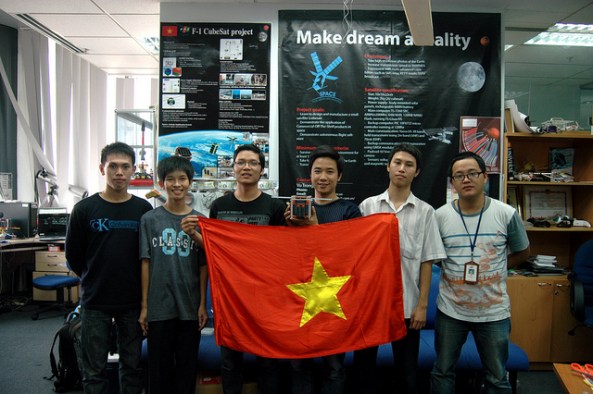
The broadcast shows students from the FPT University in Hanoi who are involved in the project and has an interview with Thu Trong Vu XV9AA.

F-1 carries a low-resolution camera (640×480), a 3-axis magnetometer and two Yaesu VX-3R transceivers using 145.980 and 437.485 MHz.

It is planned to launch to the ISS on July 21 in the HTV-3 cargo vessel and be deployed in September by Japanese astronaut Akihiko Hoshide KE5DNI using the ISS Kibo robot arm.


Watch CubeSat F-1 on VTV1

For the latest news on F-1 see the FSpace website http://fspace.edu.vn/

Video depicting F-1 CubeSat XV1VN deployment from the ISS http://www.uk.amsat.org/?p=8446

Vietnam Student CubeSat F-1 http://www.uk.amsat.org/?p=5025

Amateur Radio TV and CW Beacons for ISS

The minutes of the ARISS International Monthly Teleconference for June 19 carry this report on the status of the amateur radio equipment for the ISS Columbus module.

Kenneth [N5VHO] reported that an onboard power issue somewhat impacted ARISS radio operations. The air purifier for the ATV [Automated Transfer Vehicle] has needed to be plugged in, recently, in the Service Module (SM). The ARISS radio in the SM was turned off while the purifier was being used. The radio is turned on by the crew for school contacts and when the crew gets on the air for random contacts, as Astronaut Kuipers has done in the past few weeks. The ATV will be docked at the ISS until late September.

Gaston [ON4WF] said the HamTV project is progressing. There have been discussions with ESA about the possibility of adding extra units to the HamTV transmitter that is being developed by Kaiser Italia. This is acceptable in as far as the KI unit under construction does not need to be modified.

A so called “Video Beacon” will be added externally to the HamTV unit. This beacon will allow automated DATV transmissions more or less permanently. The content of these DATV transmissions will be uploaded from the ground through existing channels and transferred to the Video Beacon on request. This function will also be used for educational purposes. Moreover, astronauts could record footage and load it into the Video Beacon for automated transmission.

Another additional unit will be a CW beacon transmitter delivering a small band low power signal (100 mW) on a frequency nearby the HamTV frequency. This beacon will transmit permanently and use the second ARISS L/S-band antenna. This offers ground stations signal reception with large S/N margins, facilitating antenna tracking and signal acquisition, especially at the beginning of a pass. The CW Beacon will transmit telegraphy signals, alternating its identification (call sign), a continuous carrier and possibly some telemetry comprizing onboard parameters (temperature, pressure, humidity, ambient sound level, etc.).

Lou W5DID suggested that we may be able to power it from the packet module already on the ISS, making it simple to operate.

ESA is being asked to address the cost of the Safety Package and testing such as EMI tests and outgassing tests for these additional units, but development and manufacturing will be supported by ARISS. A cost estimate is being developed for our team to build the units. A funding campaign will be set up to collect donations to cover the cost.

Amateur Radio on the International Space Station (ARISS) http://ariss.rac.ca/

// < ![CDATA[
//

Encouraging Science, Technology, Engineering and Mathematics

First US Woman Astronuat Sally Ride on STS-7 - Image Credit NASA

The Women in STEM High School Aerospace Scholars  (WISH) project is sponsoring two six-day summer camps for rising high school seniors that should feature a presentation by astronaut Shannon Walker KD5DXB and an Amateur Radio contact with the International Space Station (ISS).

Eighty-four female high school students from 29 states will plan a simulated mission to Mars and experience life as an engineer or scientist when NASA’s Johnson Space Center in Houston hosts two events focused on science, technology, engineering and mathematics (STEM) in June and July.

Shannon Walker KD5DXB - Image Credit NASA

The young women will work in teams with female NASA mentors to develop mission plans for launching to Mars, living and working there, and integrating the many components necessary for a successful planetary mission. They will work within the confines of a fictitious budget and build several small mockups of vehicles to demonstrate a successful launch and landing of the Mars spacecraft.

“WISH gives some of our brightest future innovators a chance to experience some of the exciting challenges that NASA engineers and scientists face on a daily basis,” said Johnson Deputy Director and four-time space shuttle astronaut Ellen Ochoa KB5TZZ. “It shows the young women that there are a variety of opportunities for them in technical fields.”

Young women participating June 24-29 will hear a first-hand account of life in space from NASA astronaut and radio amateur Shannon Walker KD5DXB. Participants July 8-13 will have a chance to speak with a current space station astronaut via ham radio as part of the Amateur Radio on the International Space Station program, a NASA educational initiative that facilitates direct links between students and astronauts.

The young women were selected based on completion of interactive, online lessons focused on space exploration and mapped to national education standards, academic merits and geographic diversity. The WISH program encourages young women to pursue science, technology, engineering and mathematics degrees and exposes them to the real-world applications of STEM careers at NASA. This program is in its second year. It began as a NASA accompaniment to the White House Council on Women and Girls.

For more information about WISH and a list of student participants, visit:
http://www.nasa.gov/audience/foreducators/teachingfromspace/students/wish.html

WISH: Women in STEM High School Aerospace Scholars http://www.wish.aerospacescholars.org/

Source NASA http://www.nasa.gov/home/hqnews/2012/jun/HQ_12-209_WISH.html

Amateur Radio on the International Space Station ARISS http://ariss.rac.ca/

Hey, kids! Send your stuff into orbit

International Space Station

Wanna do some space science? You no longer have to be a professional researcher, or even a grown-up, to get your experiment into orbit.

MSNBC reports that a new program called DreamUp is offering slots on the International Space Station’s experimental racks to school groups for as little as $15,500 a pop, and you can use credit-card reward points to help cover the cost.

“We are committed to lowering the barriers for entry to space research,” Jeffrey Manber, managing director of NanoRacks, said in a news release announcing the program. “This is a double win. This first-of-its-kind student experiment donation platform will help create a world-class experience for students.”

Read the full MSNBC story at http://cosmiclog.msnbc.msn.com/_news/2012/06/15/12245222-hey-kids-send-your-stuff-into-orbit