Astronaut’s Flashing Success

Blue Laser Flash seen from ISS

Light (top center) flashed from the Lozano Observatory, about 40 miles north of San Antonio, was easily visible from orbit. Click on the image to see it full-sized.

Radio amateur and ISS astronaut Don Pettit KD5MDT describes how he succeeded in receiving signals on a frequency of 650 THz.

Flashing the International Space Station with beams of light as it passes overhead had never been successfully done—until now.

It sounds deceptively easy. In an earlier post I wrote about the technical requirements. But like so many other tasks, it becomes much more involved in the execution than in the planning.

Early Sunday morning, at 01:27 our time, the San Antonio Astronomical Association, an amateur astronomy group, succeeded in flashing space station with a one-watt blue laser and a white spot light as we passed overhead. This took a number of engineering calculations. Projected beam diameters (assuming the propagation of a Gaussian wave for the laser) and intensity at the target had to be calculated. Tracking space station’s path as it streaked across the sky was another challenge. I used email to communicate with Robert Reeves, one of the association’s members. Considering that it takes a day, maybe more, for a simple exchange of messages (on space station we receive email drops two to three times a day), the whole event took weeks to plan.

I was ready with cameras for the early morning San Antonio pass and can report that it was a flashing success. Here’s one of the pictures to prove it.

Don Pettit KD5MDT

Telebridge station ON4ISS in Belgium will call OR4ISS at approximately 13:11 UTC.

 Planned ISS contact Tuesday, March 6, 2012 13.11 UTC

The questions are asked by children who won the Ruimteschip Aarde (Spaceship Earth) competition. In this competition André Kuipers challenged them to turn their class room into a spaceship and to think very good about what they and their class mates needed to survive in space for a very long time. They showed their results in videos. In some of the questions the children refer to inventions they made for this competition, such as the Poep Brandstof Generator (Poop fuel generator, Q4) and the Geur Vergeet Geheugen Machine (a machine that makes it possible to smell forgotten scents from earth, Q6)
Hello Andre, this is Jasper Wamsteker of the Netherlands Space Office and the Ruimteschip Aarde project. I am here together with the proud winners of the first special mission of Ruimteschip Aarde. I see a lot of delighted and excited faces around me. The children here have a lot of questions for you, but first I have a question myself.
1. We can hear you, but we cannot see you. Please could you describe to us where you are at the moment?
2. Will it ever be possible that children go on al long space trip? Or would this be too dangerous for the growth and the strength of their bones and organs?
3. If you eat salt in space, does it affect your bone density?
4. For the competition we designed a PBG (Poop Fuel Generator). Poop is converted into fuel and thus used for relocation in space by the principle of action=reaction. Do you think the PBG can ever be made and used by astronauts on a space mission that takes several years?
5. How long can you survive in space in case no new provisions are brought?
6. For the competition we came up with the idea of the GVGM (Forgotten Scents Remembrance Machine). This helps you to smell and remember smells from earth. Which 3 scents would you like the GVGM to be able to reproduce?
7. You do a lot of experiments in the ISS. Which one has your preference?
8. Did you ever came up with an idea for an experiment yourself, that you would like to conduct in space?
9. What do you do in case the oxygen falls out?
10. Now that you are in space, do you read a science fiction novel there, or is that not necessary anymore?
11. Is there an experiment that you would like to conduct, but which you cannot do because of lack of time?
12. Is there a game that you and your fellow astronauts play together in your free time?
13. When you were launched, did you feel the high speed of the rocket?
14. Can you imagine what it would be like to be so far away that it is not possible anymore to see earth?
15. You travel to the ISS in a very small capsule. How can you take all your clothes with you?
16. Is there a device which can be used in the ISS, that you would like to be made?
17. What effects on your body do you experience now that you are in space?
18. Would you like to live in space forever together with your friends and family?
19. Do you ever have stomach ache as a result of lack of gravity?

Radio Hams send photo via satellite

ARISSat-1 Deployment

ARISSat-1 Deployment

The Cincinnati press reports that two Anderson Township amateur radio operators recently sent and received a photo from a satellite that was manually deployed from the International Space Station (ISS).

Farrell Winder W8ZCF and his son Jeff Winder KB8VCO achieved this despite the fact that an antenna on the satellite had snapped off prior to launch.

Read the Cincinnati press article at http://communitypress.cincinnati.com/apps/pbcs.dll/article?AID=/C2/20120301/NEWS/303010057/

ISS Astronaut Active on 145.800 MHz

André Kuipers PI9ISS on ISS

André Kuipers PI9ISS on the ISS

Astronaut André Kuipers PI9ISS was calling CQ from the International Space Station on 145.800 MHz FM on both Saturday and Sunday afternoon, Feb. 25-26.

Paul Waddington M6WAD

Paul Waddington M6WAD and son Ethan

André worked mainly Dutch stations although one UK Foundation holder Paul Waddington M6WAD was lucky enough to have a contact with him on Sunday.

Paul says “I am absolutely thrilled to have had a QSO with the ISS. I just thought I would put out a random call, as I have done so many times in the past, and he answered me. I must say, when he did reply, I became a little tongue tied in disbelief!!! I use a Yaesu FT7900 to a Comet GP-15N Triband antenna.”

When the astronauts work other radio amateurs back on Earth they transmit on 145.800 MHz FM but operate “split” listening for replies 600 kHz lower on 145.200 MHz. If you are lucky and hear them calling CQ just remember to activate your rigs repeater shift to ensure you reply on the correct frequency. You should never transmit on 145.800 MHz.

The amateur rado station on the ISS runs QRP, just 5 watts of FM to an omni-directional antenna. Despite the low power it is a strong signal and can easily be received on a handheld radio with quarter wave whip.

Get the latest status of the space station at the ISS Fan Club http://www.issfanclub.com/

Read ‘Listening to the International Space Station’ http://www.uk.amsat.org/3491

M6WAD http://www.qrz.com/db/M6WAD

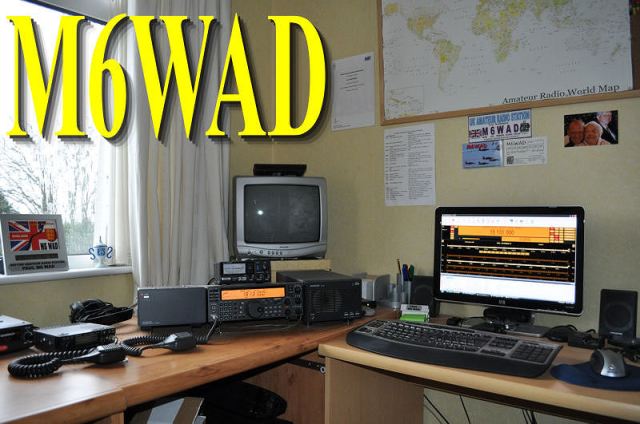
M6WAD Station

M6WAD Station

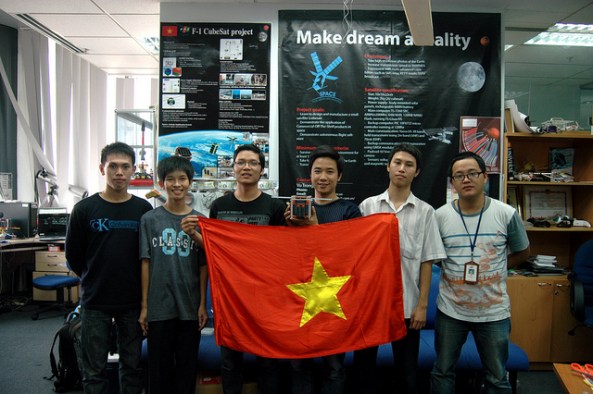
Vietnam Student CubeSat F-1

Vietnamese students have produced a video about their amateur radio CubeSat F-1, callsign XV1VN.

The F-1 is an educational CubeSat to be launched in the summer of 2012. It will carry a low resolution C328 camera with 640×480 resolution and two Yaesu VX-3R transceivers using 145.980 and 437.485 MHz.

•VX-3R1
–Frequency: 437.485MHz, FM Narrow
–Power supply: directly from solar cells, only operates in sunlight
–Output power: max 0.3W, half-wave dipole antenna
–Modulation scheme: Morse code beacon (10 chars) using PWM CW
–Beacon interval: every 30 seconds (configurable)

•VX-3R2
–Frequency: 145.980MHz , FM Narrow
–Power supply: rechargeable battery, operates in the dark by default but can be commanded to operate in sunlight as well
–Output power: max 1.0W, half-wave dipole antenna
–Modulation scheme: AFSK 1200bps, half duplex
–Telemetry interval: one AX.25 packet every 30 seconds (configurable)

Watch F-1 picosatellite project – FSpace laboratory

F-1 CubeSat Blog on Facebook https://www.facebook.com/groups/116436068290/

Gunter’s Space Page lists F-1 on the HTV-3 launch to the ISS on July 18, 2012.

Send your name/callsign and a message into space on the F-1 CubeSat! http://fspace.edu.vn/?page_id=31

Vietnam F-1 CubeSat on Facebook http://www.facebook.com/group.php?gid=116436068290

FSpace Laboratory http://fspace.edu.vn/

TechEdSat to use ‘SatPhone’

TechEdSat

TechEdSat

TechEdSat will be deployed from the International Space Station (ISS). It is a 1U CubeSat that will demonstrate Plug and Play power architecture and two way communication via the satellite phone/data networks Iridium and Orbcomm.

UPDATE: The plan to transmit from space using frequencies allocated to Iridium and Orbcomm SatPhone ground stations has been canceled. A statement from the team says: “We were forced to disable the Iridium modem as our FCC license did not come in time. As usual, building the satellite is the easy part.”

There will be a 437.465 MHz beacon transmitting 1 watt to 1/4 wave monopole. Commanding is via the commercial networks and there is a 2 week watchdog timer to stop the beacon in the event of no commands being received.

TechEdSat will be launched along with Raiko, FITSat-1, We-Wish and F-1 to the ISS aboard HTV-3, currently planned to launch July 18, 2012. From there, it will be deployed into Low Earth Orbit  using the JAXA J-SSOD deployer, from the Japanese Experiment Module (JEM also known as Kibo).

Wiki – TechEdSat http://en.wikipedia.org/wiki/TechEdSat

Kibo Robot Arm http://kibo.jaxa.jp/en/about/kibo/rms/

ISS Amateur Radio CubeSat Deployment October 4 http://www.uk.amsat.org/?p=10119

Watch the deployment live at http://www.ustream.tv/nasahdtv

IARU Amateur Satellite Frequency Coordination pages hosted by AMSAT-UK http://www.amsat.org.uk/iaru