ISS repeater remaining on until after Field Day

Amateur Radio on the International Space Station (ARISS) logoThe International Space Station crossband FM repeater should remain active until after the Field Day weekend of June 26-27.
Amateur Radio on the International Space Station (ARISS) has decided to keep its ARISS InterOperable Radio System (IORS) in crossband repeater mode until after ARRL Field Day ends. The IORS ham station is located in the Columbus Module of the International Space Station.

ARRL HQ Contest Program Manager Paul Bourque, N1SFE, has confirmed that successful radio contacts made through the ARISS IORS, in crossband repeater mode, will count for an ARRL Field Day QSO point, but also for Field Day bonus points! Another fun opportunity for points. Don’t forget the rule limiting stations to 1 QSO per any single channel FM satellite.

On-orbit astronauts always have very busy schedules, but if a voice contact were to be made with them, it would count for QSO credit but not for satellite bonus points. Only an ARISS crossband repeater QSO qualifies for the bonus. Crossband repeater contacts are also valid for AMSAT Field Day for satellite operations, held concurrently with the ARRL event.

Frequencies for ARISS crossband repeater operation are as follows: 145.990 MHz up, 67 Hz tone and 437.800 MHz down. If you haven’t used the ISS repeater yet, be sure to practice with it before Field Day (June 26-27, 2021). These contacts can be tricky, but hams can practice right now…can you do it?

ARISS had planned a mode switch to APRS packet during the second week of June. Now, ARISS is targeting the switch by the astronauts to packet after the first ARISS school contact following ARRL Field Day. In more news for ARISS supporters: the astronauts will power down the ARISS radio station during USA spacewalks on June 16 and June 20, 2021.

ARISS – Celebrating 20 Years of Amateur Radio Continuous Operations on the ISS
https://ariss.org/

ISS SSTV 145.800 FM June 9-10  

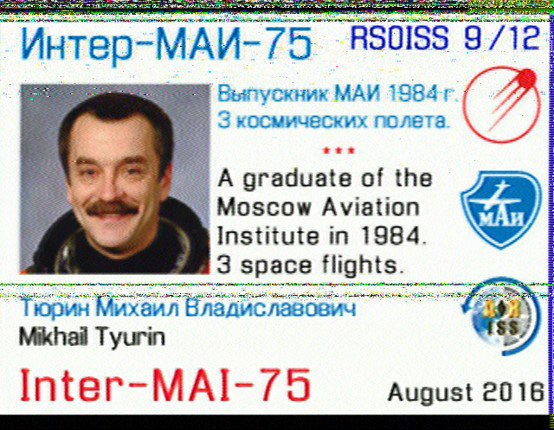
ISS SSTV MAI-75 image 9/12 received by Chertsey Radio Club on Baofeng handheld

ISS SSTV MAI-75 image 9/12 received by Chertsey Radio Club on Baofeng handheld

Russian cosmonauts on the International Space Station (ISS) are planning to transmit Slow Scan TV images on 145.800 MHz FM using the SSTV mode PD-120.

The transmissions are part of the Moscow Aviation Institute SSTV experiment (MAI-75) and will be made from the amateur radio station RS0ISS in the Russian Service module of the ISS using a Kenwood TM-D710 transceiver.

June 09, 2021 (Wednesday) from 09:35 GMT until 13:50 GMT*

June 10, 2021 (Thursday) from 08:55 GMT until 15:50 GMT*

*Dates and times subject to change.

The signal should be receivable on a handheld with a 1/4 wave whip. If your rig has selectable FM filters try the wider filter for 25 kHz channel spacing.

You can get predictions for the ISS pass times at https://www.amsat.org/track/

ARISS SSTV Blog https://ariss-sstv.blogspot.com/

Useful SSTV info and links https://amsat-uk.org/beginners/iss-sstv/

Amateur radio satellites deploy March 14

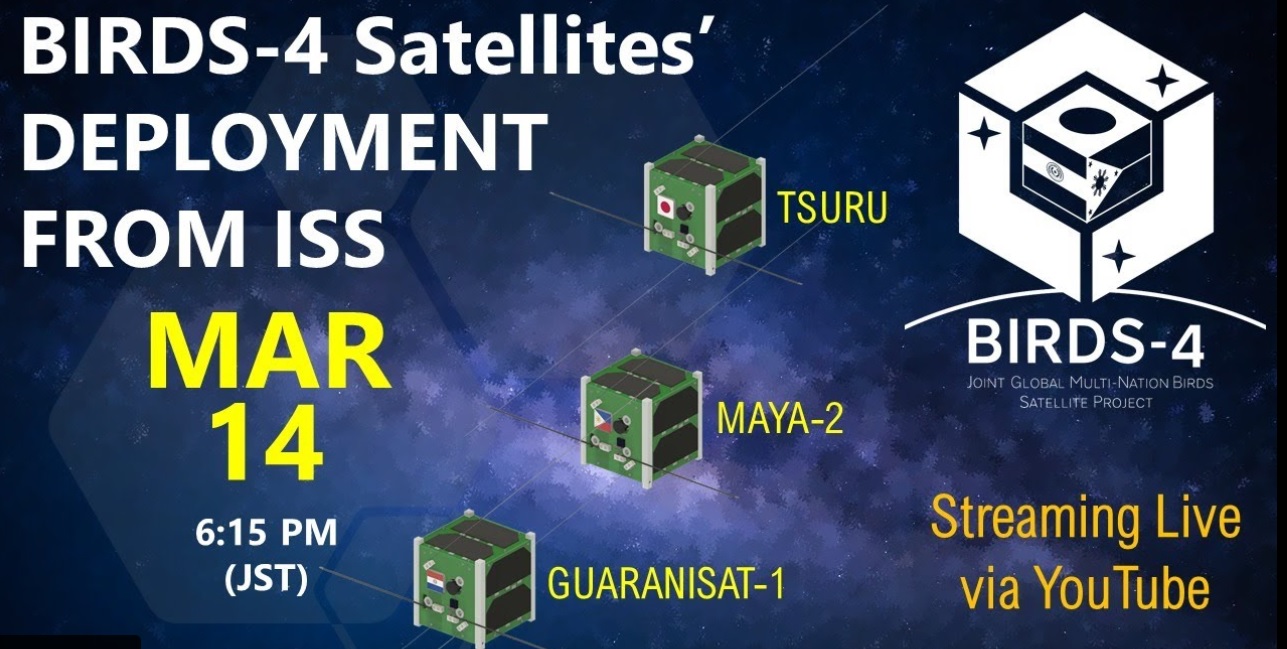
BIRDS-4 Satellite DeploymentEight satellites, all coordinated by the IARU Satellite Frequency Coordination Panel, are planned to be deployed from the International Space Station on Sunday, March 14.

ISS CubeSat deployment on March 14, 2021 - image by astronaut Soichi Noguchi KD5TVP

ISS CubeSat deployment on March 14, 2021 – image by astronaut Soichi Noguchi KD5TVP

The deployment should be streamed live on YouTube, watch from 09:15 GMT [UPDATE deployment now expected after 10:30 GMT]
https://www.youtube.com/watch?v=vLltILh8SLw

The CubeSats being deployed are:
• OPUSAT-II
• GuaraniSat‑1 (BIRDS‑4)
• Maya‑2 (BIRDS‑4)
• Tsuru (BIRDS‑4)
• RSP-01
• WARP-01
• TAUSAT‑1
• STARS-EC

It is understood the BIRDS-4 satellites are carrying digipeaters and TAUSAT‑1 has an FM transponder. Further information including the IARU coordinated frequencies are at http://amsat.org.uk/iaru/


ISS SSTV 145.800 FM Jan 28-29

ISS SSTV MAI-75 image 9/12 received by Chertsey Radio Club on Baofeng handheld

ISS SSTV MAI-75 image 9/12 received by Chertsey Radio Club on Baofeng handheld

Russian cosmonauts on the International Space Station (ISS) are planning to transmit Slow Scan TV images on 145.800 MHz FM using the SSTV mode PD-120.

The transmissions are part of the Moscow Aviation Institute SSTV experiment (MAI-75) and will be made from the amateur radio station RS0ISS in the Russian Service module of the ISS.

Jan 28 – Starts after 12:10 GMT and ends at 17:15 GMT*

Jan 29 – Start about 13:10 GMT and ends at 18:05 GMT*

*Dates and times subject to change.

ARISS SSTV Blog https://ariss-sstv.blogspot.com/

Useful SSTV info and links https://amsat-uk.org/beginners/iss-sstv/

ISS Slow Scan TV event 145.800 MHz FM

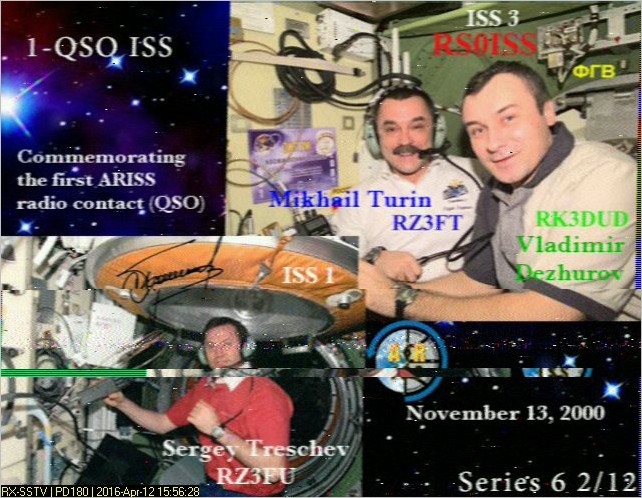
ISS SSTV image received by Mike Rupprecht DK3WN April 12, 2016 at 1556 UT

ISS SSTV image received by Mike Rupprecht DK3WN April 12, 2016 at 1556 UT

An ARISS Slow Scan TV (SSTV) event is scheduled from the International Space Station (ISS) for December 24-31.

This will be a special SSTV event to celebrate the 20th anniversary of ARISS operations on the ISS.

The event is scheduled to begin on December 24 from 16:40 GMT and continue until December 31 ending at 18:15 GMT. Dates and times subject to change due to ISS operational adjustments.

Images will be transmitted on 145.800 MHz FM +/- 3 kHz Doppler shift and the expected SSTV mode of operation is PD 120.

If your radio has selectable FM filters then for best results try selecting the wider filter designed for 25 kHz channel spacing.

ARISS SSTV Blog http://ariss-sstv.blogspot.com/

Post and view images on the ARISS SSTV Gallery https://www.spaceflightsoftware.com/ARISS_SSTV/

ARISS SSTV Award: After your image is posted at the gallery, you can acquire a special award by linking to https://ariss.pzk.org.pl/sstv/ and follow directions for submitting a digital copy of your received image.

ISS SSTV info and links https://amsat-uk.org/beginners/iss-sstv

Amateur Radio on the International Space Station (ARISS) https://www.ariss.org/

Athlone students to contact ISS

Shannon Walker KD5DXB

Shannon Walker KD5DXB

An ARISS educational school contact is planned between astronaut Shannon Walker KD5DXB on the International Space Station and students at Athlone Community College, Athlone, Co. Westmeath.

The contact is scheduled on Monday, December 7, 2020, at approximately 2:50 PM (1450 GMT, 1550 CET) with the link to the ISS operated by the amateur radio ground station EI1ISS.

The ISS FM downlink signal will be audible across the British Isles and Europe on 145.800 MHz +/-3.5 kHz Doppler shift. Those who do not have an amateur radio receiver or are in a different part of the world will still be able to receive the signal from space by using either of these online WebSDR radios:
Goonhilly: https://vhf-goonhilly.batc.org.uk/
Farnham: http://farnham-sdr.com/
Click on the FM mode button, and enter 145800 into the “kHz” frequency box.

It is understood the event will also be live streamed, for URL check https://twitter.com/ACCspacecall

Shannon Walker was selected by NASA to be an astronaut in 2004. She holds a Bachelor of Arts degree in Physics, a Master of Science and a Doctorate of Philosophy in Space Physics from Rice University. Walker began her professional career at the Johnson Space Center (JSC) in 1987 as a Robotics Flight Controller for the Space Shuttle Program. In 2010, she served as Flight Engineer for Expedition 24/25, a long-duration mission aboard the International Space Station that lasted 163 days. Walker served as mission specialist on the Crew-1 SpaceX Crew Dragon, named Resilience, which launched November 15, 2020. She is currently serving as Flight Engineer on the International Space Station for Expedition 64.

Athlone Community College information:

Athlone, situated in the centre of Ireland, is the largest town on the River Shannon.  Athlone Community College is a second-level school which has 1200 students aged between 12 and 18 from a diverse range of backgrounds, both rural and urban.

Our school motto is “by teaching we learn”. Mathematics, Science and Engineering subjects occupy a special place in the school curriculum. The school’s staff and teachers are proudly committed to students fulfilling their potential in a welcoming and friendly environment.

The school has an active sporting programme which includes Rugby Football, Gaelic Football, Athletics and Golf while the Arts are catered for by a school Orchestra and Choir.

Our students have enjoyed studying the ISS and the space programme. We really appreciate the crew fitting our school into their busy schedule. Thank you! It will be a memorable experience for us all here.

Students First Names and Questions:

1. Roisín (16):  Did you enjoy the launch into space?

2. Tristan (16):  Tell us something about current experiments on the ISS?

3. Seán (14):  What is your favourite area in the ISS?

4. Shauna (16):  What activities do you do in your spare time?

5. Cillian (12):  What is the most interesting thing you have seen on Earth from the space station?

6. Michelle (16):  What evidence of climate change can you see from space?

7. John (16):  How many years of training does it take to become an astronaut?

8. Patrick (16):  Where does the ISS get its energy from?

9. Zayna (16):  What happens if you are in a space suit and your nose becomes really itchy?

10. Kian (16):  When you return home what will you miss most about the ISS?

11. Roisín (16):  What was the most difficult challenge you had to overcome during training?

12. Tristan (16):  When you first saw the earth from space what was your reaction?

13. Seán (14):  Has something useful on earth come from space experiments?

14. Shauna (16):  Are your muscles weak when you return from micro gravity?

15. Cillian (12):  If there was a manned mission to Mars would you consider going?

16. Michelle (16):  Will it ever be feasible to travel to another solar system?

17. John (16):  How do you keep fit with the low gravity in space?

18. Patrick (16) Does your sense of taste and smell change in space?

19. Zanyna (16):  While on the ISS are you able to communicate with family?

20. Kian (16):  When did you decide you wanted to become an astronaut – from a young age or did your interest develop at a later age?

Athlone Community College
http://www.athlonecc.ie/athlone-community-college-link-international-space-station/
https://www.facebook.com/1545707655495475/photos/a.1545729618826612/3626284060771147
https://twitter.com/ccathlone

About ARISS:

Amateur Radio on the International Space Station (ARISS) is a cooperative venture of international amateur radio societies and the space agencies that support the International Space Station (ISS). In the United States, sponsors are the Radio Amateur Satellite Corporation (AMSAT), the American Radio Relay League (ARRL), the ISS National  National Aeronautics and Space Administration (NASA).

The primary goal of ARISS is to promote exploration of science, technology, engineering, the arts and mathematics by organizing scheduled contacts via amateur radio between crew members aboard the ISS and students. Before and during these radio contacts, students, educators, parents, and communities learn about space, space technologies, and amateur radio. For more information, see https://www.ariss.org/