Flabob Airport students talk to Space Station

NASA astronaut Don Pettit KD5MDT

NASA astronaut Don Pettit KD5MDT

It was 13 months of preparation for 10 minutes of conversation – but what a conversation!

On Thursday morning, a select group of students from the Flabob Airport Preparatory Academy spent about 10 minutes on an amateur radio teleconference call with the International Space Station, asking astronaut Donald Pettit KD5MDT a variety of questions about his duties and the effects of prolonged weightlessness on the human body.

Press-Enterprise report:

“My heart was just pounding,” said Brittany Cain, a 17-year-old junior at the school. “It was just amazing to be able to ask the question. But I was so nervous, I can’t remember his answer.”

The contact was made possible by Clint Bradford K6LCS an amateur radio operator and the liaison between NASA, the school and amateur radio. Bradford worked with NASA to get Thursday’s call approved.

“Our hope is that through this experience the students will keep questioning and keep looking skyward,” Bradford said. “They should never stop asking questions about space.”

Bradford also made the connection to amateur radio operator Claudio Ariotti IK1SLD who connected to the space station as it passed over Italy. The radio feed was sent to Flabob by telephone.

Read the full Press-Enterprise story at
http://www.pe.com/local-news/local-news-headlines/20120419-jurupa-valley-students-question-real-life-rocket-man.ece

Watch Flabob-ARISS – BEFORE the Contact

Watch the Press-Enterprise video of the contact

NASA sets date for Flabob Airport ARISS contact
http://www.southgatearc.org/news/april2012/nasa_sets_date_for_flabob_airport_ariss_contact.htm

Amateur Radio on the International Space Station (ARISS) http://ariss.rac.ca/

CubeSats: good things come in small packages

CubeSats may be small but they have big ambitions. Credit: Aalborg University

CubeSats may be small but they have big ambitions. Credit: Aalborg University

By Ben Gilliland
For the vast majority of Earth’s history it had but one satellite – the Moon – but that all changed in 1957 when, on October 4, the Soviet Union launched the first artificial satellite into Earth’s orbit.Sputnik-1 was a 58cm (23 inch) sphere that contained two 1-watt radio transmitters and three batteries (two for powering the radios and one to power a cooling fan). The 83kg aluminum sphere emitted radio signals that were transmitted back to Earth via four 2.4m-2.9m “whip” antenna.

Its radio did little more than beep at Earth, but its signal was picked up by amateur “ham radio” enthusiasts all over the world.

In many ways, Sputnik was not just the world’s first satellite, it was also the first “people’s satellite” – anyone with suitable radio equipment could listen to the plucky little satellite as, for 22 days, it whizzed around the globe at 29,000km/h (18,000mph).

Sputnik-1 kick-started the space race and the satellite industry, but was really little more than a transmitter that beeped. Credit: NASA

Sputnik-1 kick-started the space race and the satellite industry, but was really little more than a transmitter that beeped. Credit: NASA

America’s first satellite was even smaller. Launched on January 31, 1958, and weighing in at just 14kg, Explorer-1 boasted several scientific instruments including a cosmic ray detector, five temperature sensors and micrometeor detectors.But satellites didn’t stay small, simple and accessible for very long.

As they increased in complexity, so they increased in size. From the size of a beach ball, satellites were soon the size of a family cars, then buses and (in the case of the International Space Station) the size of a football field.

With increased size and complexity came increased costs.
It can take a decade and hundreds of millions of pounds to develop an Earth observation satellite – but that is just the tip of the financial iceberg. Launching a satellite weighing several tonnes into orbit can cost between £30million and £250million ($50million to $400million) and just paying for the radio bandwidth needed to get your information back to Earth can cost up to £1million ($1.6million) a year. That’s not taking into account the cost of ground operations and maintenance of the satellite.

Continue reading

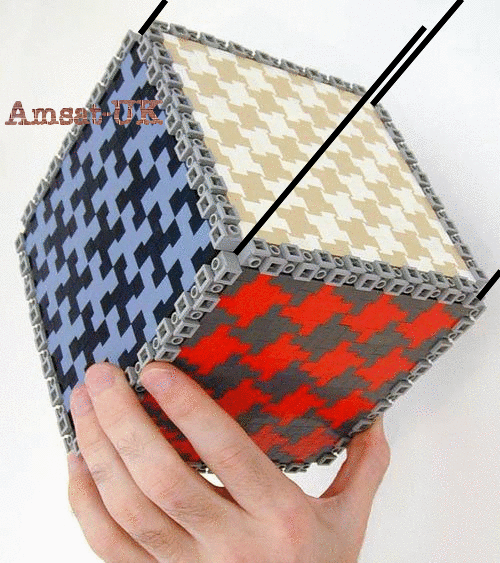
Lego™ 1U Cubesat,launch confirmed April 2012

Lego ™ first 1U Cubesat

In a little under a weeks time Lego-1 is due to make history by being the first 1U cubesat to be made from 40% lego,a team from ogel universtiy hope to be the first
team to have a cubesat in orbit, made by the 1940’s building blocks.

Mr Smith, the team leader says “The glue used to construct Lego-1 has been tested
by  NASA” after a little more questioning we was told the compound is ‘top secret’
but we managed to see a tube of it on the way into the clean room. ‘Polymerization of methyl-2-cyanoacrylate’ holds this cubesat together,incasing all the electronics, including a mode V beacon, and an impressive Linear Transponder (Inverting).

Uplink 435.2000-435.2600
Downlink 145.9200-TBD

Lego-1 is due to launch on the English built ‘yadslooflirpa’ Rocket in April this year,all final checks are now complete and  finger crossed, be the first lego built Cubesat in orbit’ A full in-depth article is due to be officially released on the 3rd of April 2012.

Steve from Ogel university comments “We are all looking forward to the launch,I worked on the solar-sail as part of my Masters degree,after this project I hope to release my new concept,a ‘1R’  a round cubesat, it’s a little bigger than a tennis ball”

GoodLuck with your round cubesat Steve!

Telemetry software will become available within the next few days,Lego-1 also hopes to become the first cubesat to allow amateur radio operators to tweet messages direct to the Cubesat, for them to be rebroadcasted via a 5w beacon. ( @lego-1 )

For more information please contact Rob, m0tfo@amsat.org

Download a photo of the team behind the Lego Cubesat

[wpdm_file id=3]

Don’t forget you can give a kind donation towards the FUNcube Launch Fund http://tinyurl.com/czfcro4

O/OREOS Mission: “Cost effective” CubeSat science


Astrobiology magazine posts a piece on the success of NASA’s O/OREOS mission that points out that serious science can be accomplished by tiny spacecraft:

‘The full success of the O/OREOS mission demonstrates convincingly that cubesats can be cost-effective platforms for performing science research and conducting technology demonstrations,’ said Mary Voytek, senior scientist of NASA’s Astrobiology Program at NASA Headquarters, in a statement from NASA. ‘The capabilities of cubesats are growing steadily, making them good candidates to operate precursor experiments for missions on larger satellites, the International Space Station, lunar surface exposure facilities, and planetary exploration.’

O/OREOS monitored the effects of the space environment on microorganism growth and metabolism in a high-inclination, low-Earth orbit.

Wayne

Image credit: NASA Ames

O/OREOS Mission: "Cost effective" CubeSat science


Astrobiology magazine posts a piece on the success of NASA’s O/OREOS mission that points out that serious science can be accomplished by tiny spacecraft:

‘The full success of the O/OREOS mission demonstrates convincingly that cubesats can be cost-effective platforms for performing science research and conducting technology demonstrations,’ said Mary Voytek, senior scientist of NASA’s Astrobiology Program at NASA Headquarters, in a statement from NASA. ‘The capabilities of cubesats are growing steadily, making them good candidates to operate precursor experiments for missions on larger satellites, the International Space Station, lunar surface exposure facilities, and planetary exploration.’

O/OREOS monitored the effects of the space environment on microorganism growth and metabolism in a high-inclination, low-Earth orbit.

Wayne

Image credit: NASA Ames

Space Shuttle Solid Rocket Booster Video

From the upcoming Special Edition Ascent: Commemorating Space Shuttle DVD/BluRay a movie from the point of view of the Solid Rocket Booster with sound mixing and enhancement done by the folks at Skywalker Sound.

Watch Riding the Booster with enhanced sound