New Horizons Stamp Drive

New Horizons stamp concept by Dan Durda

New Horizons stamp concept by Dan Durda

As fast as NASA’s New Horizons spacecraft is heading toward Pluto, the drive to honor this historic exploration of the ninth planet is speeding toward its finish. Less than a week remains to put your name on the petition supporting an effort for the U.S. Postal Service to commemorate Pluto and New Horizons on a postage stamp.

In just over a month since the drive was announced, more than 10,000 people have signed the online petition. But mission leads would like to have many more signatures before they close out the list on March 13 – the 82nd anniversary of the announcement of Pluto’s discovery by American astronomer Clyde Tombaugh.

Read the full story at http://pluto.jhuapl.edu/news_center/news/20120307.php

You can sign the petition at http://www.change.org/petitions/usps-honor-new-horizons-and-the-exploration-of-pluto-with-a-usps-stamp

1st Interplanetary CubeSat Workshop

The 1st Interplanetary CubeSat Workshop takes place in Cambridge, Massachusetts, 29-30 May, 2012

iCubeSat, the Interplanetary CubeSat Workshop, will address the technical challenges, opportunities, and practicalities of space exploration with CubeSats.

The workshop will provide a unique environment for open practical collaboration between academic researchers, industry professionals, policy makers, and students developing this new and rapidly growing field.

Talks and round tables will focus on three themes: technology, science, and open collaboration.

Keynote speakers

Technology: Mason Peck, NASA, Chief Technologist

Science: Sara Seager KB1WTW, MIT, Professor of Physics and Planetary Science

The program will also include unconference sessions to provide additional opportunities to engage with the interplanetary CubeSat community and potential collaborators. Talks and supporting material will be streamed and posted on the conference website. A lively social program in and around summertime Boston will be arranged for participants and their guests.

Further information on the event website – http://icubesat.wordpress.com/

NASA Announces Third Round Of CubeSat Space Mission Candidates

Roland Coelho WH7BE Research Associate at California Polytechnic State University, San Luis Obispo, with a CubeSat - Image Credit NASA

Roland Coelho WH7BE Research Associate at California Polytechnic State University, San Luis Obispo, with a CubeSat - Image Credit NASA

NASA has selected 33 small satellites to fly as auxiliary payloads aboard rockets planned to launch in 2013 and 2014. The proposed CubeSats come from universities across the country, the Radio Amateur Satellite Corporation, NASA field centers and Department of Defense organizations.

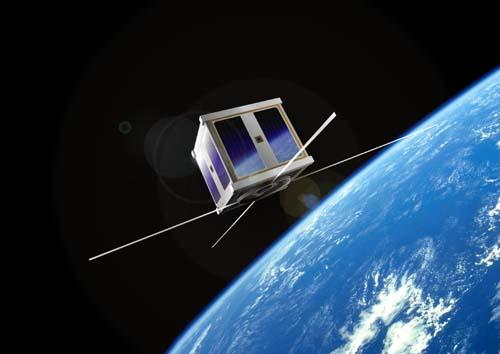
CubeSats are a class of research spacecraft called nanosatellites. The cube-shaped satellites are approximately 10 cm long, have a volume of about one litre and weigh less than 1.3 kg.

The selections are from the third round of the CubeSat Launch Initiative. After launch, the satellites will conduct technology demonstrations, educational research or science missions. The selected spacecraft are eligible for flight after final negotiations and an opportunity for flight becomes available. The satellites come from the following organizations:

— Air Force Institute of Technology, Wright-Patterson AFB, Ohio
— Air Force Research Lab, Wright-Patterson AFB
— California Polytechnic State University, San Luis Obispo
— Cornell University, Ithaca, N.Y.
— Massachusetts Institute of Technology, Cambridge
— Montana State University, Bozeman
— Naval Postgraduate School, Monterey, Calif. (2 CubeSats)
— NASA’s Ames Research Center, Moffett Field, Calif.
— NASA’s Goddard Space Flight Center, Greenbelt, Md.
— NASA’s Jet Propulsion Laboratory, in partnership with the California Institute of Technology, Pasadena (2 CubeSats)
— NASA’s Kennedy Space Center, Cape Canaveral, Fla.
The Radio Amateur Satellite Corporation, Silver Spring, Md.
— Saint Louis University, St. Louis
— Salish Kootenai College, Pablo, Mont.
— Space and Missile Defense Command, Huntsville, Ala. (2 CubeSats)
— Taylor University, Upland, Ind.
— University of Alabama, Huntsville
— University of California, Berkeley
— University of Colorado, Boulder (2 CubeSats)
— University of Hawaii, Manoa (3 CubeSats)
— University of Illinois, Urbana (2 CubeSats)
— University of Michigan, Ann Arbor
— University of North Dakota, Grand Forks, N.D.
— University of Texas, Austin
— US Air Force Academy, Colorado Springs, Colo.
— Virginia Tech University, Blacksburg

Thirty-two CubeSat missions have been selected for launch in the previous two rounds of the CubeSat Launch Initiative. Eight CubeSat missions have been launched (including five selected via the CubeSat Launch Initiative) to date via the agency’s Launch Services Program Educational Launch of Nanosatellite, or ELaNa, program.

For additional information on NASA’s CubeSat Launch Initiative program, visit: http://go.usa.gov/Qbf

For information about NASA and agency programs, visit: http://www.nasa.gov/

Source NASA

AMSAT Fox-1 Amateur Radio CubeSat selected for NASA ELaNa launch collaboration http://www.uk.amsat.org/4558

Software Defined Radio (SDR) Testbed for ISS

ISS SCaN Testbed

NASA Glenn Research engineers prepare the SCaN Testbed flight system hardware in Vacuum Facility 6 for rigorous thermal-vacuum testing. Image Credit: NASA

New and improved ways for future space travelers to communicate will be tested on the International Space Station after a launch later this year from Japan. The SCaN Testbed, or Space Communications and Navigation Testbed, was designed and built at NASA’s Glenn Research Center over the last three years.

The SCaN Testbed will provide an orbiting laboratory on space station for the development of Software Defined Radio (SDR) technology. These systems will allow researchers to conduct a suite of experiments over the next several years, enabling the advancement of a new generation of space communications.

The testbed will be the first space hardware to provide an experimental laboratory to demonstrate many new capabilities, including new communications, networking and navigation techniques that utilize Software Defined Radio technology. The SCaN Testbed includes three such radio devices, each with different capabilities. These devices will be used by researchers to advance this technology over the Testbed’s five year planned life in orbit.

“A Software Defined Radio is purposely reconfigured during its lifetime, which makes it unique,” says Diane Cifani Malarik, project manager for the SCaN Testbed. This is made possible by software changes that are sent to the device, allowing scientists to use it for a multitude of functions, some of which might not be known before launch. Traditional radio devices cannot be upgraded after launch.

By developing these devices, future space missions will be able to return more scientific information, because new software loads can add new functions or accommodate changing mission needs. New software loads can change the radio’s behavior to allow communication with later missions that may use different signals or data formats.

The SCaN Testbed is a complex space laboratory, comprised of three SDRs, each with unique capabilities aimed at advancing different aspects of the technology. Two SDRs were developed under cooperative agreements with General Dynamics and Harris Corp., and the third was developed by NASA’s Jet Propulsion Laboratory (JPL), Pasadena, Calif. JPL also provided the five-antenna system on the exterior of the testbed, used to communicate with NASA’s orbiting communications relay satellites and NASA ground stations across the United States.

NASA’s Goddard Space Flight Center, Greenbelt, Md., developed communications software that resides on the JPL SDR.

Glenn led the design, development, integration, test and evaluation effort and provided all the facilities needed to fabricate, assemble and test the SCaN Testbed, including a flight machine shop, large thermal/vacuum chamber, electromagnetic interference testing with reverberant capabilities, a large clean room and multiple antenna ranges, including one inside the clean room.

Glenn also will be the hub of mission operations for the SCaN Testbed, with high-speed ties to NASA’s Marshall Space Flight Center, Huntsville, Ala., for real-time command and telemetry interfaces with space station. NASA Johnson Space Center’s White Sands Test Facility, Las Cruces, N.M., and Goddard’s Wallops Flight Facility, Wallops Island, Va., will provide Space Network and Near Earth Network communications.

The SCaN Testbed will launch to space station on Japanese Aerospace Exploration Agency’s H-IIB Transfer Vehicle (HTV-3) and be installed by extravehicular robotics to the ExPRESS Logistics Carrier-3 on the exterior truss of space station.

The SCaN Testbed will join other NASA network components to help build capabilities for a new generation of space communications for human exploration.

Source NASA

AMSAT Fox-1 CubeSat selected for NASA ELaNa launch collaboration

AMSAT FOX

AMSAT FOX

Project ELaNa, NASA’s ‘Educational Launch of NanoSat’ managed by the  Launch Services Program at the Kennedy Space Center, announced on February 10 that the AMSAT Fox-1 CubeSat has been selected to join the program.

NASA will work with AMSAT in a collaborative agreement where NASA  will cover the integration and launch costs of satellites deemed to have merit in support of their strategic and educational goals.

Watch for full details to be published in the AMSAT Journal.

AMSAT teamed with the ARRL to write and deliver the 159 page educational proposal to NASA. Letters documenting the importance of AMSAT’s satellites in the education programs at the ARRL and also at the Clay Center for Science and Technology at the Dexter and Southfield schools in Brookline, MA, were important parts of our proposal.

AMSAT President Barry Baines, WD4ASW said,
“The ELaNA Launch opportunity marks AMSAT’s return to space after the conclusion of the successful ARISSat-1/KEDR flight. We need to get the flight Fox-1, along with an operational flight backup satellite, built, integrated, tested, and delivered. Our ability to provide a spacecraft and get it launched is dependent upon the active support of our donors who wish to see Fox-1 fly.”

AMSAT Vice-President of Engineering, Tony Monteiro, AA2TX noted this will provide a launch opportunity for AMSAT’s next generation of FM repeater satellites with features and operation beyond the experience of AO-51. AMSAT’s Fox-1 Engineering Team is making progress developing the advanced satellite that will provide these features:

Fox-1 is designed to operate in sunlight without batteries once the battery system fails. This applies lessons learned from AO-51 and ARISSat-1 operations.

In case of IHU failure Fox-1 will continue to operate its FM repeater in a basic, ‘zombie sat’ mode, so that the repeater remains on-the-air.

Fox-1 is designed as the immediate replacement for AO-51. Its U/V (Mode B) transponder will make it even easier to work with modest equipment.

From the ground user’s perspective, the same FM amateur radio equipment used for AO-51 may be used for Fox-1.

Extending the design, Fox-2 will benefit from the development work of Fox-1 by adding more sophisticated power management and Software Defined Transponder (SDX) communications systems.

The Fox-1 Project presents an opportunity to literally put your callsign on the Fox hardware. AMSAT is looking for major donations to help underwrite the cost of solar cells/panels, one of the more significant expenses of the project.

These solar cells are needed for the flight unit as well as for the a flight spare. As Fox-1 will have solar cells on all six sides of the spacecraft and given the relatively small surface area available on each side (at most 4″ by 4″ per side), AMSAT needs to invest in high efficiency solar cells to gain as much power as possible to operate the spacecraft.

Several opportunities to make your donation to keep amateur radio in space include:
• Call Martha at the AMSAT Office +1-888-FB AMSAT (1-888-322-6728)
• Paypal donation widget on the main page at: http://www.amsat.org
• Paypal donation widget for Project Fox at: http://www.amsat.org/amsat-new/fox/
• You can also go to the Paypal site and send your donation to martha@amsat.org
• The AMSAT Store: http://www.amsat-na.com/store/categories.php

Project Fox web site provide a good overview of the technical progress of the new satellite: http://www.amsat.org/amsat-new/fox/

Thanks to AMSAT President Barry Baines, WD4ASW, AMSAT Vice-President of Engineering, Tony Monteiro, AA2TX and AMSAT’s Project Fox Engineering team for the above information.

Time-lapse Video of Aurora from the ISS

NASA Earth scientist Melissa Dawson has created a stunning time-lapse video of the Northern Lights. She came up with the idea in August after seeing pictures that were taken three seconds apart from the ISS as it moved along the eastern coast of North and South America.

Watch Northern Lights from Space

Watch Interview with NASA Earth Scientist Melissa Dawson