Tiny ‘Firefly’ Satellite Set To Flash Straight Into Lightning and Thunderstorms

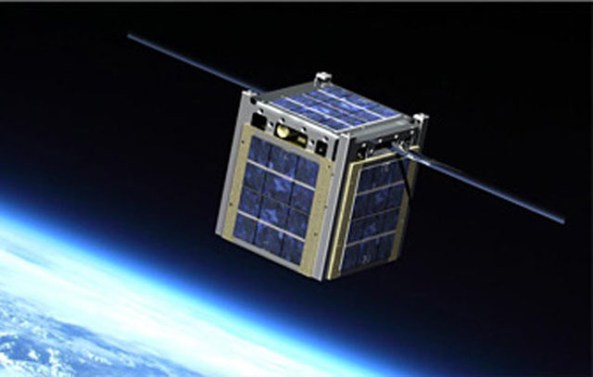
Illustration showing Firefly, a mark-carton-sized satellite, gathering data on a gamma-ray burst.

Firefly, a milk-carton-sized satellite, will study gamma-ray bursts that accompany lightning.
Credit: Zina Deretsky, National Science Foundation

‘CubeSat’ will help solve mysteries of terrestrial gamma ray flashes, 1,000 times more powerful than ‘northern lights’

NSF’s Therese Moretto Jorgensen explains what CubeSats tell us about the atmosphere.
Credit: National Science Foundation

imagine a fully-instrumented satellite the size of a half-gallon milk carton.

Then imagine that milk carton whirling in space, catching never-before-seen glimpses of processes thought to be linked to lightning.

The little satellite that could is a CubeSat called Firefly, and it’s on a countdown to launch next year.
CubeSats, named for the roughly four-inch-cubed dimensions of their basic building elements, are stacked with modern, smartphone-like electronics and tiny scientific instruments.
Built mainly by students and hitching rides into orbit on NASA and U.S. Department of Defense launch vehicles, the small, low-cost satellites recently have been making history. Many herald their successes as a space revolution.
Several CubeSat projects funded by the National Science Foundation (NSF) are currently in orbit, making first-of-their-kind experiments in space and providing new measurements that help researchers understand Earth’s upper atmosphere.
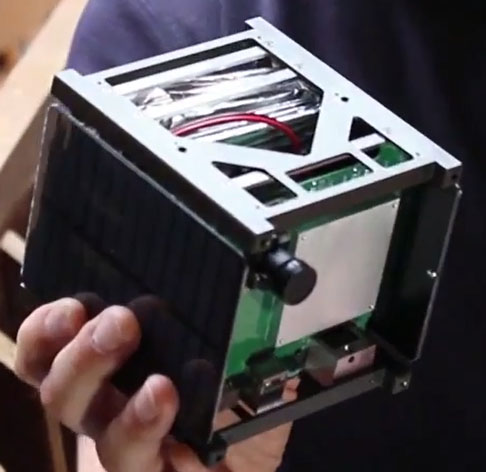
Atmospheric scientist Allan Weatherwax of Siena College offers a glimpse inside a CubeSat.
Credit: National Science Foundation

Firefly is designed to help solve the mystery of a phenomenon that’s linked with lightning: terrestrial gamma rays, or TGFs.
Bursts of gamma rays usually occur far out in space, near black holes and other high-energy cosmic phenomena.  Scientists were surprised when, in the mid-1990s, they found powerful gamma-ray flashes happening in the skies over Earth.

Powerful natural particle accelerators in the atmosphere are behind the processes that create lightning. TGFs result from this particle acceleration.
Individual particles in a TGF contain a huge amount of energy, sometimes more than 20 mega-electron volts. The aurora borealis, for example, is powered by particles with less than one-thousandth as much energy as a TGF.

But what causes a TGF’s high-energy flashes? Does it trigger lightning–or does lightning trigger it? Could it be responsible for some of the high-energy particles in the Van Allen radiation belts, which can damage satellites?
Firefly soon will be on the job, finding out.

Illustration of Firefly orbiting high in the atmosphere above Earth.

Firefly, as it will look once launched high into the atmosphere above Earth.
Credit: NASA

The CubeSat will look specifically for gamma-ray flashes coming from the atmosphere, not space, conducting the first focused study of TGF activity.

The Firefly team is made up of scientists and students at Siena College in Loudonville, N.Y.; NASA Goddard Space Flight Center in Greenbelt, Md.; the Universities Space Research Association in Columbia, Md.; the Hawk Institute for Space Science, Pocomoke City, Md.; and the University of Maryland Eastern Shore, Princess Anne, Md.

Students are involved in all aspects of the mission, from design and development, through fabrication and testing, to operations and data analysis.

Illustration of Firefly gathering data on a terrestrial gamma ray originating from lightning.

Firefly ‘catching’ a terrestrial gamma ray, or TGF, in action.
Credit: NASA

Firefly will carry a gamma-ray detector along with a suite of instruments to detect lightning, says Therese Moretto Jorgensen, program director in NSF’s Division of Atmospheric and Geospace Sciences, which funds Firefly and its CubeSat companions in space.

The CubeSat will return the first simultaneous measurements of TGFs and lightning.
When thunderstorms happen, powerful electric fields stretch upward for miles, into the upper atmosphere. These electric fields accelerate free electrons, whirling them to speeds that are close to the speed of light.

When these ultra-high-speed electrons collide with molecules in the air, they release high-energy gamma rays as well as more electrons, starting a cascade of electrons and TGFs.”Gamma rays are thought to be emitted by electrons traveling at or near the speed of light when they’re slowed down by interactions with atoms in the upper atmosphere,” says Moretto Jorgensen. “TGFs are among our atmosphere’s most interesting phenomena.”

Atmospheric scientists think TGFs occur more often than anyone realized and are linked with the 60 lightning flashes per second that happen worldwide, says scientist Allan Weatherwax of Siena College, a lead scientist, along with Doug Rowland of NASA’s Goddard Space Flight Center, on the Firefly project.

Build-up of electric charges at the tops of thunderclouds from lightning discharges can create a large electric field between clouds and the ionosphere, the outer layer of Earth’s atmosphere. But how this might lead to TGFs is unknown.

“Firefly will provide the first direct evidence for a relationship between lightning and TGFs,” says Weatherwax. “Identifying the source of terrestrial gamma-ray flashes will be a huge step toward understanding the physics of lightning and its effect on Earth’s atmosphere.”
Unlike lightning, a TGF’s energy is released as invisible gamma rays, not visible light. TGFs therefore don’t produce colorful bursts of light like many lightning-related phenomena. But these unseen eruptions could help explain why brilliant lightning strikes happen.
Following Firefly is FireStation, a set of miniaturized detectors for optical, radio and other lightning measurements.FireStation will fly a bit higher than Firefly.
Its orbit is on the International Space Station.

Cheryl Dybas, NSF (703) 292-7734 cdybas@nsf.gov

South African CubeSat DynaCube

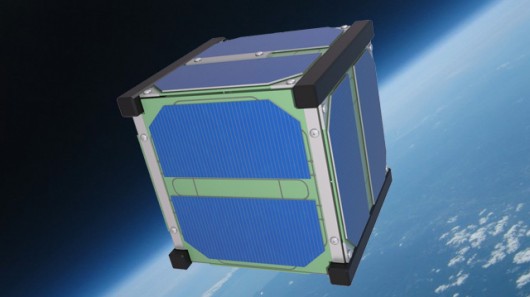
Image of a CubeSat in Space

DynaCube is a 1U CubeSat intended to take pictures of the earth that also carries temperature sensors and radiation detectors.

It plans to have a VHF CW beacon and a separate VHF 1200 bps GMSK telemetry downlink.

It is intended to launch from Baikonur into a Sun Synchronous Orbit (SSO).

Facebook https://www.facebook.com/permalink.php?id=162777567175347&story_fbid=216853691767734

Denel Dynamics http://www.deneldynamics.co.za/

IARU Satellite Frequency Coordination Panel status http://www.amsat.org.uk/iaru/


SkyCube Camera Demonstration

SkyCube Camera

A successful demonstration of SkyCube’s 4D Systems JPEG UART camera talking to its computer processor board.

The processor controls the camera and converts its raw image data to ASCII (text). It then sends the ASCII out one of its serial ports. The ASCII image is captured with a logic analyzer and displayed on a PC laptop screen.

The camera is operating at its lowest possible resolution (80×60) for the purpose of the test. This is obviously not how it’ll be used it in space, but it does show that all the pieces are working, and that they can talk to each other. For more details on the project, go to http://www.skycube.org/

Watch SkyCube Camera Demo 2012 07 16

SkyCube satellite uses Kickstarter for Funding http://www.uk.amsat.org/8955

SkyCube: a social space mission

skycube.

Southern Stars Group LLC, the company responsible for the popular SkySafari apps for iOS, Android and Mac OS X, is thinking a little bigger with its next project. The publicly funded SkyCube is a miniature CubeSat satellite that will orbit the planet, transmitting low-resolution images of the Earth while broadcasting short messages from sponsors in the form of data pings. In short, it’s the world’s first social space mission.

The hardware involved in the project isn’t anything we haven’t seen before. The satellite itself is a 10x10x10 cm (3.9 cubic-inch) “1U” CubeSat, which is the current leading picosatellite standard with nearly 100 of the devices built and launched to date. The SkyCube will be the second payload on a SpaceX Falcon 9 rocket, set to launch sometime in 2013.

Once deployed, it will orbit more than 300 miles (483 km) up, taking low-resolution pictures and broadcasting short, simple messages from the project’s sponsors as it crosses over most of the world’s inhabited regions. At the end of the mission, the SkyCube will deploy its 10 ft (3 m) diameter balloon, making it visible from the Earth, with a brightness akin to that of the Hubble Space Telescope. If everything goes to plan, the miniature satellite will eventually return to Earth, brought down by atmospheric drag.

So if you want to broadcast your own short message from space, the Southern Stars Group has got your back, with pledges starting at just US$1. This base option gives you a ten-second time slot on the mission, in which you can broadcast a single 120-character message. The sponsorship options go all the way up to $10k, for which the company will fly two people out to Cape Canaveral from anywhere in the continental US. From there, sponsors can watch the satellite lift off and once it’s successfully in orbit, they can control the SkyCube for an entire day to take pictures, send messages, or just sit back and contemplate the balance of their bank accounts.

The company is also making use of its app-making skills, creating applications for both iOS and Android. These will allow users to track the satellite, send messages and request images.

The SkyCube marks the next step in a series of initiatives and projects that are making space programs far more accessible to the general public. Rocket and spacecraft construction company Interorbital Systems recently announced its project to make space available to all. For $8,000, customers receive both a TubeSat Personal Satellite Kit and launch to low Earth orbit. That’s significantly cheaper than the SkyCube’s CubeSat miniature satellite, which costs around $100k to put in orbit.

So, have something important to say? Well, in 2013 you’ll be able to say it from space. The SkyCube has 57 days to go on Kickstarter, meaning that you’ve got until Wednesday September 12 to secure your chance to “tweet from space.”

Source: Southern Stars

SkyCube uses Kickstarter for Funding

Tim DeBenedictis and Anna Vital with the SkyCube satellite

Tim DeBenedictis and Anna Vital with the SkyCube satellite

PC World magazine reports that a fundraising campaign for the satellite, SkyCube, launched on Kickstarter last weekend (July 14) with the goal of raising US$82,500. Kickstarter is an online service popular with entrepreneurs and startups for raising money.

SkyCube-SatelliteThe article says the SkyCube team is led by Tim DeBenedictis, a self-described “space nut” and the man behind the popular Sky Safari smartphone app that provides a guide to the stars.

It will take pictures of Earth with three VGA cameras and deliver 120-character messages to smartphones running a SkyCube app. The messages will be collected on Earth and transmitted to the satellite about once a day, where they will be stored in memory and broadcast every 10 seconds. In addition to the app, anyone with a fairly modest amateur radio-type receiver might also be able to pick up the broadcasts directly.

The PC World article incorrectly says that Chris Phoenix is the projects radio expert, he isn’t, Chris is doing the firmware not RF.

SkyCube will be the first 1U CubeSat to carry an inflatable balloon. When the 3-meter reflective balloon is deployed 90 days after launch it should be visible to observers on the ground. A few weeks after deploying the balloon SkyCube will burn up in the Earth’s atmosphere.

It is understood they are planning to use 915 MHz and hope to launch on a SpaceX Falcon 9 rocket in the first half of 2013. http://www.southernstars.com/skycube/

Watch SkyCube Interview

Read the PC World story ‘Space Nut’ Looks Skyward With Web-funded Satellite
http://www.pcworld.com/businesscenter/article/259375/space_nut_looks_skyward_with_webfunded_satellite.html 

SkyCube Proposes “Tweets from Space” http://www.uk.amsat.org/8435

Southern Stars SkyCube http://www.southernstars.com/skycube/

Kickstarter SkyCube http://www.skycube.org/

Radio ham Zac Manchester KD2BHC used Kickstarter to raise $74,586 in donations to fund the development and deployment of over a hundred amateur radio KickSat sprite satellites.

The amateur radio satellite project ArduSat managed to raise donations of $106,330 in just 30 days.

Kickstarter is not just about raising large sums of money, for example Sandy Antunes used Kickstarter to raise $2,780 to buy a ham radio transceiver and antennas to create an amateur radio satellite ground station Calliope

Kickstarter to launch in UK http://www.bbc.co.uk/news/technology-18780184

Ecuador, heading into space

CubeSat NEE-01 Pegasus

A Chinese rocket due to launch in the 2nd quarter of 2013 will carry CubeSat NEE-01 Pegasus from Ecuador.

Ronnie Nader with Elisse Nader and CubeSat

The NEE-01 Pegasus engineering team was led by Cmdr. Ronnie Nader, Ecuador’s first astronaut. The tiny 1U CubeSat (10cm cube) has a large fold-out solar array, a world first, and carries a 902 MHz band 720p HD TV transmitter, another world first for a CubeSat. Also operating in the same band will be a beacon that will send a Morse Code ID, a SSTV image and Ecuador’s national anthem.

The raw aluminum structure of the CubeSat was donated by Professor Bob Twiggs KE6QMD. After launch the 10 by 10 by 10 cm NEE-01 Pegasus will deploy its 75 cm fold-out solar panels, the largest to be flown on a CubeSat.

As part of the educational outreach objectives of the satellite video of the Earth taken by the HD camera will be made available to school students in Ecuador.

The satellite will send two signals that will be received and decoded by the EXA’s HERMES-A ground station in Guayaquil and then uploaded live to the Internet using Facebook and Twitter; the first signal will contain text book questions and the second will contain an image related to the question. If the students are able to answer the question correctly they will be granted access to the video camera on board the spacecraft and will be able to see earth from space as the astronauts see it in their space missions. More advanced students will have access to the pure radio signal so they can try decoding it by themselves.

The satellite featured in the July 15 edition of the El Murcurio newspaper.

Read the El Murcurio newspaper article in Google English http://tinyurl.com/Ecuador-in-Space

NEE-01 Pegasus on Facebook https://www.facebook.com/NEE01PEGASO/

IAC2011 Paper http://exa.academia.edu/RonnieNader/Papers/795135/NEE-01_PEGASUS_The_first_Ecuadorian_Satellite

NEE-01 Pegasus will monitor near-earth objects http://www.uk.amsat.org/6932

Italian Microsat to Deploy Six Amateur Radio Satellites http://www.uk.amsat.org/?p=7717