HAMSAT VO-52 Dutch Transponder Activated

VO-52 on FUNcube Dongle by Dave G4DPZ

VO-52 received on an AMSAT-UK FUNcube Dongle by Dave Johnson G4DPZ during the 17:27 pass on March 14, 2012

The Dutch SSB/CW linear transponder on the AMSAT-India amateur radio satellite HAMSAT VO-52 has been successfully activated.

Transponder # 1, which had been operating for over 6 years, fell silent on February 28 and efforts have been underway to activate transponder # 2.

Mani VU2WMY reports that the commands to ‘Turn On’ the transponder # 2 on-board HAMSAT VO-52 were successfully sent on March 14 during the 1400 UT 35 deg ascending Node pass over Bangalore, India.

The commands were successful and the CW message beacon of the Dutch transponder # 2, built by William Leijenaar PE1RAH, was heard in Bangalore loud and clear, some 6 years and 4 months since it was last switched on.

The Dutch SSB/CW transponder uses these frequencies:
Uplink:         435.2250 – 435.2750 MHz SSB/CW
Downlink:     145.9250 – 145.8750 MHz SSB/CW
Beacon:       145.8600 MHz CW

When working through linear transponder satellites such as VO-52 use as little power as possible, this will help extend the lifetime of the transponder and satellite batteries. As a guide ensure your downlink signal is no stronger than the satellite beacon. Low duty cycle modes such as SSB and CW are recommended.

How to work the SSB satellites such as VO-52 http://www.uk.amsat.org/2712

AMSAT-India Thanks You http://www.uk.amsat.org/5777

HAMSAT VO-52 Activation Planned For Wednesday http://www.uk.amsat.org/5685

HAMSAT VO-52 Falls Silent http://www.uk.amsat.org/5217

Leijenaar Electronics http://www.leijenaarelectronics.nl/

AMSAT-India http://www.amsatindia.org/

HAMSAT VO-52 Activation Planned For Wednesday

HAMSAT VO-52

HAMSAT VO-52

Mani VU2WMY reports that due to ‘Operational Constraints’ the commands to turn on the Dutch SSB/CW transponder on HAMSAT (VO-52) could not be sent on Tuesday and attempts at 01:44 UT and 03:20 UT Wednesday were unsuccessful.

The next attempt will be made during the 14:00 UT pass over India.

William Leijenaar PE1RAH, designer and builder of the Dutch SSB/CW linear transponder on HAMSAT (VO-52), requests reports when the transponder is activated. He says:

! ! !  Please don’t use high uplink powers !!! (We don’t want it to rise temperature very fast just after cold switch on) ! ! !

Please listen for the CW beacon at 145.860, which is a good reference.
(Audio records and reports are very welcome at ISRO and myself)

73 de PE1RAH,
William Leijenaar

The frequencies used will be:

Uplink:         435.2250 – 435.2750 MHz SSB/CW
Downlink:     145.9250 – 145.8750 MHz SSB/CW
Beacon:       145.8600 MHz CW

How to work the SSB satellites http://www.uk.amsat.org/2712

HAMSAT VO-52 Falls Silent http://www.uk.amsat.org/5217

Leijenaar Electronics http://www.leijenaarelectronics.nl/

AMSAT-India http://www.amsatindia.org/

New Amateur Satellite Frequency Coordination Request Form

Hans van de Groenendaal ZS6AKV

Hans van de Groenendaal ZS6AKV

IARU Satellite Advisor Hans van de Groenendaal ZS6AKV has made available a new version of the Amateur Satellite Frequency Coordination request form.

Frequency coordination for amateur radio satellites is provided by the IARU through its Satellite Advisor, an official appointed by the IARU Administrative Council, its top policymaking body.

The IARU Satellite Advisor is assisted by an Advisory Panel of qualified amateurs from all three IARU Regions. The panel meets regularly via Skype to consider amateur satellite frequency coordination requests for satellites planned for operation on frequencies in the amateur service. The panel members often provide advice and assist satellite builders with the selection of   the best possible frequencies to meet the objectives of their mission.

The Amateur Satellite Frequency Coordination request form has been updated (Version 27) and is available for download from http://www.iaru.org/satellite.

On the IARU web satellite page there are also available a number of guideline documents which will assist satellite builders, including a document on the ITU requirements for Amateur Radio Satellites.

73

Hans van de Groenendaal ZS6AKV
IARU Satellite Advisor

A list of coordinated amateur radio satellites can be found at http://www.amsat.org.uk/iaru

ESA to start mini space mission series

BBC Science correspondent Jonathan Amos reports that the European Space Agency is starting what it expects to become a regular series of small science missions.

The first winning “S-Class” idea will receive 50 million euros (£42m) and will be readied for launch in 2017.

Prof Mark McCaughrean, head of ESA’s Research and Scientific Support Department is reported as saying:

“We want to hear from innovative people who’ve got a clever idea that doesn’t need a billion or half a billion euros, but can be done with a much smaller amount.”

Read the full BBC News story at http://www.bbc.co.uk/news/science-environment-17335339

Call for a Small mission opportunity in ESA’s Science Programme for a launch in 2017 http://sci.esa.int/2012-S-Call

The Hindu – Hams Engineering Success

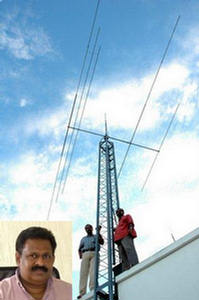
The Hindu newspaper reports on K. G. Girish Babu VU2KGB who uses computerised antenna design for VHF and UHF wireless communication. He helped his son Rahul make an antenna, the largest in India, which can track amateur radio satellites.

He says he also designed and manufactured the entire ground station antenna and structures for the experiments jointly conducted by the German Aerospace (DLR) and Indian Space Research Organisation (ISRO).

Wireless communication always fascinated him. He made a wireless transmitter while studying in class eight, for the science exhibition. “Thanks to my teacher Rajan and the wonderful chemisty and physics lab at our school (Government HS, Chavakkad). He always encouraged my experiments and brought me copies of Science Today magazine.”

While in college, (St Albert’s, Kochi), “I, along with a friend, rigged up a wireless transmitter. We didn’t know that it was illegal. When some issues came up, we hid the equipment,” he remembers.

In 1979, he cleared the examination to obtain his Grade I amateur radio operator licence with the call sign VU2KGB. His wife, A. Maya Shankar, is licenced at VU2CIA.

Read the full The Hindu story at http://www.thehindu.com/life-and-style/money-and-careers/article2974047.ece

AMSAT-UK Colloquium 2012 First Call for Speakers

Holiday Inn Guildford GU2 7XZ

Holiday Inn Guildford GU2 7XZ

The AMSAT-UK International Space Colloquium will be held on September 15-16, 2012 in Guildford.

The Colloquium attracts an international audience from across Europe as well as North America and the Middle East. Attendees range from the builders of the CubeSats and Nanosats, those who communicate through them and beginners who wish to find out more about this fascinating branch of the hobby.

It provides a rare opportunity to chat with satellite designers and builders, discussions frequently continue until the early hours of the morning.

A Gala dinner is held on the Saturday evening along with the fund raising auction.

This is the first call for speakers for the AMSAT-UK International Space Colloquium 2012 which, due to the Olympic & Paralympic Games, will be held this year on the weekend of September 15-16, 2012 at the Holiday Inn, Guildford, GU2 7XZ, United Kingdom.

This Colloquium will take place a few weeks before the planned launch of AMSAT-UK’s FUNcube-1 satellite carrying a 435/145 MHz linear transponder for SSB/CW communications.

AMSAT-UK invites speakers, to cover topics about micro-satellites, CubeSats, Nanosats, space and associated activities, for this event.

They are also invited to submit papers for subsequent publishing on the AMSAT-UK web site. We normally prefer authors to present talks themselves rather than having someone else give them in the authors’ absence. We also welcome “unpresented” papers for the web site.

We appreciate that it is not always possible to give a firm indication of attendance at this stage but expressions of interest would be appreciated.

Submissions should be sent *ONLY* to G4DPZ, via the following routes:

e-mail: david dot johnson at blackpepper dot co dot uk

Postal address at http://www.qrz.com/db/G4DPZ

AMSAT-UK also invite anyone with requests for Program Topics to submit them as soon as possible to G4DPZ. Invitations for any papers on specific subjects will be included in the future call. Likewise if anyone knows of a good speaker, please send contact and other information to G4DPZ.

AMSAT-UK International Space Colloquium http://www.uk.amsat.org/colloquium/twelve