AMSAT-BR QO-100 FT8 QRPp Experiment

AMSAT-BR Logo and Dish AntennaAMSAT-Brazil is organizing a reverse beacon FT8 QRPp experiment/contest via the QO-100 geostationary amateur radio transponder.

The first 10 spotted stations with lower SNR will receive a Certificate of Accomplishment.The dead line will be May 1st 2020. To qualify, the SNR must be lower than -18 dB (as measured by the ft8 decoder). The receiver will be active on Saturdays and Sundays from 12:00 UTC to 24:00 UTC and will be tuned to 10.489540 GHz with a 3.5 kHz bandwidth. All stations calling CQ will be logged.

The objective for the project is to incentive low power experimentation through the QO-100 narrow band transponder. Stations participating in the experiment are welcome to send a brief description of their setup, including information about RF power output, hardware and software setups, antenna type and gain, photos, etc. to the email address
py2sdr at gmail dot com.

73, Edson PY2SDR

You can listen to the QO-100 transponder downlink online at https://eshail.batc.org.uk/nb/

QO-100 information https://amsat-uk.org/satellites/geo/eshail-2/

Project for school QO-100 amateur radio stations

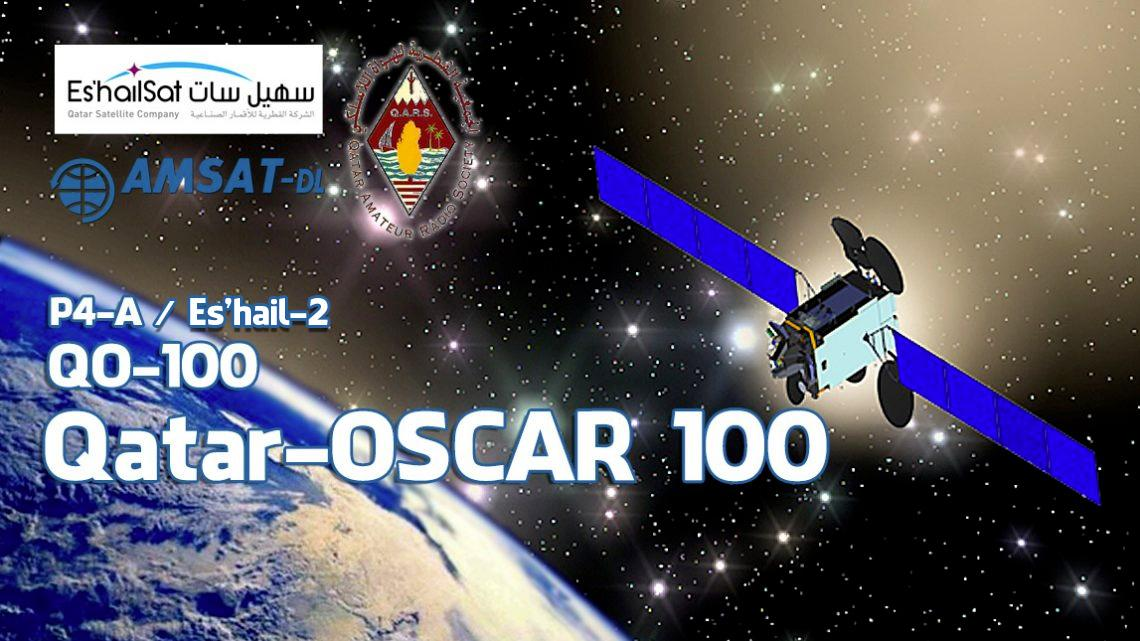
Es'hail-2 Qatar-OSCAR-100DARC reports on a Practical Seminar about the amateur radio QO-100 geostationary satellite transponders. Part of seminar fees goes to the “School stations on QO-100” project.

A translation of the DARC post reads:

Top-class seminar in the DARC office in Baunatal: On February 28, experts from AMSAT-DL e.V. gave around 40 people a detailed insight into the possibilities offered by the QO-100 amateur radio transponders on the geostationary satellite Es’hail-2.

AMSAT-DL President Peter Gülzow, DB2OS, started with a keynote speech. Workshops with four lecturers dealt with different operating modes, different hardware concepts and readily available software solutions for the PC.

Part of the attendance fee will go to the joint project of DARC and AMSAT-DL “School stations on QO-100”. Together they want to equip ten schools that already have a training call sign with a complete reception system for the narrowband transponder.

DARC and AMSAT-DL want to motivate more young people for amateur radio through the possibilities that QO-100 offers.

Source DARC https://darc.de/

QO-100 info https://amsat-uk.org/satellites/geo/eshail-2/

Ham radio QFH satellite antennas built at workshop

Participants built QFH antennas at the ORARI workshop

Participants built QFH antennas at the ORARI workshop

Radio amateurs built Quadrifilar Helicoidal (QFH) satellite antennas at a workshop in Indonesia organised by a local branch of the national amateur radio society ORARI.

A translation of the ORARI website report reads:

On Saturday, February 22, 2020, South Jakarta Local ORARI Jakarta held a Homebase Antenna Workshop for LAPAN-A2 / LAPAN-ORARI (IO-86) Satellite Communications. The workshop was held at the Local ORARI Club Station in South Jakarta, with guest speaker Suryono Adisoemarta (Yono / YD0NXX).

The agenda of this workshop consists of theory and practice. Theoretical material includes the introduction of amateur radio satellites in general, the introduction of LAPAN-A2 / LAPAN-ORARI (IO-86) satellites and satellite tracking techniques. Whereas practical material includes making a Quadrifilar Helicoidal (QFH) antenna and communication with the LAPAN-A2 / LAPAN-ORARI (IO-86) satellite.

The workshop was opened at 9:20 by Irsan YC0OST as Deputy Chair of South Jakarta Local ORARI. After opening, the program continued with the giving of theories about amateur radio satellites. In addition to the IO-86 satellite, there are also other amateur radio satellites that can be used such as AO-7 as the longest-running amateur radio satellite, AO-91, AO-95 and QO-100 which is a geostationary amateur radio satellite.

After the theoretical material was finished around 11:30, the program continued with the practice material for making QFH antennas. The materials for making the antenna provided by the committee included copper capillary pipes, 1 1/4 PVC PVC pipe, RG-58 cable, BNC connector and paper clips. Meanwhile, the equipment for making antennas was carried by each participant, such as solder, scissors, pliers, drill, and others. The atmosphere became even more exciting, because in making this QFH antenna there were separate challenges, especially in the RG-58 cable connection to the antenna element.

At 14:00, LAPAN provided a dedicated Voice Repeater slot on the IO-86 satellite for workshop participants to try out the antenna they made. But because the antenna is quite complicated, there is no antenna that can be tried on the Voice Repeater schedule. Mahesa Rani YD0OVE’s antenna was first tried on the regular Voice Repeater schedule. The results are quite satisfying. With her capital Handy Transceiver (HT) and a hand-held QFH antenna, YD0OVE successfully received 14 amateur radio stations.

In this workshop, several guests were present including the President of AMSAT-ID Hakim YB0AN, Chair of the Central Jakarta Local ORARI Edy YCØEDY, and the South Jakarta Local ORARI DPP Beben YB0HJW and Fahlifi YF0BRR.

Source ORARI https://tinyurl.com/IndonesiaORARI

AMSAT Files Comments Opposing Deletion of 3.4 GHz Band

FCC SealAMSAT has filed comments on the Federal Communications Commission’s Notice of Proposed Rulemaking which proposes to delete the 3.3 – 3.5 GHz (9 cm) amateur band, including the 3.40 – 3.41 GHz amateur satellite service allocation.

In the comments, AMSAT opposes the deletion of this allocation and emphasizes the necessity of adequate microwave spectrum for future amateur satellite projects, including AMSAT’s GOLF program and the Lunar Gateway.

AMSAT further notes that the most desirable allocations for use as uplinks are the allocations between 2.4 and 5.67 GHz. These allocations total 80 MHz. The most desirable allocation for downlink use is the 10.45 – 10.50 GHz allocation, totaling 50 MHz.

As many of the proposed uses include amateur television and high-speed data transmission with satellites in high earth orbit or lunar orbit, these allocations may quickly become inadequate. AMSAT also notes that the 2.4 and 5.67 GHz allocations are widely used for ISM and consumer devices, such as WiFi and Bluetooth-enabled devices. The 3.4 GHz allocation is shared between amateur use and other non-federal and federal licensees, but is free from the unpredictable interference of consumer devices.

While acknowledging that the 3.4 GHz amateur satellite service allocation is not currently used by any amateur satellites and that it is unsuitable for worldwide communication since it is not available in ITU Region 1, AMSAT identifies a number of potential future uses for the band as worldwide usage of the other available allocations increases. These potential uses include a future amateur satellite in geostationary orbit above the Americas.

In the comments, AMSAT also noted several non-amateur satellite uses of the broader 3.3 – 3.5 GHz amateur service allocation, including its wide use in mesh networking, EME communications, and contesting.

The full text of the comments as filed can be downloaded at https://tinyurl.com/ANS-054-FCC

Interested parties may file reply comments on or before March 22, 2020 at https://www.fcc.gov/ecfs/
The proceeding is WT Docket No. 19-348.

Source AMSAT News Service (ANS)

Indian radio hams interviewed by UK radio station

Shyama Vagadia VU3WHG

Shyama Vagadia VU3WHG

Rajesh Vagadia VU2EXP is well-known as the West India Zone Regional Coordinator for AMSAT-INDIA. Over the years he has done a great of educational outreach explaining and demonstrating amateur satellite communications to school and college students.

In December 2019 he was involved in a workshop at RK University, see the report at https://amsat-uk.org/2019/12/06/satellite-demo-for-students/

Arcacia Radio in Nottinghamshire, UK, will be broadcasting an interview with two Indian radio amateurs Rajesh Vagadia VU2EXP and Shyama Vagadia VU3WHG. In this interview rather than satellites Rajesh and Shyama will be sharing their valuable experience of Amateur Radio Emergency Communication service during Cyclone Vayu that hit the coast of Porbandar (Gujarat) India in June 2019.

Rajesh has supplied AMSAT-UK with some information about the interview:

The interview will cover Cyclone info, Emergency Communication Preparedness, Teamwork, Radio Operations, Reporting, Supporters credit, Coordination with Radio clubs/organisations and Government Departments, etc.

Rajesh VU2EXP is an active radio amateur from Rajkot who is engaged in ham radio promotional activities, whereas Shyama VU3WHG is a 10th grade student at Saint Paul’s School, Rajkot and remains the youngest female Ham in the State of Gujarat!

The interview, part of Backtracks show presented by Brian Ford, is scheduled to be broadcast on Tuesday, February 18, 2020 at 1400 GMT (2pm) and repeated on Thursday, February 20 at 1400 GMT.

Kindly spare time and listen to our Interview on Acacia Radio on 1287 AM or listen worldwide via the live internet radio stream at
http://radio.canstream.co.uk:8033/live.mp3

You may visit Acacia Radio website at:
http://www.AcaciaRadio.com/
https://twitter.com/AcaciaRadio1287

5 watt 2.4 GHz Amplifier Kit for QO-100

5 watt 2400 MHz Amplifier Kit

5 watt 2400 MHz Amplifier Kit

The AMSAT-UK shop is now stocking a 5 watt 2.4 GHz amplifier kit for use with the QO-100 geostationary satellite.

The amplifier was designed by Kurt Moraw DJ0ABR and the kit was implemented by Arved Viehweger M0KDS.

The kit includes a single sided PCB on which is already mounted the PA transistor, there is a suitable heat sink on which to mount the PCB with the provided screws. All electronic components are included as are 2 SMA sockets. Assembly of the kits will require some surface mount components to be soldered to the PCB.

Note: It does not include a case for the unit and a separate 24 volt power supply will be required.

Kit details at https://shop.amsat-uk.org/QO-100_5W_Amplifier_Kit_designed_by_DJ0ABR_and_implemented_by_M0KDS/p3815740_20307881.aspx

Assembled PCB https://shop.amsat-uk.org/product/u-100ampassembled

QO-100 information https://amsat-uk.org/satellites/geo/eshail-2/