Newfoundland on QO-100 ?

QO-100 North America CertfificateDuring May there are plans for two separate attempts to make contacts from Newfoundland using the QO-100 geostationary satellite amateur transponders.

Newfoundland is just outside the coverage area of QO-100, the elevation at Signal Hill at St. Johns is -0.9°, however, contacts have been made from Indonesia at an elevation as low as -1.3° so there is a chance of success.

Gopan VO1/M0XUU (VU3HPF) will be in Newfoundland from May 8-15 and will attempt to make QO-100 contacts.

David VO1/G0MRF and Graham VO1/G3VZV will be in Newfoundland May 15-19 and plan to be active on QO-100 using SSB / CW / FT8 / FT4 / DATV.

You can follow posts on X at:

Gopan M0XUU – https://X.com/vu3hpf
David G0MRF – https://X.com/g0mrf
Graham G3VZV – https://X.com/G3VZV

Video of the presentation ‘Making QO-100 contacts from North America – A new challenge’, given by Graham G3VZV at the 2022 AMSAT-UK Colloquium
https://amsat-uk.org/2022/11/01/making-qo-100-contacts-from-north-america-a-new-challenge/

Information on QO-100 is at https://forum.amsat-dl.org/index.php?board/3-qo-100-es-hail-2-p4-a/

Belgium: 23 cm band Restrictions

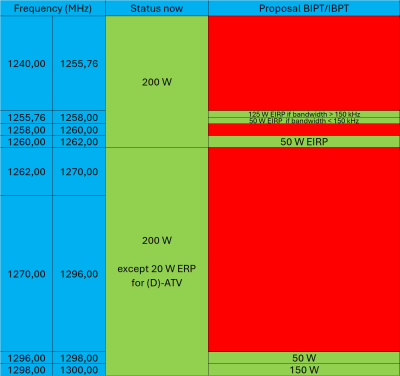
2024-03-27 Belgium 1240-1300 MHz proposed restrictions

2024-03-27 Belgium 1240-1300 MHz proposed restrictions

On March 27, 2024, Belgium’s regulator the BIPT published draft restrictions on amateur radio operation  in the 23cm (1240-1300 MHz) band.

Belgium is believed to be the first country to propose restrictions on 23cm band operation following WRC-23 ITU-R Recommendation M.2164-0

The new restrictions include:

Class A (equiv UK Full, USA Extra) – size of band reduced from 60 MHz to 8.24 MHz. EME (but not satellite uplink) is permitted 1260-1262 MHz and the antenna elevation must always be more than 15° above the horizon and the transmission power is limited to 50 W EIRP. If the elevation is above 55° above the horizon, the power is increased to 500 watts EIRP

Class B (equiv UK Intermediate, USA General) – 1296-1300 MHz only

Class C (equiv UK Foundation, USA Technician) – No access (unchanged)

The public consultation runs until April 28 https://www.bipt.be/operators/publication/consultation-on-the-frequencies-powers-and-transmission-modes-that-may-be-used-by-radio-amateurs

Read the full UBA story at https://www-uba-be.translate.goog/nl/nieuws/raadpleging-over-ontwerp-van-besluit-van-de-raad-van-het-bipt-inzake-de-frequenties?_x_tr_sl=auto&_x_tr_tl=en&_x_tr_hl=en-US

BBC Great British Railway Journeys at SSTL

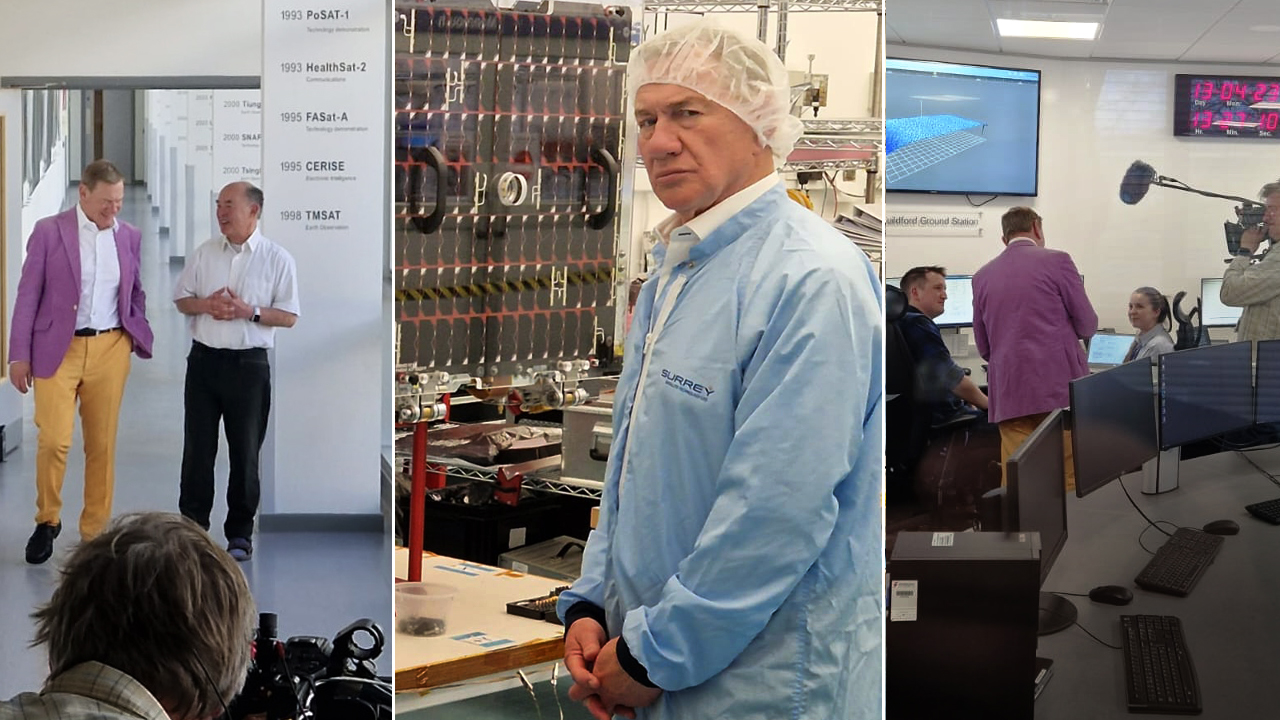
Michael Portillo visiting SSTLSeries 15 episode 4 of Michael Portillo’s TV show Great British Railway Journeys: Havant to Guildford, features Surrey Satellite Technology Ltd and Professor Sir Martin Sweeting G3YJO.

To see the segment fast-forward 20 mins 30 secs into the show.

Watch in the UK on BBC iPlayer at
https://www.bbc.co.uk/iplayer/episode/m001xj3j/great-british-railway-journeys-series-15-4-havant-to-guildford

Over the years Michael has met several radio amateurs while making his show.
In 2013 he was shown how to send Morse code by Peter Watkins M0BHY
https://web.archive.org/web/20180107172841/http://www.southgatearc.org/news/2014/january/michael_portillo_sends_morse_code.htm

In 2017 he did Amateur Radio moonbounce from Goonhilly in Cornwall under the supervison of Noel Matthews G8GTZ and Brian Coleman G4NNS
https://amsat-uk.org/2018/01/06/bbc-tv-to-show-michael-portillo-moonbounce/

ITU WRC-23: 1240-1300 MHz

IARU RNSS GraphicIARU have provided an update on the outcome of ITU WRC-23 Agenda Item 9.1B concerning the Amateur and Amateur Satellite Service allocations in 1240-1300 MHz:

“During the WRC-23 deliberations, strong positions were expressed by all the parties involved. The result is a well-supported compromise for a footnote in the Radio Regulations regarding amateur and amateur satellite service operation in the 1240–1300 MHz range. The footnote reminds administrations and amateurs of the need to protect the primary RNSS from interference and provides guidance to administrations to allow both services to continue to operate in this portion of the spectrum. The compromise was formally adopted by the Conference Plenary on December 8 and is not subject to further consideration during the final week of the WRC. The IARU team continues its work on other WRC issues including the development of agendas for future conferences.

IARU President Tim Ellam, VE6SH, noted “This is a very good result for the amateur services. The decision reached at WRC-23 on this agenda item makes no change to the table of allocations nor incorporates by reference M.2164 into the Radio Regulations. The addition of a footnote that provides guidance to administrations in the event of interference to the RNSS is a good regulatory outcome for amateurs and the primary users of this band.”

The WRC also agreed to suppress the Resolution 774 which closes the issue and satisfies the agenda item.”

Read the full IARU statement at https://www.iaru.org/recommendation-on-ai-9-1b-approved-at-wrc-23/

Download ITU‑R Report M.2532 https://www.iaru-r1.org/wp-content/uploads/2023/11/R-REP-M.2532-2023-PDF-E.pdf

IARU Summary Meeting Report WRC-23: This report is focusses on the 23 cm Band RNSS Coexistence Aspects and WRC-23 AI 9.1b by Barry Lewis G4SJH https://www.iaru-r1.org/wp-content/uploads/2023/12/Report-from-WRC_Dec-2023_23cm.pdf

23cm band report ITU‑R M.2532 published

ITU LogoIARU Region 1 reports as a part of the preparatory process for WRC-23 agenda item 9.1 topic b) involving the 23cm band (1240-1300 MHz), ITU‑R Report M.2532 has been published.

This report encapsulates the outcome of resolves 1 of ITU‑R Resolution 774 that requires a detailed review of the different systems and applications used by the amateur and amateur satellite services in the 23cm band. The review forms a part of the basis for the studies required by resolves 2 to address the amateur and amateur satellite services coexistence with the radio navigation satellite service (RNSS).

The publication represents a positive outcome from a great deal of work and committment by the IARU volunteer team that has been central to its development since 2019 in ITU‑R Study Group 5.

Download ITU‑R Report M.2532 https://www.iaru-r1.org/wp-content/uploads/2023/11/R-REP-M.2532-2023-PDF-E.pdf

The information paper ZL23_C5_19 1.3 GHz Band – Additional Information was submitted by the RSGB to the IARU Region 1 Conference held Novemebr 1-4, 2023. It provides information on the situation in the 1240-1300 MHz and 13001350 MHz spectrum. It can be downloaded from ZL23_C5_19 1300MHz INFO

Extract from CPM report 2023-10-11-Extract CPM-Report-to-WRC-23 _2_

Delfi-C3 – DO64 Deorbiting Soon

Delfi-C3 Team at AMSAT-UK Colloquium 2008

Delfi-C3 Team at AMSAT-UK Colloquium 2008

After more than 15 years in orbit, Delfi-C3’s mission is about to come to an end. The team predict that re-entry will take place around November 16th 2023.

The re-entry date might vary depending on the solar activity, which is very hard to predict accurately. See also @Marco_Langbroek on Twitter for a similar prediction.

https://twitter.com/Marco_Langbroek/status/1720110996499349663

Delfi-C3 Re-entry Prediction

Delfi-C3 Re-entry Prediction

We would like to request all amateur radio operators / SWL’s / satellite enthusiasts worldwide to listen for Delfi-C3’s telemetry downlink on 145.867 MHz, 1200 baud AX.25 BPSK. We will hand out an award certificate to the person submitting the last Delfi-C3 telemetry frame.

This can be done either through the RASCAL software (updated version coming…), through the SATNOGS network or by sending us decoded telemetry frames with reception time and location via email to Delfi_at_tudelft.nl.

On behalf of the entire Delfi-C3 team, we would like to sincerely thank the worldwide amateur radio / SWL / satellite community for assisting the team by forwarding received telemetry and reception reports.

Back in 2008 we could not imagine the great support received so far and the many first we had, including a successful ground network and flying the first linear transponder in a CubeSat.

We strongly believe that Delfi-C3 has paved the way for many follow-on missions (both amateur and commercial), and has been a great step towards maturing CubeSat technology as well as training the next generation of space engineers. Stay tuned for updates!

On behalf of the team best 73s,

Wouter PA3WEG