ESEO satellite commissioning starts

Artist impression of ESEO flying over Europe - credit ESA

Artist impression of ESEO flying over Europe – credit ESA

On Monday, December 3, 2018, the 50 kg ESA Education Office satellite ESEO was launched by Space-X on the Spaceflight SSO-A SmallSat Express mission.

UPDATE April 12: The 1200 bps BPSK telemetry beacon on 145.895 MHz was activated at 1040 UT on Friday, April 12, 2019. See ESEO Real-Time Data in the AMSAT-UK Data Warehouse at http://data.amsat-uk.org/ui/eseo

Download the ESEO (FUNcube-4) Dashboard App from
https://funcube.org.uk/working-documents/funcube-telemetry-dashboard/

Following the launch from Space Launch Complex 4E (SLC-4E) at Vandenberg Air Force Base, ESEO separated from the launch vehicle and automatically activated the periodic transmission of its telemetry beacon. However, by the time out of a predefined period, having not received commands from the ground station, the spacecraft automatically entered into safe mode.

Some initial communications issues were experienced by ESEO in receiving commands from the ground stations in Forli’ (Italy) and Vigo (Spain), but they were resolved when the ESEO team of the Observatory of Tartu offered the possibility to use a ground station in Estonia. This is capable of transmitting with higher power, for a temporary contingent use. The Estonian ground station has been configured to be operated remotely by the ESEO MCC team, which involves students of the University of Bologna.

ESEO then started executing the commands transmitted from ground.

ESEO has now completed the LEOPS (Launch and Early OPerationS) phase of its mission, reaching the platform nominal mode and has begun the process of commissioning the whole satellite: firstly the platform functions, with the payloads functions following.

As part of this commissioning process, but subject to the successful completion of other preparatory tasks of the platform subsystems commissioning, it is anticipated that initial testing of the AMSAT communications payload will be carried out within the next few weeks.

AMSAT-UK will endeavour to provide some advance notice of these tests being undertaken, but the first step will be activation of the 1200 bps BPSK telemetry beacon on 145.895 MHz. The telemetry format matches previous FUNcube missions and data from this beacon will be forwarded to the FUNcube Data Warehouse using any of the FUNcube dashboards. However, to see the decoded values and graphical displays, please download the dedicated ESEO mission dashboard which is available at
https://download.funcube.org.uk/ESEO_Dashboard_v1177.msi

The payload has, additionally, a high speed, 4800 bps BPSK data format downlink and also a Mode L/V FM transponder both of which will be tested.

ESEO Real-Time Data in the AMSAT-UK Data Warehouse at http://data.amsat-uk.org/ui/eseo

Further information about ESEO can be seen at
https://www.esa.int/Education/ESEO/ESEO_student_satellite_in-orbit_commissioning_has_started
Space meeting to be streamed via ham radio geostationary transponder

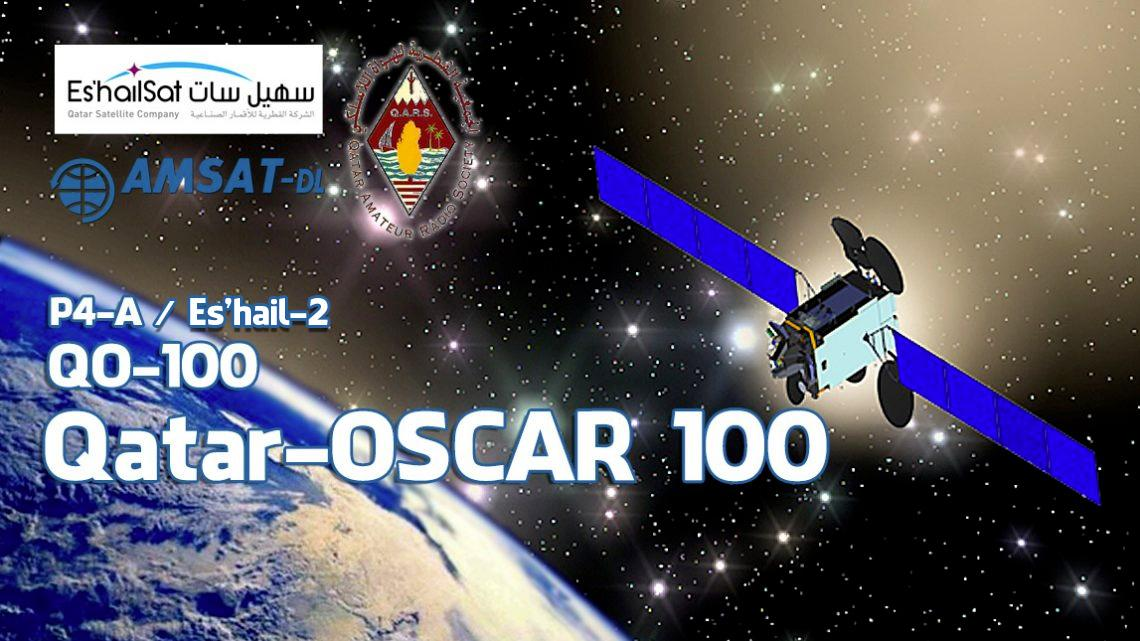
Es'hail-2 Qatar-OSCAR-100The 2nd Amateur Radio Space Meeting, taking place in Nanterre, Paris, March 9-10, will be streamed live via the Digital Amateur TV transponder on Es’hail-2 / QO-100 geostationary satellite.

A Google translation of the AMSAT-Francophone post says:

AMSAT-Francophone and Electrolab have deployed a ground station to operate the QO100 transponder in DATV.

The “broadcast DATV” team led by Yannick Avelino and with the support of Evariste F5OEO has developed the station that will broadcast live the conferences of the second amateur radio space meeting March 9-10, 2019. The team was in contact with AMSAT-DL and AMSAT-UK for permission to operate the satellite during these days.

Source http://site.amsat-f.org/2019/03/07/rencontre-spatiale-du-9-10-mars-2019-conferences-diffusees-en-direct-via-le-transpondeur-qo100/

Meeting information and Schedule of talks
http://site.amsat-f.org/2019/02/16/deuxieme-rencontre-spatiale-radioamateur-9-et-10-mars-2019-agenda-des-deux-journees-mis-a-jours-reservez-vos-places/

Qatar OSCAR-100 web receiver now live

Es'hail-2 QO-100 Narrowband WebSDR

Es’hail-2 QO-100 Narrowband WebSDR

The BATC and AMSAT-UK 10 GHz Narrowband WebSDR and Wideband Spectrum Viewer for the amateur radio transponders on the Es’hail-2 / QO-100 geostationary satellite are now available online.

Es'hail-2 / QO-100 coverage from 25.9° East

Es’hail-2 / QO-100 coverage from 25.9° East

The geostationary satellite Es’hail-2 carrying amateur radio transponders launched from Kennedy Space Center at 20:46 GMT on Thursday, November 15, 2018 and is now in a geostationary orbit at 25.9° East. The transponders should link radio amateurs across a third of the globe from Brazil to Thailand.

Following commissioning of the satellite on February 12, 2019 the Qatar Amateur Radio Society (QARS) invited radio amateurs worldwide to use the Es’hail-2 / QO-100 narrowband transponder https://amsat-dl.org/en/qo-100-nb-transponder-experimental-operation

Qatar OSCAR-100 is the first geostationary amateur radio transponder, a joint project between the Qatar Satellite Company (Es’hailSat), the Qatar Amateur Radio Society (QARS), and AMSAT Deutschland (AMSAT-DL) which provided the technical lead.

OSCAR-100 is hosted on Es’hail-2, a Broadcast Transponder Satellite owned by the Es’hailSat Qatar Satellite Company, the satellite is now in geostationary orbit at 25.9° E.

More information on the OSCAR-100 project can be found at AMSAT-DL Phase 4-A

Es'hail-2 / QO-100 2.4 GHz Ground Station - Wouter Weggelaar PA3WEG

Es’hail-2 / QO-100 2.4 GHz Ground Station – Wouter Weggelaar PA3WEG

In co-operation with AMSAT-UK, the British Amateur Television Club will be operating a 10 GHz WebSDR for the narrowband segment, and a Spectrum Viewer for the wideband (DATV) segment.

Goonhilly Earth Station is supporting the project, providing hosting for the Ground Station facility at their world-famous site in Cornwall, UK.

Es’hail-2 WebSDR https://eshail.batc.org.uk/

UHF–VHF Receive Converter for use with a satellite LNB by David Bowman G0MRFDownload article PDF here

Article: Receiving the Es’hail-2 geostationary satellite by George Smart M1GEO at https://www.george-smart.co.uk/2019/02/eshail2-rx/

Digital ATV co-ordination on Es’hail-2 / QB-100
https://amsat-uk.org/2019/02/27/digital-atv-co-ordination-on-eshail-2/

Es’hail-2 / QO-100 Teleport Inauguration Day Thursday, February 14
https://amsat-uk.org/2019/02/10/eshail-2-teleport-inauguration/

Es’hail-2 Narrowband amateur radio transponder operating guidelines
https://amsat-dl.org/en/p4-a-nb-transponder-bandplan-and-operating-guidelines

Es’hail-2 Wideband amateur radio transponder operating guidelines
https://amsat-dl.org/en/p4-a-wb-transponder-bandplan-and-operating-guidelines

Es’hail-2 amateur radio information
https://amsat-dl.org/en/eshail-2-amsat-phase-4-a

See the Satellite Forum for additional information https://forum.amsat-dl.org/

Es'hail-2 Qatar-OSCAR-100

Es’hail-2 / QO-100 Teleport Inauguration Day February 14

At Es'hailSat Qatar - Credit AMSAT-DLFollowing the successful launch of Es’hail-2, the new Es’hailSat teleport will be inaugurated on February 14, 2019.

AMSAT-DL report:

This will also be the occasion to officially put the two amateur radio transponders of Qatar OSCAR-100, the first geostationary P4-A satellite from Qatar, into operation. The opening ceremony will be held by His Excellency Abdullah bin Hamad Al Attiyah, former Deputy Prime Minister of Qatar. A71AU is also the chairman of the Qatar Amateur Radio Society (QARS) and initiator of the first Qatari amateur radio satellite.

Es'hail-2 Geostationary Satellite - credit Es'hailSat

Es’hail-2 Geostationary Satellite – credit Es’hailSat

A team of the P4-A team of AMSAT-DL, consisting of the chairman Peter Gülzow DB2OS, Achim Vollhardt DH2VA and Thomas Kleffel DG5NGI, is on its way to Qatar to set up and commission the P4-A ground segment at the ground station of Es’hailSat. In addition to LEILA and the DVB-S2 DATV system, this also includes a club station for SSB radio operation under the callsign A71A. A backup station is installed at QARS in Doha. The ground station of the AMSAT-DL at the observatory Bochum is also ready for reception and transmission. Later, radio operation via Qatar-OSCAR 100 will also be carried out here under the callsign DL50AMSAT.

During commissioning, we expressly request that you refrain from any transmission attempts!

The SCC in Qatar, as well as Bochum in Germany, are carrying out some tests to measure both transponders and to calibrate the ground systems.

Please also note the beacons sent in the NB transponder. On the DATV beacon of the WB Transponder a video of Es’hail-2 will be broadcast in an endless loop in DVB-S2 format on the opening day.

Es'hail-2 coverage area

Es’hail-2 coverage area

Furthermore, the rules of the game, as defined in the Operating Guidelines for the Narrowband transponder and Wideband transponder are formulated. Please observe the band boundaries of the NB transponder as defined by the upper and lower beacon! A later adaptation and possible extension upwards may be considered after first experiments.

We appeal to patience and to the Ham Spirit: any disruptions during commissioning and on the opening day could result in further postponements of the official release.

Source AMSAT-DL https://amsat-dl.org/en/eshail-2-qo-100-teleport-inauguration

Es’hail-2 Narrowband amateur radio transponder operating guidelines
https://amsat-dl.org/en/p4-a-nb-transponder-bandplan-and-operating-guidelines

Es’hail-2 Wideband amateur radio transponder operating guidelines
https://amsat-dl.org/en/p4-a-wb-transponder-bandplan-and-operating-guidelines

Es’hail-2 WebSDR enables you to receive both the Narrowband and Wideband transponders online
https://eshail.batc.org.uk/

Es’hail-2 amateur radio information
https://amsat-dl.org/en/eshail-2-amsat-phase-4-a
https://amsat-uk.org/satellites/geosynchronous/eshail-2/

See the Satellite Forum for additional information https://forum.amsat-dl.org/

Es’hail-2/P4A Designated Qatar-OSCAR 100 (QO-100)

Es'hail-2 Geostationary Satellite - credit Es'hailSat

Es’hail-2 Geostationary Satellite – credit Es’hailSat

On November 15, 2018, Es’hail-2/P4A was launched on a Falcon 9 launch vehicle from the Cape Canaveral Air Force Station Space Launch Complex 40 in Florida.

Es’hail-2/P4A was developed jointly by QARS (Qatar Amateur Radio Society) and Es’hailSat (the Qatar Satellite Company), with AMSAT-DL as the technical lead, and is the first geostationary amateur radio payload. The satellite has reached its final position at 25.9 °E, and the narrow and wideband transponders were successfully tested on December 23rd. The transponders are expected to be opened for general use in February 2019.

At the request of AMSAT Deutschland e.V., QARS, and Es’hailSat, AMSAT hereby designates Es’hail-2/P4A as Qatar-OSCAR 100 (QO-100). May the 100th OSCAR satellite be the guide star to future amateur radio satellites and payloads to geostationary orbit and beyond.

Drew Glasbrenner, KO4MA
AMSAT VP Operations / OSCAR Number Administrator

Es’hail-2 WebSDR enables you to receive both the Narrowband and Wideband transponders online
https://eshail.batc.org.uk/

Es’hail-2 amateur radio transponder information
https://amsat-dl.org/en/eshail-2-amsat-phase-4-a
https://amsat-uk.org/satellites/geosynchronous/eshail-2/

Consultation on Amateur Satellite Service – Your input needed

EO-79 and EO-80 – Image Credit ISIS

Satellite / nanosatellite project managers often wish to use amateur radio frequencies for educational and outreach purposes. The amateur radio community thus offers them a tremendous potential for monitoring their fragile conception. They often ask what kind of amateur radio experience would be interesting onboard a CubeSat or what services they could provide with their communications systems. The answer can be simple: a transponder, but these designers would like to bring novelty and innovation.

In order to provide more factual input, AMSAT-F has decided to launch an English Language Online Survey to find out what you do and would like to do as a satellite activity, what you expect from satellite designers and what you can bring to them. *The synthesis of these results will be presented at the second* AMSAT-F meetings « Rencontre spatiale radioamateur » on March 9 and 10, 2019 in Nanterre (France).

Do not hesitate, give your opinion by completing the questionnaire via the link : https://framaforms.org/amsat-francophone-survey-1548716436

The survey is in English but hosted on French server. Few guideline could be in French.

73
Christophe Mercier
AMSAT-F President

AMSAT-F in Google English https://tinyurl.com/France-AMSAT-F