Oscar News – Your input will be very welcome

OSCAR News 221 Spring 2018 Front CoverThe editors of the quarterly OSCAR NEWS magazine are now starting their hard work to put together the next edition. This will be published around the end of June.

Your news, views and articles for Oscar News are always very welcome. These really are the most exciting times to be involved win the amateur satellite world with so many unique new projects underway. The magazine continues to provide interesting details about these various space missions and the groundstations needed to communicate with them.

We are able to accept your input in almost any of the usual formats but please keep the images separate or put them at the end of the document.

Please contact us at ON-editor@amsat.org with your information or if you have any questions.

Thanks and 73 Graham – G3VZV

Amateur radio satellites in TX Factor Show episode 21

In episode 21 of the TX Factor show Bob McCreadie G0FGX and Mike Marsh G1IAR discuss the linear (SSB/CW) amateur radio satellites and give a demonstration with the CAMSAT XW-2F satellite.

They also review the new Icom IC-7610 transceiver, and look at programming your SDR handie and running a SharkRF openSPOT digital radio IP gateway.

As always, in their free-to-enter draw, there’s a chance to win two great amateur radio-related items – a Prism dust cover for your rig, and a copy of the book “Amsats and HamSats”.

Bob and Mike discuss satellites near the start of the show and towards the end at 48:08 they give a live demonstration of the CAMSAT XW-2F SSB transponder satellite.

Watch TX Factor – Episode 21 (TXF021)

CAMSAT XW-2 Satellites https://amsat-uk.org/satellites/communications/camsat-xw-2/

AMSAT-UK: https://amsat-uk.org/
Twitter: https://twitter.com/AmsatUK
Facebook: https://facebook.com/AmsatUK
YouTube: https://youtube.com/AmsatUK

IARU R1 highlights threat to higher ham radio bands

In issue 77 of the free IARU Region 1 VHF newsletter the Chair of VHF-UHF-uW committee Jacques Verleijen ON4AVJ highlights the threats to vital amateur radio spectrum at VHF, UHF and Microwaves.

In less than a year we will have our interim meeting about the use of the spectrum above 30 MHz. We have to face some challenges. I want to invite all Member Societies to think about how to promote, defend and use our frequencies.

They are wanted by others, both government and commercial, users. So this is a wake-up call to be aware that if we not are using those bands we will lose them. Such a setback will not be the responsibility of IARU(R1), if we lose them, but from the amateur community who often have more commitment to HF, than VHF&up.

I know that this statement will shock some of you, but it is true. Our survey on the use of VHF&up made this clear. So I want to invite all Member Societies to think creatively (out of the box, as we say now) to think how to improve activity on our dear bands.

Like some have said: “use them or lose them” and “HF is not the only bands for ham radio, but they are the easiest to use”.

Download the May 2018 newsletter from http://www.iaru-r1.org/index.php/vhfuhsshf/newsletters

Amateur satellite operation from Isle of Islay

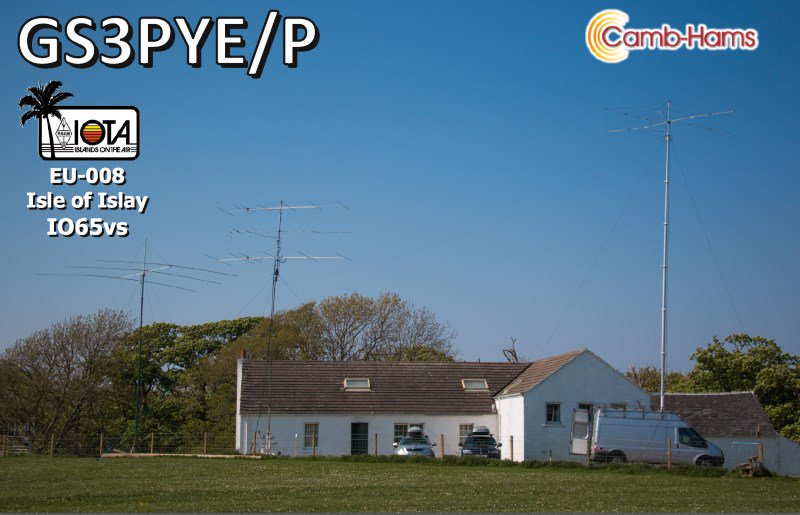
Camb-Hams 2018 Isle of IslayThe AMSAT News Service reports members of Camb-Hams operating GS3PYE/P will be active on the amateur radio satellites from the Isle of Islay between May 13-18.

The Camb-Hams have been activating the Scottish Isles each year since 2008. As in the past, ten or more operators will be active on all bands and many modes from 4m to 80m, 2m & 70cm for Satellites and 2m & 23cm for EME.

GS3PYE/P Satellite Station Isle of Islay 2018

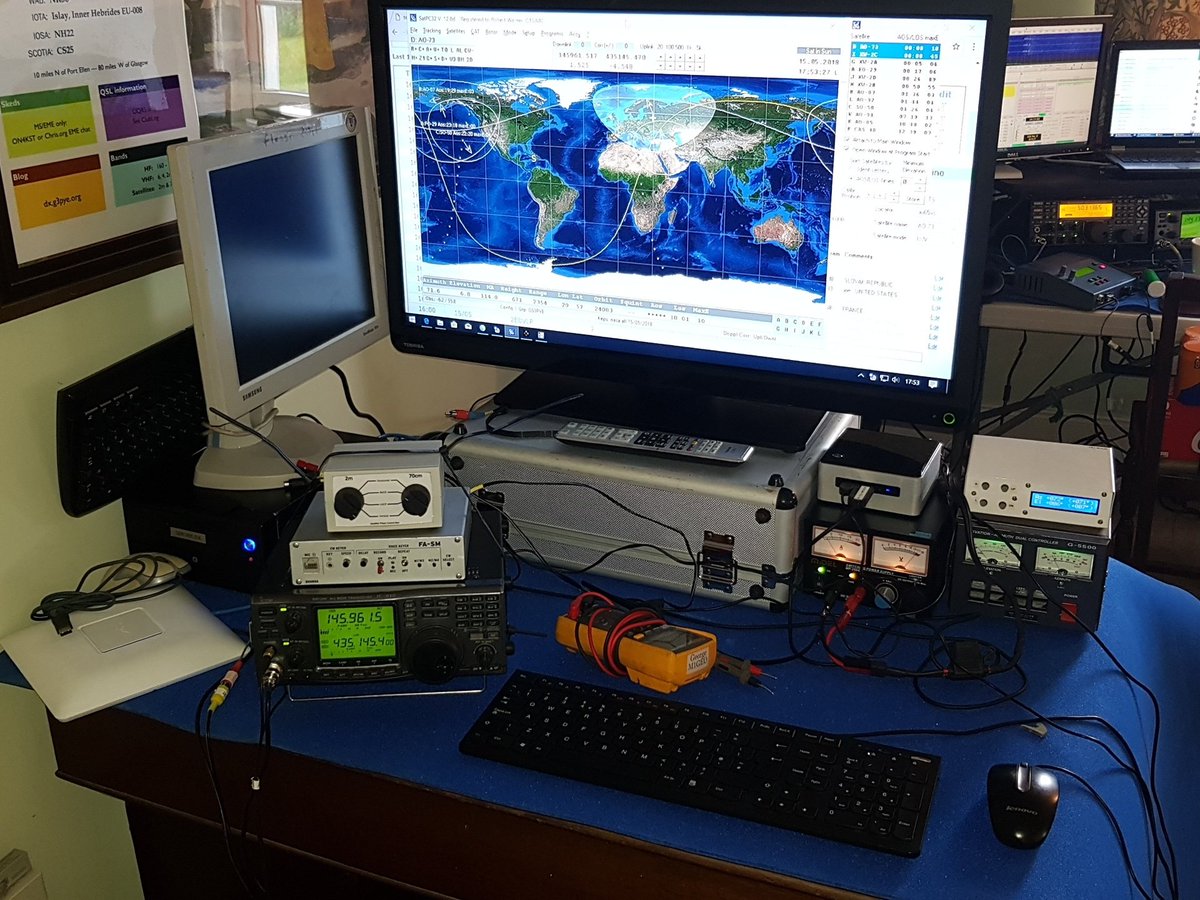
GS3PYE/P Satellite Station Isle of Islay 2018

The HF bands will be covered by four simultaneous stations while the 6m & 4m stations will have a great take-off towards the UK and Europe. All stations will be able to run at the full UK power limit. EME operations will use 150W to 55 elements on 23cm and 400W to 17 elements on 2m, primarily on JT65, but also available for CW skeds – if your station is big enough. Satellite operations on 2m & 70cm will use X-Quad antennas and a fully automatic Az/El tracking system.

Activity is planned on AO-7 (mode B), FO-29, SO-50 & AO-73.

Most importantly, this is a group of good friends doing what they enjoy, so please give them a call and enjoy the trip with them. They will be active on the major social networks before, during and after the trip, you can check on their progress and interact with the operators via their blog or through Twitter, Facebook and YouTube [see links below]. Please check their Web page for details on how to arrange skeds on the more challenging bands, modes, VHF and EME.

QSL via OQRS (info on QRZ.com) or M0VFC direct or via bureau.

Camb-Hams
http://dx.camb-hams.com/
https://twitter.com/g3pye
https://facebook.com/CambHams
https://youtube.com/CambHams

Additional Spectrum in EI – Clarification from IRTS

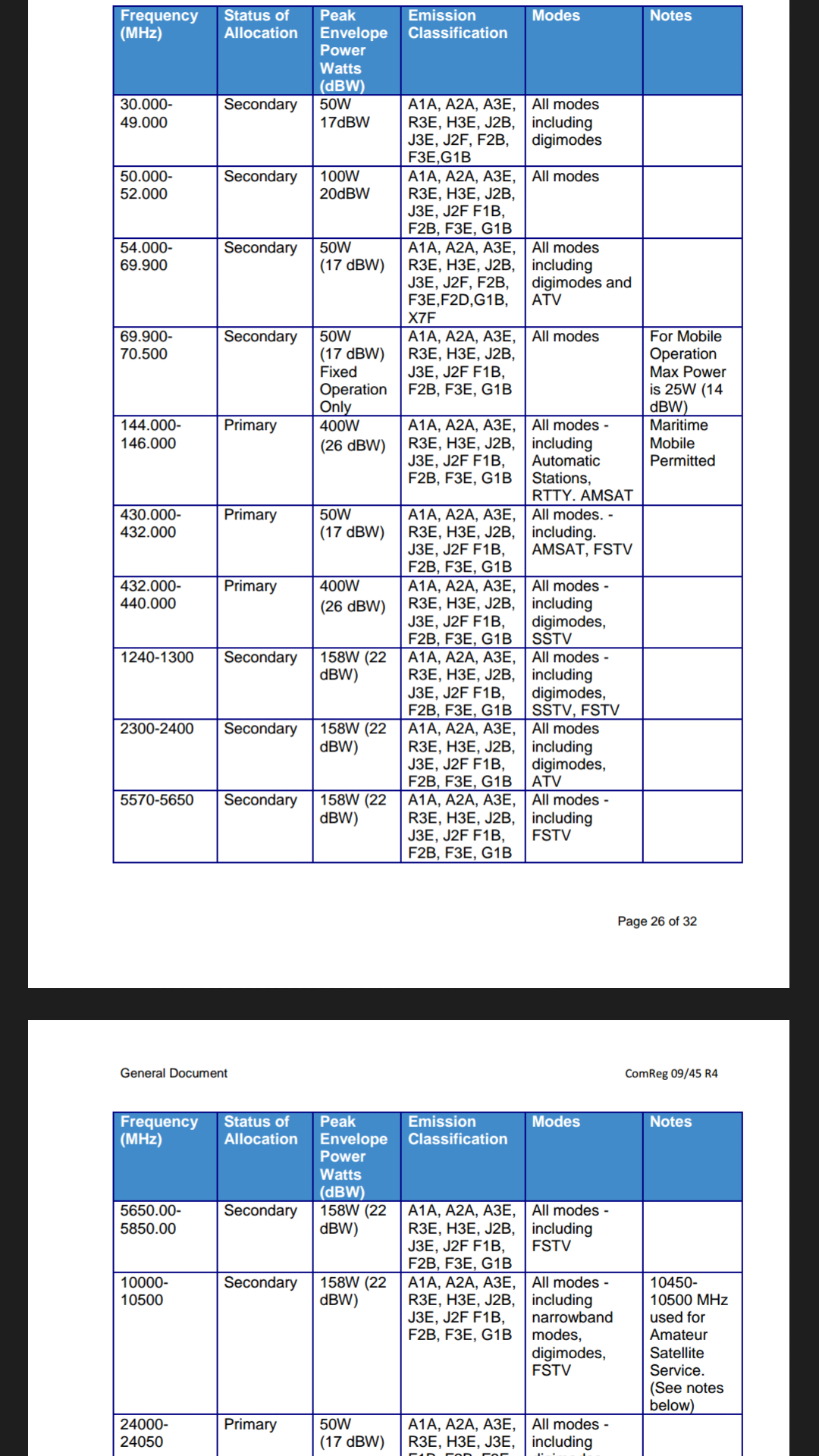
Frequency Table

Frequency Table

The very welcome announcement of the massive allocation by ComReg of low-band VHF spectrum to the Amateur Service raised some questions about the wording in the document.

Seán Nolan EI7CD, IRTS/ComReg Liaison, has kindly provided this clarification:

The use of AMSAT in ComReg Document 09/45 R4 is regrettable and is a legacy issue carried forward from earlier versions of the Amateur Station Licence Guidelines. Most of ComReg’s documents are commercially sensitive and no draft documents (other than consultations) are published. Although documents relating to amateur radio are not commercially sensitive we do fall under the non-publishing of draft documents embargo.

The use of AMSAT somewhat randomly confuses the actual situation regarding satellite operation. The frequencies in Annex 1 of the Guidelines are available to all CEPT Class 1 and Class 2 licensees. So far as satellite operation is concerned amateurs here can use the satellite segments mentioned (435-438 MHz; 1260-1270 MHz: 5650-5670 MHz –uplink and 5830-5850 MHz –downlink). The “All modes” in the Modes column in Annex 1 covers the relevant operating mode for the satellite concerned. Similarly 10450-10500 MHz can be used for satellite communications.

In the Modes column of Annex 1, all modes are indicated. In many cases “including digimodes” is stated but of course ‘all modes’ includes digimodes. In the definitions in Annex 1 digimodes are defined as “Any digital mode such as —–“. So DSTAR, DMR etc would be included.

We will of course work with ComReg to secure additional spectrum and facilities. The present initiative by ComReg is as a result of such work by IRTS. In this context we would hope in the future to get 2400-2450 MHz among the bands on general release.

Finally some people are wondering why we didn’t get 52-54 MHz. We have of course been seeking this. However, as you know the question of granting 52-54 MHz to Region 1 of the ITU to align with ITU Regions 2 and 3 is the subject of Agenda Item 1.1 of WRC-19. ComReg will be involved in in seeking to establish a CEPT Common Position and so will not move on it before WRC-19. If the IARU WRC-19 initiative is not successful we will seek a national allocation at 50-54 MHz under Article 4.4 of the ITU Radio Regulations.

I realise that the somewhat random use of “AMSAT” and the use of “All Modes” in some places and “All modes including digimodes” in others can lead to confusion. I hope my attempt to ‘clarify’ helps.

Best regards,

Seán Nolan EI7CD
IRTS/ComReg Liaison

The new ComReg amateur radio document can be downloaded from
http://comreg.ie/publication-download/amateur-station-license-guidelines

Amateur radio regulatory changes in Eire
https://amsat-uk.org/2018/05/01/amateur-radio-regulatory-changes-in-eire/

Amateur radio regulatory changes in Eire

ComReg LogoComReg‘s massive allocation of low-band VHF spectrum to radio amateurs in Eire is most welcome and sets an example to other regulators but other aspects of the regulations raise questions especially regarding Amateur-Satellite Service allocations.

Unusually for an official document ComReg seem to use “AMSAT” as an abbreviation for the ITU Amateur-Satellite Service, however, they fail to define exactly what they intend it to means. AMSAT is a registered trademark of a USA Corporation, see https://www.amsat.org/notification-of-trademark-copyright-and-other-proprietary-information/
Frequency Table

Frequency Table

The low-band VHF Amateur Service allocations are now:
30.0-49.0 MHz 50 watts
50.0-52.0 MHz 100 watts
54.0-69.9 MHz 50 watts
69.9-70.5 MHz 50 watts

The national amateur radio society, IRTS, are to be congratulated on achieving amateur access to so much spectrum.

The ComReg document as written appears to mean amateur satellite operation is not permitted in these ITU Amateur-Satellite Service allocations:
435-438 MHz
1260-1270 MHz
5650-5670 MHz
5830-5850 MHz

Oddly satellite operation is permitted in 430-432 MHz but there are no amateur satellites there!

Transmitting to amateur satellites operating in 2400-2450 MHz is only allowed with a Special Permit, it’s not included as standard in the licence. Even with the Permit amateurs will be restricted to a transmitter output of just 25 watts.

ComReg limit which modes that can be used in each band by listing three-character ITU Emission Designators. For example X7F is among those permitted for the 54.0-69.9 MHz band and means Digital Amateur TV (e.g. DVB-S) can be used. Unfortunately it appears to be the only band where X7F is permitted, an unnecessary restriction.

The Emission Designators for digital voice modes such as D-STAR and DMR don’t appear to be listed anywhere suggesting they cannot be used.

In 2006 the UK regulator Ofcom adopted a Technology Neutral approach to amateur radio, they scrapped listing of specific Emission Designators and allowed all modes to be used. It is unfortunate ComReg hasn’t taken this opportunity to do the same.

The new ComReg amateur radio document can be downloaded from
http://comreg.ie/publication-download/amateur-station-license-guidelines