Winter issue of OSCAR News now available

OSCAR News 216 December 2016 Front CoverE-members of AMSAT-UK can now download the Winter edition of OSCAR News here.

In this edition “FUNcube Update” has the latest information on the new Jordanian satellite JY1Sat which will carry a 435/145 MHz amateur radio linear transponder and will transmit images.

The paper edition should be sent to postal members in 2-3 weeks.

In this issue:
• From the Secretary
• 2017 Meetings & Events calendar
• The AMSAT-UK Shop
• A 25MHz reference for ADF4350/4351 based synthesisers
• ISS Packet Digipeater on 437.550 MHz
• Change in AMSAT-UK Membership ‘Rules’
• Orbital Debris
• UK Radio Amateur Receives Sir Arthur Clarke Award
• ARISS International Face to Face Meeting
• AMSAT-NA Space Symposium at Sea
• EO79 FUNcube transponder commences regular operation
• Spacecraft currently active with FM or linear transponders
• HamTV update
• Robin Haighton, VE3FRH – Silent Key
• SatCamp
• The “handover” of the ESEO AMSAT payload Engineering Model
• FUNcube (and other projects) update Dec 2016
• Satellite Orbits

AMSAT-UK FUNcube Mission Patch

AMSAT-UK FUNcube Mission Patch

Membership of AMSAT-UK is open to anyone who has an interest in amateur radio satellites or space activities, including the International Space Station (ISS).

E-members of AMSAT-UK are able to download OSCAR News as a convenient PDF that can be read on laptops, tablets or smartphones anytime, anyplace, anywhere. Join as an E-member at Electronic (PDF) E-membership

PDF sample copy of “Oscar News” here.

Join AMSAT-UK using PayPal, Debit or Credit card at
http://shop.amsat-uk.org/

E-members can download their copies of OSCAR News here.
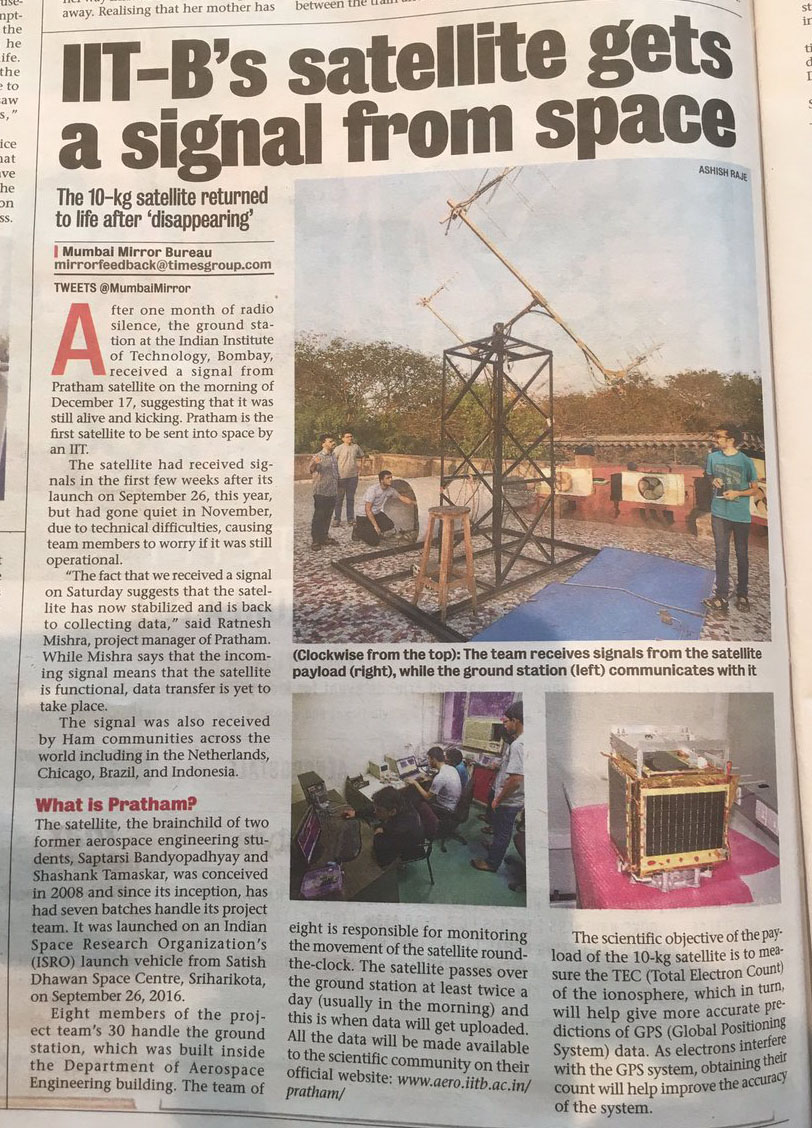
Pratham student satellite returns to life

Pratham satellite in Mumbai Mirror

Pratham satellite in Mumbai Mirror

The Mumbai Mirror reports on the return to life of the Pratham satellite launched on September 26, 2016. Pratham carries an amateur radio payload and was built by students at the Indian Institute of Technology Bombay (IIT-B).

The newspaper says:

After one month of radio silence, the ground station at the Indian Institute of Technology, Bombay, received a signal from Pratham satellite on the morning of December 17, suggesting that it was still alive and kicking. Pratham is the first satellite to be sent into space by an IIT.

The satellite had received signals in the first few weeks after its launch on September 26, this year, but had gone quiet in November, due to technical difficulties, causing team members to worry if it was still operational.

“The fact that we received a signal on Saturday suggests that the satellite has now stabilized and is back to collecting data,” said Ratnesh Mishra, project manager of Pratham. While Mishra says that the incoming signal means that the satellite is functional, data transfer is yet to take place.

Read the full article at http://mumbaimirror.indiatimes.com/mumbai/other/IIT-Bs-satellite-gets-a-signal-from-space/articleshow/56075162.cms

Pratham info https://amsat-uk.org/2016/09/07/pratham-student-satellite/

CAS-4A and CAS-4B to have Ham Radio Linear Transponders

XW-2A satellite launched September 19, 2015

XW-2A satellite was launched September 19, 2015

CAMSAT is working closely with a Beijing Government aerospace contractor to build two satellites with amateur radio linear transponder payloads.

Both will carry a 435/145 (U/V) 20 dBm (100 milliwatt) SSB/CW linear transponder, a 2m CW 17 dBm (50 mW) telemetry beacon and an AX.25 4.8 kbps GMSK 20 dBm (100 mW) telemetry downlink.

Each set of amateur radio equipment will have the same technical characteristics, but will have different frequencies for the 70cm band uplinks and 2m band downlinks.

The two micro-satellites will also carry optical remote sensing missions. Planned to be 494x499x630 mm dimension regular square shape and approximately 50 kg mass with three-axis stabilization system.

Expecting a launch from Taiyuan on March 31, 2017 into a 524 km orbit with an inclination of 42 degrees.

IARU Satellite Frequency Coordination pages http://www.amsat.org.uk/iaru/

Lunar Amateur Radio Satellites DSLWP-A1/A2

Full Moon 2010 - Credit Gregory H Revera

Full Moon 2010 – Credit Gregory H Revera

Mingchuan Wei BG2BHC reports DSLWP is a lunar formation flying mission for low frequency radio astronomy, amateur radio and education, consists of 2 microsatellites.

Developed by students at the Harbin Institute of Technology the amateur radio payload onboard DSLWP-A1 will provide telecommand uplink and telemetry / digital image downlink. An open telecommand is also designed to allow amateurs to send commands to take and download an image.

The satellites are 50x50x40 cm with a mass of about 45 kg and are 3-axis stabilized. Two linear polarization antennas are mounted along and normal to the flight direction.

The team proposes downlinks for A1 on 435.425 MHz and 436.425 MHz while downlinks for A2 would be 435.400 MHz and 436.400 MHz using 10K0F1DCN or 10K0F1DEN 250 bps GMSK with concatenated codes or JT65B.

Planning a launch into a 200 x 9000 km lunar orbit in June 2018. Further info at http://lilacsat.hit.edu.cn/

IARU Amateur Satellite Frequency Coordination pages http://www.amsat.org.uk/iaru/

RSGB Spectrum Forum Reports Released

Sarah-Sipple-M6PSK-G100RSGB_Aug2013The reports from the RSGB Spectrum Forum meeting held October 29, 2016 have been released. The VHF Spectrum Report highlights the 12 dB increase in Noise Floor.

The report, produced by the RSGB VHF Manager John Regnault G4SWX, notes that Ofcom have increased the noise floor criteria used to calculate coverage areas for Low Band VHF from -104dBm to -92dBm. This recognises the increase in human-generated noise in this part of the spectrum.

The increase in Noise Floor level means you now need 150 watts to achieve the coverage once obtained with a 10 watt transmitter.

Read the VHF Spectrum Report at
http://rsgb.org/main/files/2016/11/5.2_VHF-Managers-report_Oct2016.pdf

Read the AMSAT-UK report at
http://rsgb.org/main/files/2016/11/7.1_AMSAT-UK_SpectrumForum_Oct2016.pdf

Read the other Spectrum Forum reports at
http://rsgb.org/main/blog/spectrum-forum-posts-overview/spectrum-forum-meeting-minutes/2016/11/04/spectrum-forum-meeting-2016/

IARU issue Amateur-Satellite Service spectrum requirements

IARU_LogoThe IARU has released a revised edition of Spectrum Requirements for the Amateur and Amateur-Satellite Services.

The document mentions the need for the expansion of the 20m band from 14000-14350 kHz to 14000-14400 kHz which was the spectrum originally allocated to amateurs at the 1927 Washington Conference. No expansion to the 14 MHz Amateur-Satellite allocation is planned.

The IARU seeks expansion to 250 kHz of the Amateur-Satellite Service allocations at both 18 and 24 MHz.

A harmonized allocation for the Amateur-Satellite Service is sought at 50-54 MHz, to bridge the gap between 28 MHz and 144 MHz but it should be noted the IARU plans for a harmonized 50 MHz band at WRC-18 are for the Amateur Service only not Amateur Satellites.

The document notes that because of the crowding of the existing band 435-438 MHz with uncrewed amateur satellites and crewed space stations, it is desirable to study expansion of the band. This is exactly what the IARU were saying over 8 years ago, as yet they do not appear to have actually studied band expansion. See the 2008 IARU Spectrum Requirements document.

Regarding the existing 1260-1270 MHz Amateur-Satellite Service allocation the IARU say they seek the deletion of the “Earth-to-space only” restriction. They note that WRC-2000 allocated the band 1240-1300 MHz to the radiodetermination-satellite service for space-to-space use. In addition, WRC-2000 allocated the band 1260-1300 MHz to the radiodetermination-satellite service for space-to-Earth use such as for the European Galileo positioning system. These actions do not change the Amateur and Amateur-Satellite Service allocations but present new sharing situations and potential operating restrictions.

Due to the high level of interference from license exempt devices substitute spectrum for the Amateur-Satellite Service 2400-2450 MHz allocation is sought.

It seems the IARU no longer any intends to seek a global Amateur-Satellite Service allocation at 3400-3410 MHz.

There are no plans to improve the status of Amateur-Satellite allocations at 5 or 10 GHz.

Download the Spectrum Requirements document from
http://www.iaru.org/spectrum-requirements.html

Download the Summary Record of the IARU Administrative Council meeting held in Viña del Mar, Chile, October 7-8, 2016 http://www.iaru.org/administrative-council-meetings.html