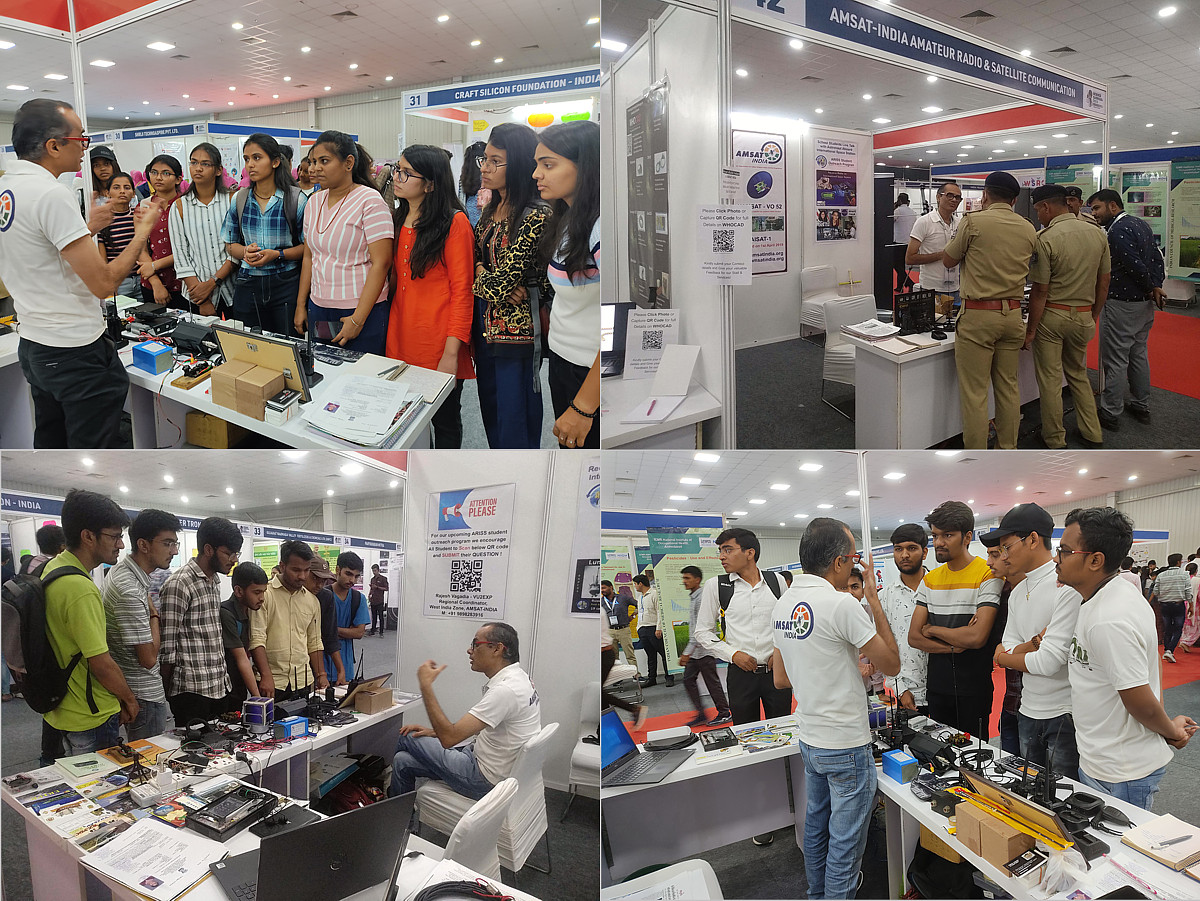
Engineering Students were among the visitors to the stand
To celebrate National Science Day of India on February 28 one of the biggest Science Carnival 2023 was organised by Gujarat state – India at prestigious Science City Ahmedabad during 28th February to 4th March 2023.
AMSAT-INDIA was specially invited to participate in this biggest scientific exhibition for mass awareness on Amateur Radio & Satellite Communication!
AMSAT-INDIA Regional Coordinator Rajesh Vagadia VU2EXP & team member Sakshi Vagadia VU3EXP did huge efforts to mass promote AMSAT activities amongst all sort of visitors which includes young kids, school-college students, budding engineers, IT Programmers, general public, professionals from various industries, scientists from renowned organization like ISRO, PRL, IPR, VSSE, ISR, officers from BSF, Police, Fire dept and citizens from every walk of life! More than 100,000 visitors were reported and grabbed the opportunity to visit science carnival 2023 and our Science exhibition during 5 days.
AMSAT-INDIA stall was spacious & decent sized at 3m x 3m, it was a big attraction at the center of the Science Exhibition. With well prepared different informative Banners on AMSAT-INDIA, Various Satellite Activities, Amateur Radio Satellite chronology, ARISS Student outreach program, ARISS SSTV event, Question submission for our upcoming ARISS student outreach program etc was absolutely eye catching from a distance.

Kiran on the AMSAT-India stand
For the curious visitors we tried to highlight every aspect of our hobby and exhibited all sorts of Radio stuff, Documents, QSL Cards, Books, Ham Licence, Awards, Project articles, Tracking software, SSTV software, SDR Software, Cube Satellite models etc to give bit idea of our hobby.
Experiencing various amateur radio gears, satellite antenna & test instruments were highly appreciated by visiting budding engineers from a number of colleges at AMSAT-INDIA stall. Some of the stuff we displayed include; Dual band Arrow-II antenna, dual band Yagi, tape measure antenna, GP, Telescopic antenna for SDR, Radios includes Icom IC-705 with LiFePO4 battery pack, Kenwood VHF base, half dozen of VHF/UHF HTs, RTL-SDR setup, LDG ATU, NanoVNA, Morse Key, cw oscillator, Paddle, electronic keyer, SWR/Power meter, Cable, Connectors etc. It made our task easy to explain the use of each stuff according to the visitors’ query.
We came across various types of queries like how to be a Ham, Procedure to get license, Types of Amateur Radio satellites, operating modes, setting up ground station, how to receive ISS SSTV images, how to establish satellite contact etc. We made a humble attempt to answer & satisfy all of those queries. We enjoyed a very detailed discussion with students/groups who already know about Amateur Radio and always need to learn more on Satellite Communication.
We also highlighted contributions of worldwide AMSAT organizations, IARU, ARISS, RSGB, ARRL and our ARSI & GIAR. I also mark a note on an author and my teacher Mr. Nagendra Vijay of popular Gujarati Science magazine named ‘Scope’ who did tremendous efforts to introduce Ham Radio in Gujarat (India) 40 years back and still continue to create awareness via it’s leading Science magazine ‘Safari’, his stall was just after a row.
Our AMSAT-INDIA stall were visited by many well-wisher GIAR Ham friends including VU2CPV Pravinbhai, VU2JGI Jagdishbhai, VU2MJP Manojbhai, VU2SPF Bhatnagarji, VU3APY Asheshbhai, VU3VDC Vitthhalbhai, VU3GLY Priyesh, VU3WHO Snehal etc.
It was a great experience for us to spend the whole 5 days enjoying talking & explaining our favorite hobby Amateur Radio & Satellite Communication!
We were happy to present amateur radio as a scientific hobby & experimenting platform for diversified fields and not just emergency communication tools!
Lots of positive & appreciating feedback we received in the visitor feedback book.
We are thankful to Science Carnival 2023 Organiser Dr. Vrajesh Parikh, Pulkesh Prajapati, Dr. Narotam Sahoo & team for inviting us for this prestigious Science Carnival Exhibition. I also thank our AMSAT-INDIA Secretary Mr Nitin Muttin VU3TYG, Director Educational B. A. Subramani VU2WMY, President Ramesh Ramsubbu VU2RMS & committee for complete guidance and support extended to us.
I specially thank team member Sakshi Vagadia VU3EXP & my XYL Kiran Vagadia for supporting and assisting me all the time during the 5 day exhibition.
I am optimistic to see the next generation taking keen interest in Amateur Radio & Satellites from VU Land.
Thank you
73 Rajesh Vagadia VU2EXP
Rajkot – Gujarat
Regional Coordinator West India Zone, AMSAT-INDIA
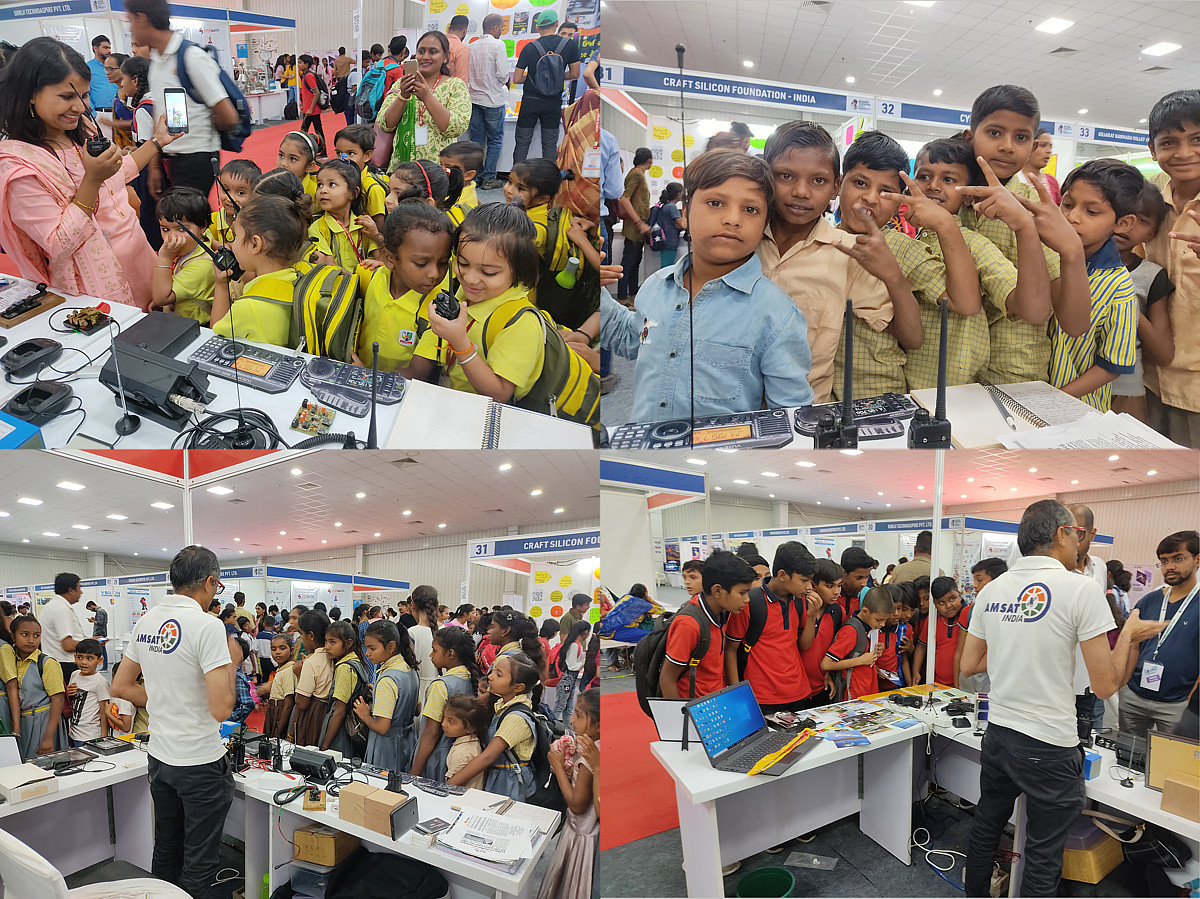
Many youngsters visited the stand




 AMSAT-UK
You must be logged in to post a comment.