RSGB Letter in PC Pro Magazine

PC Pro Magazine LogoRSGB President John Gould G3WKL highlights Amateur Satellites, FUNcube and the RSGB Youth Committee in a letter, an edited version of which appears on page 30 of the October issue of PC Pro Magazine, in the shops now.

See the full text of John’s letter at http://www.pcpro.link/252rsgb

The letter was a follow-up to an article in the August issue of PC Pro Magazine by Jon Honeyball G1LMS
http://www.southgatearc.org/news/2015/july/ham_radio_in_pc_pro_magazine.htm

Twitter links:
G1LMS – https://twitter.com/jonhoneyball
G3WKL – https://twitter.com/G3WKL
RSGB  – https://twitter.com/theRSGB
Youth Committee – https://twitter.com/theRSGByouth
PC Pro https://twitter.com/pcpro
AMSAT-UK https://twitter.com/AmsatUK

Amateur Radio Allocations Discussed

Logo WRC RA 2015At the CEPT CPG-PTA-8 meeting in Catania, Sicily, July 21-24, 2015 several amateur radio allocations were discussed.

The minutes contain these items of interest to the Amateur and Amateur Satellite Services:
4.13.1.1 IMT/MBB above 6 GHz
4.13.1.3 Amateur allocation to 50-54 MHz
4.13.1.7 To consider an allocation to the space operation service in the range 137-960 MHz to accommodate the growing number of small non-GSO satellites
4.13.1.11 Studies towards an identification for land mobile and fixed services operating in the frequency range 275-450 GHz
4.13.1.14 Amateur proposal for new primary allocation between 1800-2000 kHz

Annex VI notes these potential new IMT (mobile broadband) allocations were discussed:
• 10.0-10.45 GHz – France/Germany/Italy/Denmark – Lack of bandwidth.  UK, Sweden support parts of this band
NATO harmonized band.
• 45.5-48.9 GHz – No opposition received on this band. Added to draft Resolution. IARU noted that the amateur service have a global primary band between 47-47.2 GHz
• 66-71 GHz, 71-76 GHz, 81-86 GHz – Satisfies bandwidth argument and no opposition was expressed. Bands added to draft Resolution.

To download the meeting documents:
• Go to http://www.cept.org/ecc/groups/ecc/cpg/cpg-pt-a/client/meeting-documents
• Click on 2015
• Click on 8th CPG PTA Meeting – 21-24 July – Sicily
• Click Input Contributions and Goto table
• Tick documents
• Click on Minutes and Annexes and Goto table
• Tick documents
• Do same for Annex IV – Draft Briefs, Annex V – Draft ECPs, Annex VI – misc
• Click the Download selected button

WRC-15 takes place in Geneva, Switzerland, from November 2-27, 2015
http://www.itu.int/en/ITU-R/conferences/wrc/2015/

SUWS WebSDR supports Meteor Scatter enthusiasts

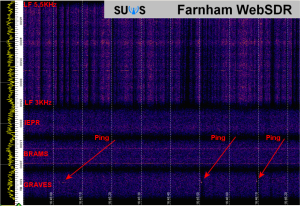
Meteor pings received on SUWS WebSDR

Meteor pings received on SUWS WebSDR

The SUWS WebSDR, a popular resource for the Amateur Satellite and 434 MHz High Altitude Balloon communities, has recently been upgraded to support VLF and 49.990 MHz for Meteor Scatter observations.

The SUWS team hope that these new bands will further enhance the capabilities of the WEB SDR, which already covers a large proportion of the 2m, 70cm and 3cm Amateur bands.

The bands were added in order to try and replicate some of the work already undertaken by Dr David Morgan 2W0CXV and to make the SDR available as an on-line resource for others who are interested in observing such phenomena.

https://amsat-uk.org/2015/06/09/the-generation-of-vlf-emissions-by-meteors/

Antenna's at SUWS WebSDR site in Farnham

Antenna’s at SUWS WebSDR site in Farnham

Performance on the VLF bands is now quite good, but it still suffers slightly from some electrical noise from other equipment in the site and Sferic noise (Lightning discharges) from about 4 kHz upwards.

50 MHz is currently operating on a temporary antenna, but it is possible to hear the local beacons and repeaters, plus more distant Amateur stations during Sporadic E openings. So it is a good indicator of band conditions, but is probably not quite sensitive enough at the moment to allow detection of some of the weaker meteor pings emanating from the BRAMS CW radar on 49.97 MHz and IEPR CW radar on 49.99 MHz

However 143 MHz is working well and Pings from Graves on 143.05 MHz can be heard quite frequently.

Here is an example of how the WEB SDR can be used to detect meteors.

It is possible by looping a PC sound card input and output whilst running a web browser, to use Spectrum Lab to display a waterfall of the audio from the PC. Then by opening multiple instances of the WEB SDR in the browser, selecting USB and setting each SDR instance to a slightly different centre frequency and adjusting the filter pass-bands. It is possible to concurrently capture plots from VLF signals, IEPR, BRAMS and GRAVES and display them side by side on one screen (see attached). Because the same PC, Browser and internet connection is being used for all the signals, the plots should be almost time synchronous.

The SUWS team hope that these new enhancements will be enjoyed by their users, and expect that further improvements will continue to be made over the coming months.

Use the SUWS WebSDR at http://websdr.suws.org.uk/

Radio Astronomy Group Meteor Scatter Workshop takes place in Northampton on October 31
https://amsat-uk.org/2015/08/11/rag-meteor-scatter-workshop/

Getting started in Amateur Radio Meteor Scatter (MS)
http://www.geekshed.co.uk/getting-started-in-meteor-scatter-ms/

AMSAT-UK https://amsat-uk.org/
Twitter https://twitter.com/AmsatUK
Facebook https://facebook.com/AmsatUK
YouTube https://youtube.com/AmsatUK

AMSAT-UK publishes a newsletter, OSCAR News, which is full of Amateur Satellite information. A sample issue of OSCAR News can be downloaded here.
Join AMSAT-UK via the online shop at http://shop.amsat.org.uk/

What is Amateur Radio ? http://www.essexham.co.uk/what-is-amateur-radio

GB1DS – Amateur Satellites and Meteor Scatter

Meteor Scatter Propagation - SNOTEL

Meteor Scatter Propagation – SNOTEL

Run by the Brecon & Radnor Amateur Radio Society, GB1DS will operate on most bands and satellites on the weekend of August 15-16, coinciding with the annual Perseids meteor shower which will make for an incredible operation.

In co-operation with the Brecon Beacons National Park, the station aims to promote the incredible beauty of the Beacons and surrounding areas during such a special time. One of only five Dark-Sky reserves in the world and the only one in Wales.

More information about the Brecon Beacons and its Dark-Sky reserve can be found at http://www.breconbeacons.org/stargazing

Information on the station can be found at http://qrz.com/db/gb1ds

The Essex-based Loughton & Epping Forest Amateur Radio Society (LEFARS) recently tried Meteor Scatter, see http://lefars.org.uk/WPblog/2015/08/10/meteor-scatter/

Getting started in Meteor Scatter (MS) http://www.geekshed.co.uk/getting-started-in-meteor-scatter-ms/

Free WSJT software http://physics.princeton.edu/pulsar/k1jt/

Meteor Scatter Information
http://www.mmmonvhf.de/ms.php
http://rsgb.org/main/technical/propagation/meteor-scatter/

Radio Astronomy Group Meteor Scatter Workshop Oct 31 with Jean-Louis Rault F6AGR
https://amsat-uk.org/2015/08/11/rag-meteor-scatter-workshop/

Do not Digipeat via PCSAT

US Naval Academy PCSAT

US Naval Academy PCSAT

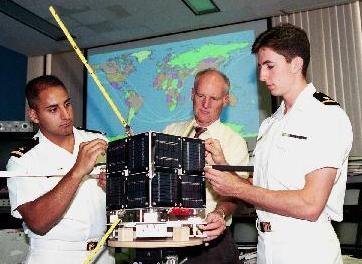
As has been reported in the RSGB News, the PCSAT spacecraft was launched September 30, 2001 and has, due to an on-board power system issue, started to transmit APRS again on 144.390 MHz.

Although this is the correct frequency for APRS operation in IARU Region 2, it is not compatible with our Region 1 bandplan which has this part of the band designated for weak signal and particularly Meteor Scatter operation.

The orbit of this spacecraft means that sometimes it is in full sunlight and, at other times, it is eclipsed for a major percentage of the orbit. As the on-board batteries have lost their ability to hold a charge, the problem can only occur when it is in sunlight.

Various methods of mitigate this problem are presently under active consideration but in the meantime it is important that no amateur in Region 1 should attempt to digipeat through this spacecraft. Additionally those amateurs on the east coast of the American continent are also requested not to attempt to activate the spacecraft when it can be “seen” from Europe.

At IARU level, further work is being undertaken to reduce the risk from future spacecraft potentially causing similar problems. Such problems could result from developers not following the globally agreed bandplans for amateur satellite operations. In particular the IARU Satellite Coordinator has been requested to make urgent contact with the team responsible for XW-2(CAS-3) mission of nine satellites from China. Some of the proposed frequencies do not respect the internationally agreed Region 1 Bandplan for 2 metres.

Interference from PC-Sat reported July 28, 2002 http://home.hccnet.nl/uffe.noucha/pcsat

SPROUT Deployable Membrane – Request for Telemetry

SPROUT satellite students at Nihon-Univ. Miyazaki Laboratory

SPROUT satellite students at Nihon-Univ. Miyazaki Laboratory

Students at Nihon University in Japan are requesting the assistance of radio amateurs in collecting telemetry from the SPROUT satellite which has deployed an inflatable membrane structure.

SPROUT Amateur Radio SSTV Satellite

SPROUT Amateur Radio Satellite

The SPROUT JQ1YGZ Team say:

We’d like to show to everyone about SPROUT, and we’d like to ask receiving cooperation to everyone.

SPROUT was launched at May 24, 2014 from Tanegashima Space Center in Japan.

There are 3 main missions in SPROUT.
・Deployment demonstration of inflatable membrane structure.
・Demonstration of attitude determination and control technology for several kilogram class nano-satellite.
・Upbringing of human resources of a space sector

For more information
http://sat.aero.cst.nihon-u.ac.jp/sprout-e/
Please see this website.

SSTV image received from SPROUT by Mario LU4EOU on May 31, 2014 at 0408 UT

SSTV image received from SPROUT by Mario LU4EOU on May 31, 2014 at 0408 UT

This time, we made a deployment demonstration of inflatable membrane structure. But it’s necessary to get a deal of data to get information on a satellite, and it takes time to get one of data only my satellite communication ground station.

So when everybody of amsat would do reception cooperation, information on a satellite can be got quickly.

We’d like to request reception cooperation of everybody of “AMSAT-UK” for study promotion.

If you wouldn’t mind, please reception cooperation. Please inform the following mail address of your question and a reception report – sprout_contact@forth.aero.cst.nihon-u.ac.jp

Best regards

SPROUT JQ1YGZ Team on Facebook https://www.facebook.com/profile.php?id=100008270115808

SPROUT transmits on 437.525 MHz FM 1k2 AFSK AX.25
http://www.dk3wn.info/sat/afu/sat_sprout.shtml

SPROUT SSTV activation https://amsat-uk.org/2014/05/31/sprout-sstv-digitalker-active/