Ham radio workshop held at PDEU University

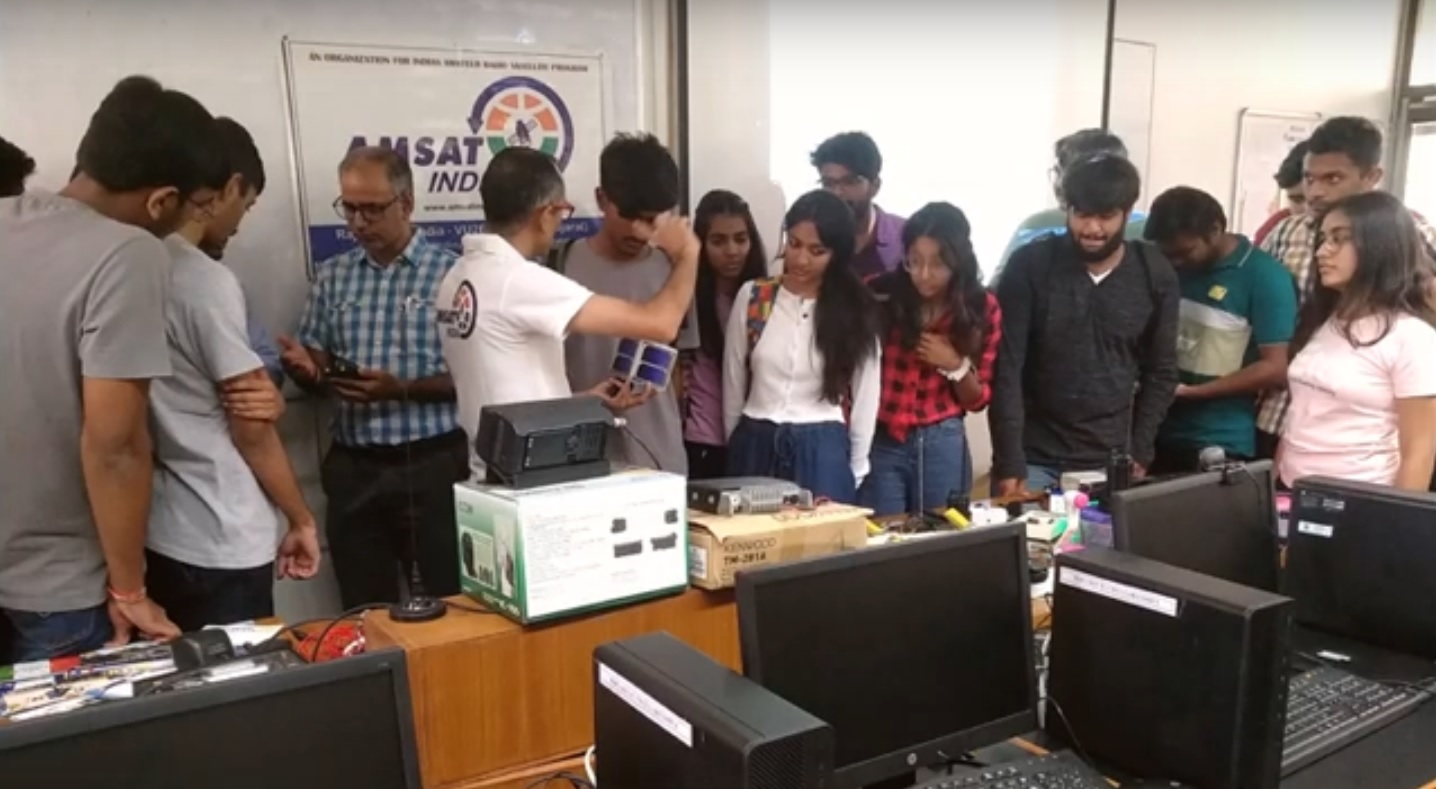
2022-04-05 Amateur Radio Workshop at PDEU UniversityA full featured two day Amateur Radio Workshop was conducted by Rajesh Vagadia VU2EXP (Regional Coordinator, AMSAT-INDIA) on April 5-6, 2022, at renowned university PDEU in Gandhinagar, Gujarat, India.

40 highly interested students of EC & ICT (plus faculties) dived into the fascinating World of Amateur Radio for two days. Total 8 hours of packed program was scheduled, on day 1 from 1330 to 1730 & for day 2 0900 to 1300 (IST).

On day 1 (5th April 2022), step by step I covered History & Introduction of Amateur Radio, Operating procedure, Modulations, Bands & Frequency allocations, Morse Code, RST Systems, Phonetic, Q-Codes, License Grades, Procedure to obtain Ham License etc. I always encourage students to ask their doubts at any point of my presentation, and with such practice I really get a number of interesting questions which I enjoy to answer all.

I tried to convey the real image of Ham operators Life – how Ham Radio is involved in our daily life. Students have been crazy when I said, a bachelor male operator is free to roam here & there and hence he’s known as VFO, but when he gets settled (after marriage) he is known as Crystal Controlled (Universal fact)! Also they wonder to know how we ham community extends our respect to even 75 year old female operator by mentioning them as Young Lady (YL). I explained how we use different numbers like 59 & 73, but warned not to use random figures like 88 for any YL as you might be in trouble (hi..hi..). All phases of life from being a Harmonic, OM, YL, Fundamental, Silent Key etc terms are part of radio operators’ life!

A good collection of Radio stuff was carefully displayed for the benefit of students, which includes, HTs, VHF/HF Base, PSU, Cables, Connectors, Adaptors, SWR / Power Meter, Frequency meter, L/C meter, NanoVNA, Dummy Load, Sound Card Interface, RTL-SDR Dongle, CPO, Morse Key, Electronic Keyer, Paddle, Fox hunt tape measure Antenna, GP Antenna, Telescopic Antenna, Dual Band Yagi Antenna, IOio Antenna, Attenuator, Offset Attenuator, Cube Satellite Model etc. Also I displayed my IC-705 SDR QRP Rig with LiFePO4 Power pack for various Demos!

All EC & ICT students really enjoyed & learnt the feature/functioning of most of the displayed stuff by trying it themselves. Additionally hundreds of my QSL cards, Log Book, Call book, various Awards, Ham Radio study books and interesting articles were kept on display which was thoroughly observed by students. They were amazed to see NASA QSL for Juno flyby experiment, Japan & German research center’s QSL from Antarctica, Awards for ARISS SSTV event and many more from IOTA, FD etc activation. I explained how we can send and receive paper QSL Cards very economically via QSL Bureau worldwide. Highlighted our ARSI’s QSL Bureau services from India.

All over first day was fully packed with lots of learning, enjoying radio stuff & clearing dozens of doubts of students. I got nice support from my family ham members VU3EXP Sakshi Vagadia & VU3GLY Priyesh Vagadia who accompanied me from my QTH Rajkot.

Satellite Communications Demonstration

Satellite Communications Demonstration

On day 2 (6th April 2022) we started our workshop at 0900. We had planned a series of practical demonstrations on this day. Initially I presented roles & objectives of various Ham organizations like AMSAT, ARISS & ARRL and informed how giant efforts are made by these organizations to promote Amateur Radio Satellite Activities, Encourage School Students towards STEM, and offering the ultimate knowledge base for radio hams. Also highlighted AMSAT-INDIA’s activities and its contribution of two Satellites VO-52 & AISAT. We gave an idea on how ARSI represents the interests of Indian Hams before national & international regulatory. GIAR Club was also recognized for their excellent Emergency Communication support to the State Government during natural calamities.

We have gracious presence of GIAR ham members’ incl. VU3IKI Ke Ke, VU3DVA Dipakbhai, VU3VDC Vitthhalbhai & VU3HXS Dhirenbhai at the workshop.

I presented how students can be engaged with ARISS ISS SSTV Events by receiving sstv Image with simple RTL-SDR Dongle & small homebrewed yagi antenna. We gave a live demo of the student’s SSTV Image transmission & reception with the help of two stations installed in the venue. Participants were wondering to see the Picture being transmitted in audio format & received/converted back to Student image.

Thereafter Morse code demo was carried out which was equally interesting for Students. I randomly asked the student’s name & generated his code with paddle & electronic keyer, the name was decoded by the software and projected on the screen! Students were taught the importance of Morse code (SOS) even for emergencies, though advised not to use codes during college exams! hi..hi..

For the Digital Communication demo, I invited students & faculties to send me a few messages. I converted those text messages into PSK31 audio signals & transmitted from station one, second station received & decoded each message mentioned with students’ name. It was fun to view student messages/ feedback projected on a big screen. Also briefed on various digital modes Ham operator uses.

Students then very well understood why Ham Radio is also known as the oldest Social Media, by seeing all such techniques we use since decades, that too without any mobile network or internet !!

Our Satellite Communication Demo was scheduled at 1047 (IST) with AO-91 Cube-Sat. The reason to choose this bird was suitable pass time & very good elevation of 63 degree, two days back we already checked this bird & it was functional. I already requested a few VU Hams to respond & support our Sat Demo.

All students & faculties get assembled at Rooftop by 1030. I used a pair of HT, IOio Dual Band Antenna and Tracking app in my simple setup. I explained various terms of satellite & basic procedure of operation to the group. All the students were very curious to see how a tiny cube-sat of 1.3 kg extend long distance communication within its footprint. I connected a wired (bluetooth) speaker with a bit of a long cable so the group can hear Reception. But as some of us have experienced, Murphy strikes at the last moment and my speaker failed just before appearing of AO-91 !!! There was no time for troubleshooting, I immediately used my headphone to avoid the audio loop, as it was my full duplex configuration. Two minutes later I could hear a strong signal of VU2LBW Lucky, I copied him 59, exchanged reports and established a successful Sat QSO. Lucky was really loud & clear with his decent setup.

I was willing to let faculty/student experience this live contact, I ask Lucky to address & respond again and I handed Headphone & Mic to Prof. Jigar Shah, Lucky patiently talked with him conveyed his Callsign, Handle & QTH Bangalore (MK82TV), Prof. enjoyed the live demo and responded well.

We also gave a chance to one more female student; meanwhile I was continuously tracking the satellite & aiming the antenna towards it. Before LOS I heard another good Station VU2UUU Kaustav Saha from Gurgaon (ML88NK), I worked with him too with 59 reports.

So it was a semi successful Satellite Demo as I could not allow all students to listen to ongoing (Rx) conversation. But participants were very happy to learn the complete procedure; they were thrilled to witness the potential of amateur radio satellites. Later on Lucky VU2LBW favored me by sharing our Sat QSO recording, which was circulated amongst all students for reference & memory!

At 1100 there was short tea break, participants were so enthusiastic that even in leisure time they been to radio stuff exhibition area to have closer look and learn more on devices like NanoVNA, CubeSat (model), Morse Keyer/Paddle, Signalink USB, RTL-SDR dongle, Icom IC-705 etc, I enjoyed interaction and satisfying their queries.

We were towards the ending session. I presented what are the interesting events radio amateurs enjoy & carry out globally, which includes Sp. Callsign Activation (highlighted my activated call AT1JCB), Field Day, Contests, Light House operation, IOTA (illustrated AT2SL), JOTA, Hill Top, Fox Hunting (ARDF), High Altitude Balloon Deployment & Tracking, EME, ARISS SSTV & Student outreach Program, SatCom, Satellite Telemetry decoding, Radio Astronomy, Meteor Scatter, Ham Fest etc.

I conveyed objectives & brief procedures of all these events into which Radio Hams love to be engaged. Participants learnt that Amateur Radio is much more than a Communication device! I always promote Ham Radio as an experimenting platform which has something for every genre.

At the end, students were asked to split into four groups to enjoy VHF Demo, students learnt how to operate a HT, Started giving calls to other groups, responding to the caller, giving feedback & comments over radio! Our fellow hams incl. VU3EXP, VU3IKI, VU3HXS, VU3VDC, VU3DVA and VU3GLY nicely assisted each group. Faculties’ incl. program coordinator Prof. Jigar Shah & HoD ICT Prof. Gangaprasad Pandey Sir conveyed Vote of Thanks over Radio. On behalf of our Ham team Sakshi Vagadia VU3EXP thanks to all participants & PDPU University for organizing this memorable workshop.

At 1300 our workshop concluded. Was nice to see students come out with learning something new & exciting, many showed their interest to be Radio Ham & enjoy this fascinating and unique hobby. Everybody liked our slogan ‘One World One Language’. There were huge efforts collectively made for this workshop and I wish to get some shining radio amateurs in the future.

I would like to specially thank VU2LBW Lucky & VU2UUU Kaustav for his valuable support during Satellite Demo, I understand they had devoted time on busy working day, after all that’s the spirit of Radio Amateur.

I thank PDEU University, Program Coordinator Prof Jigar Shah & HoD ICT Prof Gangaprasad Pandey Sir for extending excellent support & hospitality for our team and for making this workshop fruitful.

I have uploaded all Workshop Photos in YouTube.

Watch Glimpse of Ham Radio Workshop at PDEU University Gandhinagar by Rajesh Vagadia VU2EXP

A special note I would like to make it, I read & learnt about Ham Radio 35 years back in one well-known Gujarati science magazine named ‘Scope’, brilliantly written by Shri Nagendra Vijay Sir. After completing my workshop, during the return journey at Ahmedabad (Bopal), I got the opportunity to meet & take the blessing of Shri Nagendra Vijay Sir. What a brilliant personality, highly knowledgeable, but very low profile gentleman I ever met. I was inspired to begin my Ham journey by reading all his Article & dedicated ‘Ham Radio’ Book! To meet my mentor was a great moment for me; I hereby dedicate all my accomplishment to my knowledge guru (teacher) Shri Nagendra Vijay Sir. He still continues to inspire thousands of readers with his science magazine named ‘Safari’. I felt without giving credit to this author, my article will be incomplete.

Thanks & 73

Rajesh P. Vagadia – VU2EXP
Rajkot (Gujarat) India
Regional Coordinator,
West India Zone,
AMSAT-INDIA

Spring 2022 OSCAR News now available to download

Spring 2022 OSCAR News Front CoverE-members of AMSAT-UK can now download the March 2022 edition of OSCAR News, issue 237, here.

The paper edition edition will be sent to postal members and should arrive in the next 2-3 weeks.

In this issue:
• From the Secretary’s Keyboard
• AO-91 Distance Record
• 23cm Band and RNSS – Compromises need to be found
• JW0X – JW100QO by DX-Adventure
• How to add another satellite to the SatPC32 software
• Nayif-1 (EO-88) celebrates a 5th Birthday in orbit!
• AMSAT OSCAR 73 – The Beginning of the End?
• URESAT-1 – A chess playing ham radio satellite
• Two Minor Breakup Events in Fourth Quarter of 2021
• Some Initial Testing of Mobile Data Modes via QO-100
• Bob Bruninga, WB4APR (SK)
• Small Spacecraft Reliability Initiative Knowledge Base Tool v2.0 Released

AMSAT-UK FUNcube Mission Patch

AMSAT-UK FUNcube Mission Patch

Membership of AMSAT-UK is open to anyone who has an interest in amateur radio satellites or space activities, including the International Space Station (ISS).

E-members of AMSAT-UK are able to download the quarterly publication OSCAR News as a convenient PDF that can be read on laptops, tablets or smartphones anytime, anyplace, anywhere. Join as an E-member at Electronic (PDF) E-membership

PDF sample copy of “Oscar News” here.

Join AMSAT-UK using PayPal, Debit or Credit card at
http://shop.amsat-uk.org/

E-members can download their copies of OSCAR News here.

WRC23: 23cm band work continues in CEPT

CEPT CPG WRC23 LogoThe Chair of IARU Region 1 Spectrum Affairs, Barry Lewis G4SJH, reports on the work being done in defending the interests of the Amateur Services in the 1240-1300 MHz band.

On the IARU Region 1 site he writes:

The 4th meeting of the CEPT project team (CPG PTC) tasked with developing the CEPT Brief for WRC23 agenda item 9.1b on 23cm band amateur service and RNSS coexistence took place during March 2022. The IARU R1 was present and provided a contribution to the working document. A summary report describing the contributions and the meeting activity can be found here:
https://www.iaru-r1.org/wp-content/uploads/2022/03/IARU-Report-from-CPG_PTC4r1.pdf

The meeting did not tackle any technical studies directly but the developing brief reports and summarises the activities taking place in other groups where they are being carried out. Updates were made to the background including a description of the work carried out by the amateur community in CEPT and ITU‑R with respect to resolves 1 of the WRC-19 Resolution 774. Further updates were introduced to describe the study work taking place in ITU‑R (WP’s 4C and 5A).

The draft CEPT Brief will undergo further development as technical studies evolve in the wider regulatory community including both CEPT and ITU‑R. The next activity concerning this topic will take place in the CEPT arena (SE40) to progress the technical studies and the draft ECC Report.

Source IARU Region 1 https://iaru-r1.org/

CEPT CPG https://www.cept.org/ecc/groups/ecc/cpg/now4wrc23/client/meeting-documents/

Ofcom Consultation: Space Spectrum Strategy

Ofcom are holding a public consultation on their proposed strategy for managing radio spectrum used by the space sector.

Ofcom say:

Supporting the growing use of cutting-edge satellite technology to offer innovative services for people and businesses, is at the heart of Ofcom’s new proposed space spectrum strategy.

The space sector is expanding rapidly, with the number of space launches increasing by almost 60% between 2017 and 2021.

Companies such as OneWeb and SpaceX are deploying large numbers of new satellites – known as non-geostationary orbit (NGSO) satellite systems. Meanwhile, universities and start-ups are using smaller satellites to test and trial a range of exciting new projects.

Our proposed space spectrum strategy sets out our priorities for how we will help the sector deliver even more services in the coming years, while making sure it uses spectrum efficiently.

Supporting the growth of satellite broadband

Thousands of NGSO satellites orbit the Earth constantly, tracked by satellite dishes as they move across the sky, to provide broadband to homes and businesses in remote locations.

But these innovative news services need radio spectrum to work – and that’s where Ofcom comes in.

Our job is to make sure this spectrum is used efficiently and manage risks of interference between different spectrum users. So our space spectrum strategy sets out where we think we can make the biggest difference over the next two to four years, building on the licensing changes we introduced last year.

This includes considering options for future access to UK spectrum that could boost the capacity of satellite services, such as additional access to the 14.25 – 14.50 GHz band, as well as pursuing improvements to international NGSO rules.
Protecting vital Earth observation services

Earth observation satellites are playing an increasingly important role in collecting data on climate change. For example, they use radio waves to monitor changes in the natural world, such as the changing thickness of ice in polar regions. These systems also help other industries, such as agriculture, the emergency services and weather forecasting.

Part of our job is to help ensure Earth observation systems are protected from interference from other spectrum users.
Safe access to space

The rapidly rising numbers of space objects and proposals for mega-constellations has led to concerns across the space community about the potential for space debris.

Our role is to make sure there is appropriate spectrum available for systems that support the safe use of space, such as radar systems that track the many objects in space.

Helen Hearn, Ofcom Interim Spectrum Group Director, said: “While spectrum might be alien to some, we all rely on these invisible radio waves every day. And they’re vital to the rapidly growing space industry.

“So as the next generation of satellites beam down vital information to us, we’re playing our part to help the sector continue its journey and make sure these enterprising pioneers have the launchpad they need.”

The consultation closes on 24 May 2022 and we aim to publish our final strategy later this year.

Consultation document
https://ofcom.org.uk/__data/assets/pdf_file/0024/233853/consultation-space-spectrum-refresh.pdf

Further details anf response form at
https://www.ofcom.org.uk/consultations-and-statements/category-2/space-spectrum-strategy

EASAT-2 and HADES Update

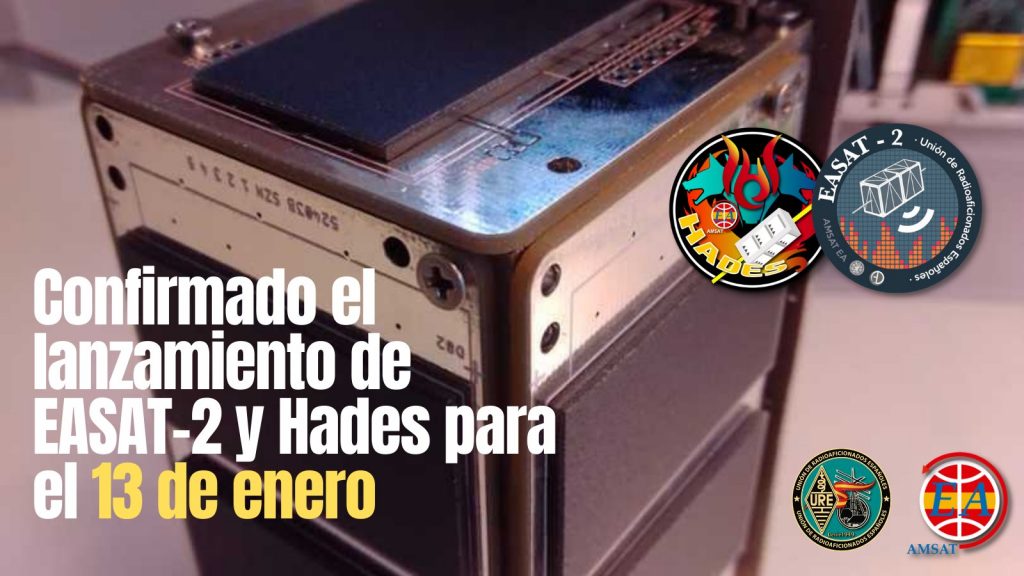
EASAT-2 and HADESAMSAT-EA Mission Manager Felix EA4GQS provides an update on the status of the EASAT-2 and HADES satellites launched on January 13.

On the AMSAT Bulletin Board he writes:

We confirm the reception of both EASAT-2 and HADES, as well as the decoding of telemetry and the FM recorded voice beacon with the callsign AM5SAT of the first one. EASAT-2 appears to be working well except for the deployment of the antennas, something that apparently has not yet occurred and causes weak signals. However, the AMSAT-EA team confirms that, based on the reception of FSK, CW, the FM voice beacon and the telemetry data that has been decoded, it can be said that the satellite is working perfectly. In the event of low battery or system malfunction, the on-board computer would not transmit CW messages or the voice beacon-callsign, as it would be in a ‘safe’ state with only fast and slow telemetry transmissions.

These signals that have been able to confirm the operation of both satellites were received by Dr. Daniel Estévez EA4GPZ at 18:07 UTC on Saturday, January 15, using two antennas from the Allen Telescope Array. The TLEs used were obtained from the radio amateur community, with Doppler observations from the Delfi-PQ satellite, deployed together with EASAT-2 and Hades.

TLEs used were these ones:
https://github.com/AMSAT-EA/easat2-tle-lottery/blob/main/satnogs-2022-01-16-DELFI-PQ.tle

Daniel EA4GPZ performed a preliminary analysis using just one polarization of one of the satellite dishes. EASAT-2 has been detected with a relatively strong signal, close to the Delfi-PQ signal, obtaining said recorded voice FM beacon transmissions and FSK, FSK-CW at 50 baud.

The CW beacon clearly shows the message: VVV AM5SAT SOL Y PLAYA, which is one of several that both satellites emit, although the callsign AM5SAT confirms that it is EASAT-2.

In the recording made by Daniel EA4GPZ there is also a faint trace confirmed to be from Hades and stronger packets probably from the IRIS-A satellite.

HADES, like EASAT-2, is transmitting weak signals, weaker than the ones of EASAT-2, most likely because the on-board computer has not yet managed to deploy the antennas either, although it will continue trying regularly. The reason the signals are suspected to be weaker at Hades is that the antennas are more tightly folded than those of EASAT-2. In any case, this is great news, since the transmission pattern confirms the proper functioning of the satellite. In the observations you can see the FSK tones with a deviation of about 5 kHz interspersed with the FM carrier corresponding to the voice beacon of the satellite, which has callsign AM6SAT. The AMSAT-EA team is working to try to decode the telemetry signals and obtain more detailed information on the state of the satellite.

We kindly ask you, if you have very high gain antennas, to try to receive them, specially Hades. If we could decode telemetry it would be very helpful for us.

Until antennas are deployed it will be very difficult to use their repeaters or to receive any SSTV camera images from Hades, but we hope that this will happen sooner or later, at least because even if the computer doesn’t succeed applying heat to the resistor where the thread is attached, with time, the thread should break due to the space environment conditions.

Details of the decoded telemetry and voice, as well as more details in:
https://www.amsat-ea.org/ (Texts are in Spanish)

And in the following Twitter threads:

EASAT-2 transmissions:
https://twitter.com/ea4gpz/status/1482457631566487553

EASAT-2 decodings by Gabriel Otero:
https://twitter.com/gaoterop/status/1482758196037050382

HADES transmissions:
https://twitter.com/ea4gpz/status/1482696274797338625

Thanks a lot and 73,

Felix EA4GQS – AMSAT EA Mission manager

IARU-R1: 23cm Band and RNSS – Compromises need to be found

RNSS - Credit IARU Region 1

RNSS – Credit IARU Region 1

The Chair of IARU Region 1 Spectrum Affairs, Barry Lewis G4SJH, reports on the work being done in defending the interests of the Amateur Services in the 1240-1300 MHz band.

On the IARU Region 1 site he writes:

As we head into 2022 the ITU‑R and CEPT work considering the 23cm band and coexistence with the RNSS systems (GALILEO, COMPASS, GLONASS, GPS…) will continue so where have we got to and where is it heading?

The IARU has provided extensive information regarding the amateur and amateur satellite service applications in the band 1240 – 1300MHz as well as operational characteristics and data indicating the density of active transmitting stations and the busiest periods when these are most likely to be operational. Using this data, one CEPT administration has provided an extensive set of propagation model predictions for a number of amateur operating scenario assumptions (including satellite working and EME operation) that predict an “interfered area” over which an amateur transmissions may be received by a RNSS receiver at levels exceeding a defined protection level. Another ITU‑R member administration contributed a smaller set of predictions using the same model. The received RNSS interference level that the RNSS can tolerate (receiver protection level) is based on ITU‑R recommended criteria and depends on whether narrowband or wideband interfering signals are being transmitted.

The propagation model predicts that an interfered area can extend out to several tens of km (depending on the scenario) but at the extremes of the area, the time probability of exceeding the protection level is very low (1%) and for only 50% of locations. The model can only assume a full power continuous transmission.

In addition much attention has been paid to documenting an interference case recorded in Italy between an Italian 23cm band repeater and GALILEO receivers at the nearby European Commission Joint Research Centre in Ispra where work is undertaken to develop and test GALILEO system applications. The impact of traffic through this very local repeater (12.5km distant) on three different GALILEO receivers has been documented. This work suggests that whilst RNSS receiver bandwidth can have a part to play in enabling coexistence, beyond that nothing has been reported that could help develop any coexistence criteria. Nothing is reported about the mode of failure in the receivers beyond degradation on C/N.

This one case is often cited as the “proof” that interference can occur.

At present the conclusions from this work are being developed (in ITU‑R and CEPT) and IARU work continues to ensure these results are put into a real world context to understand what they imply with respect to successful coexistence.

Amateur transmissions virtually anywhere in the band will be co-frequency with the RNSS receivers from one system or another. It is therefore obvious that any RNSS receiver will be open to any co-frequency amateur transmission and amateur operators have no way of knowing where or when a RNSS service user is active. Therefore IARU has expressed a view that for successful coexistence guidance to be developed, some compromises will need be necessary.

As we move through the work in 2022 we need these compromises will become apparent so that the amateur community can know how to respond appropriately in a way that can allow our diverse set of applications to continue to develop whilst minimising any potential disruption to RNSS services. It is anticipated that the international views on the ITU‑R studies will need to stabilise by the middle of this this year in order to meet the timetable for the WRC-23 preparatory work. These views will likely propose technical and operational measures to be applied to the amateur and amateur satellite services that could be formalised in the Radio Regulations.

As the study activities work towards conclusions it is vital that the national societies engage with their national amateur radio regulators to ensure they understand and hear about the importance of this band for the amateur radio community.

Source IARU-R1
https://www.iaru-r1.org/2022/23cm-band-and-rnss-compromises-need-to-be-found/

RNSS and Amateur Services