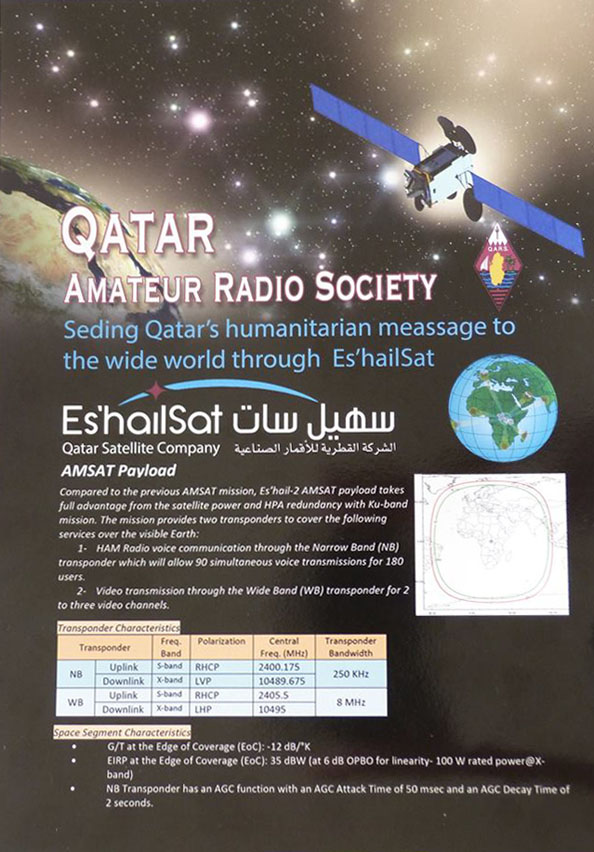
Frequencies of Es’hail 2 Geostationary Amateur Radio Transponders

Qatar Amateur Radio Society Geostationary Transponders Leaflet Page 1

Qatar Amateur Radio Society Geostationary Transponders Leaflet Page 1


The Qatar Amateur Radio Society released a leaflet about the geostationary amateur radio transponders at the IARU Region 1 Conference taking place September 20-27, 2014 in Varna-Albena, Bulgaria. The frequencies quoted are:

Amateur satellite service spectrum used by cell-phone masts in the UK

Amateur satellite service spectrum used by cell-phone masts in the UK

Linear transponder
2400.050-2400.300 MHz Uplink
10489.550-10489.800 MHz Downlink

Wideband digital transponder
2401.5-2409.5 MHz Uplink
10491.0-10499.0 MHz Downlink

In the UK the 10475-10500 MHz section of the Amateur Satellite Service allocation was auctioned by Ofcom for nationwide cell-phone backhaul links. The winner of the auction was T-Mobile(UK) now part of the phone company EE. The use of this segment of the band by cell-phone masts may cause problems to UK amateurs wishing to receive the transponders. See this spreadsheet of spectral masks for the 10 GHz links.

Gunter Krebs reports on his Space Pages that Es’hailSat has signed a contract with MELCO to build the Es’hail-2 Geostationary Comsat. Es’hail 2 is a planned communication satellite operated by Es’hailSat, the Qatar Satellite Company. It will also feature an radio amateur payload.

The new satellite will be positioned at the 26° East hotspot position for TV broadcasting and significantly adds to the company’s ability to provide high quality, premium DTH television content across the Middle East and North Africa. It will feature Ku-band and Ka-band transponders to provide TV distribution and government services to strategic stakeholders and commercial customers who value broadcasting and communications independence,interference resilience, quality of service and wide geographical coverage. Es’hail 2 is expected to be launched at the end of 2016.

In September 2014, a contract with MELCO was signed to build the satellite based on the DS-2000 bus.

Es’hail 2 will also provide the first Amateur Radio geostationary communication capability linking Brazil and India. It will carry two “Phase 4” Amateur Radio transponders. The payload will consist of a 250 kHz linear transponder intended for conventional analogue operations in addition to another transponder which will have an 8 MHz bandwidth. The latter transponder is intended for experimental digital modulation schemes and DVB amateur television. The uplinks will be in the 2.400-2.450 GHz and the downlinks in the 10.450-10.500 GHz amateur satellite service allocations. Both transponders will have broad beam antennas to provide full coverage over about third of the earth’s surface. The Qatar Amateur Radio Society and Qatar Satellite Company are cooperating on the amateur radio project. AMSAT-DL is providing technical support to the project.

Gunters Space Page http://space.skyrocket.de/doc_chr/lau2014.htm

2006 Ofcom auction of upper segment of 10 GHz Amateur Satellite Service spectrum
http://stakeholders.ofcom.org.uk/consultations/10ghz/

10 GHz Cell-Phone Links Spectral Mask http://tinyurl.com/10GHz-Cell-Phone-Mask

IARU Region 1 Conference link http://iaru.lz-live.com/

RSGB WRC-15 page http://rsgb.org/main/news/special-focus/wrc-15/
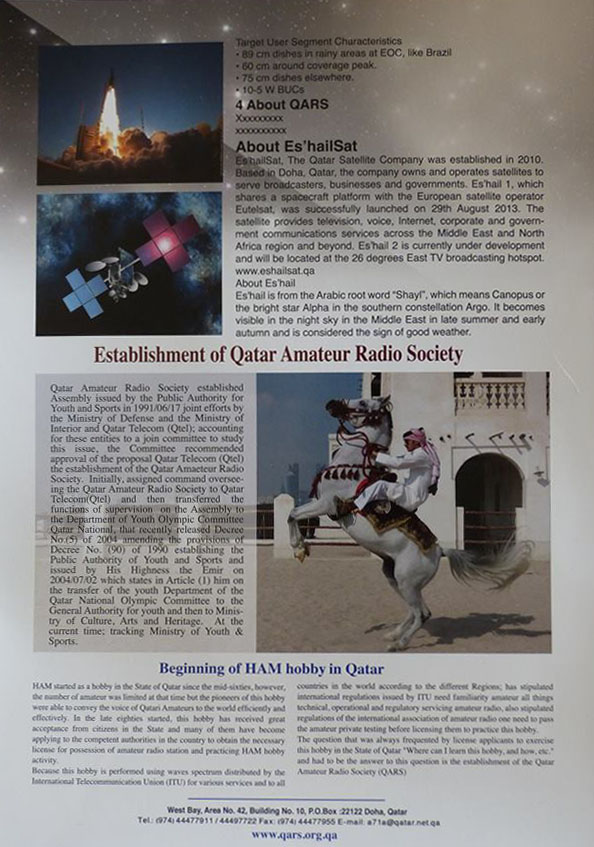
Qatar Amateur Radio Society Geostationary Transponders Leaflet Page 2

Qatar Amateur Radio Society Geostationary Transponders Leaflet Page 2


OSCAR News Issue 207

OSCAR News Issue 207Issue 207 of the AMSAT-UK amateur radio satellite publication OSCAR News was released on September 11. E-members can download it here.

The paper edition is usually posted 2-3 weeks after publication of the electronic issue.

In this issue:
• Goonhilly Earth Station receives FUNcube-1 Equipment
• FUNcube-3/EO79
• FUNcube-1 demonstrated in the Faraday Lecture Theatre
• FUNcube-1 Spin Rate
• Sad News about HAMSAT VO-52
• IARU Region 1 General Conference Papers 20-27 Sep 2014
• ISS SSTV Active Again
• Report from the Region 1 Satellite Coordinator
• FUNcube-2 on UKube-1
• FUNcube-1 operations
• Active Satellites by Mile DK3WN
• AMSAT-UK accounts and AGM Minutes
• AMSAT-UK Colloquium 2014
• FUNcube-4 on ESEO

AMSAT-UK FUNcube Mission Patch

AMSAT-UK FUNcube Mission Patch

Membership of AMSAT-UK is open to anyone who has an interest in amateur radio satellites or space activities, including the International Space Station (ISS).

E-members of AMSAT-UK are able to download OSCAR News as a convenient PDF that can be read on laptops, tablets or smartphones anytime, anyplace, anywhere. Join as an E-member at Electronic (PDF) E-membership

There are two rates for the paper edition to cover the extra postage costs:
UK
Rest of the World (Overseas)

PDF sample copy of “Oscar News” here.

Join AMSAT-UK using PayPal, Debit or Credit card at
http://shop.amsat.org.uk/shop/category_9/Join-Amsat-UK.html

E-members can download their copies of OSCAR News here.

23 cm band and WRC-2018

IARU_Region_1_logopaper to be discussed at the IARU Region 1 Conference in Varna-Albena, Bulgaria, September 21-27, 2014 highlights the threat to continued amateur radio usage of our 23 cm allocation which is now being used by the Galileo GPS system. The amateur 23 cm allocation includes a key Amateur Satellite Service uplink band at 1260-1270 MHz.

Michael Kastelic OE1MCU, Chair of the IARU R1 VHF/UHF/Microwave Committee has written the paper VA14_C5_36 which says:

After the last reports and slides received by the author, it seems that radio amateurs will lose the 23 cm band in the near future. That is the reason for this late proposal.

We can be optimistic, but more than a small piece of spectrum for near band communication will not survive. Also the enthusiastic testing with ATV on 70 cm is not a replacement for 23 cm, because this will cause disturbance to our amateur satellites and all cars will stay locked if the ISM band is used.

GNSS - Credit Microwave Journal

GNSS – Credit Microwave Journal

Proposal:
Radio amateurs need a new allocation (like 1300 -1310 MHz) for the agenda of the World Radio Conference 2018 (WRC2018) so that amateurs get back spectrum near the existing 23 cm band.

Further it is proposed to engage the EC after WRC-2015 to bring this theme to the
agenda for WRC-2018 with high priority

Read the paper at http://tinyurl.com/IARU-VA14-C5-36

Potential Interference To Galileo From 23 cm Band Operations
http://www.southgatearc.org/articles/galileo.htm

Up until now there have only been four Galileo test satellites in orbit which have been used to validate the system. The first two satellites of the operational Galileo GPS constellation were launched on August 22, 2014, they will be followed by further launches over the next 3 years. 

During the initial test phase two German ATV repeaters were shutdown due to interference to a user’s Galileo receiver, they were:
• DB0QI which was 18 km from the receiver
• DB0ITV which was 55 km from the receiver
It is thought both repeaters were running an ERP of just 15 watts, but the ERP figure has not been confirmed.

It appears that all 23 cm repeaters in Austria have been shutdown.

Alessio Sacchi IZ4EFN posted the following information regarding the situation in Italy on the AMSAT Bulletin Board:
Few weeks back I spoke with a member of the Italian CC, as our club was going to add a 1296 MHz port to a local repeater. He said Alenia Space has submitted strong warnings regarding possible interference with Galileo and he anticipated it could be hard to get a frequency assigned in that portion of the spectrum in the near future.

IARU R1 VHF/UHF/Microwaves discussion forum
http://www.thersgb.org/forums/index.php?forums/vhfmicrowave/

Other VHF/UHF/Microwave papers for the Conference can be downloaded from
http://www.iaru-r1.org/index.php?option=com_remository&Itemid=&func=fileinfo&id=522

Join AMSAT-UK

AMSAT-UK_Bevelled_Logo

AMSAT-UK Logo

Founded in 1975 AMSAT-UK is a voluntary organisation that supports the design and building of equipment for amateur radio satellites.

AMSAT-UK initially produced a short bulletin called OSCAR News to give members advice on amateur satellite communications. Since those early days OSCAR News has grown in size and the print quality has improved beyond recognition. Today, OSCAR News is produced as a high-quality quarterly colour A4 magazine consisting of up to 40 pages of news, information and comment about amateur radio space communications.

The new lower-cost E-membership provides OSCAR News as a downloadable PDF file giving members the freedom to read it on their Tablets or Smartphones anytime, anyplace, anywhere.

An additional advantage is that the PDF should be available for download up to 2 weeks before the paper copy is posted.

AMSAT-UK FUNcube Mission Patch Rev4 20100609

AMSAT-UK FUNcube Mission Patch

The Membership year lasts for 12 months starting on January 1 each year.

If you join after July 31 of any particular year, then you will receive complimentary membership for the whole of the following year, i.e. join on August 10, 2014, and you have nothing more to pay until Dec 31, 2015.

Take out an Electronic membership here http://shop.amsat.org.uk/shop/category_9/Join-Amsat-UK.html

E-members can download their copies of OSCAR News from http://www.amsatuk.me.uk/on

A sample issue of OSCAR News can be downloaded here.

D-STAR satellite repeater test 437.050 MHz

TabletSat-Aurora in Space - Credit Sputnix

TabletSat-Aurora in Space – Credit Sputnix

A test of the D-STAR Parrot Repeater on the TabletSat-Aurora satellite is expected to take place during Monday, August 11 on 437.050 MHz (+/- 10 kHz Doppler shift).

TabletSat-Aurora - Credit Sputnix

TabletSat-Aurora – Credit Sputnix

TabletSat-Aurora launched with 11 other satellites carrying amateur radio payloads from Dombarovsky near Yasny on Thursday, June 19, 2014.

The D-STAR GMSK Parrot (Store and Forward) Repeater can store up to 8 seconds of voice message and runs 0.8 watts to a whip antenna.

There are two other transceivers on the satellite, they transmit GMSK telemetry data on 435.550 MHz and 436.100 MHz. Their power can be varied by command from the ground station between 0.8 and 2.0 watts. TabletSat-Aurora is also a downlink on 8192 MHz.

Dmitry Pashkov R4UAB reports the test on his website at http://r4uab.ru/?p=7160

Description of TabletSat-Aurora in Google English http://tinyurl.com/TabletSat-Aurora-Description

Facebook https://www.facebook.com/SPUTNIX.ltd/

Dnepr Launch for D-STAR Satellite https://amsat-uk.org/2014/06/18/dnepr-launch-for-d-star-satellite/

Satellite Tracking https://amsat-uk.org/beginners/satellite-tracking/

Online WebSDR for VHF Satellites

144 MHz prototype helix antenna

144 MHz prototype helix antenna

You can use the free online SUWS Web Software Defined Radio (WebSDR) from your PC or Laptop to receive the International Space Station (ISS) and the many amateur radio satellites transmitting in the 145.800 – 146.000 MHz band.

Martin Ehrenfried G8JNJ has equipped the SUWS WebSDR with omni-direction helix antennas for both 144 and 432 MHz which have proved effective for both high altitude balloon and satellite reception.

The SUWS WebSDR is located at Farnham not far from London, listen to it at http://websdr.suws.org.uk/

Martin says this about the special satellite antennas “I had been experimenting with single turn ‘twisted halo’ design, and decided to try stacking them to see if I could achieve more gain. Modelling suggested that a stretched 3 turn helix with a helix circumference of approx 1/2 wave length and an overall length of 1/2 wave at 70cm, and fed with a gamma match at the centre would offer reasonable gain, an omni-directional pattern and mixed polarisation.”

Full details of the antennas are available at
http://g8jnj.webs.com/currentprojects.htm

WebSDR for 144, 432, 1296 and 10368 MHz
https://amsat-uk.org/2013/12/28/websdr-for-434-and-1296-mhz/