QST Editor to speak at Colloquium

Steve Ford WB8IMY

Steve Ford WB8IMY

QST Editor and ARRL Publications Manager Steve Ford, WB8IMY will give a presentation to the AMSAT-UK International Space Colloquium at the Holiday Inn in Guildford on Saturday, July 26.

Steve will be traveling to the UK to talk about the satellite operations at the impressive ARRL Headquarters station in Newington, Connecticut.

He has written many amateur radio books including the ARRL Satellite Handbook, Get on the Air with HF Digital, VHF Digital Handbook and Remote Operating for Amateur Radio.

The Colloquium is open to all, further details can be found at
https://amsat-uk.org/colloquium/colloquium-2014/

Summer issue of OSCAR News now available

OSCAR News Summer 2014 Front CoverE-members of AMSAT-UK can now download the Summer edition of OSCAR News here. In this issue is a picture of Brent Salmi KB1LQD and Bryce Salmi KB1LQC at the National Radio Centre in Bletchley Park where they met up with AMSAT-UK’s Graham Shirville G3VZV.

The paper edition should be posted to members in 2-3 weeks.

In this issue:
• Prof Colin Pillinger obituary
• AGM Calling Notice
• AO7 40th Birthday
• Astronaut Wubbo Occels remembered
• AMSAT-UK satellite Projects update
• UK CubeSat Forum report
• FUNcube-1 Lessons learnt
• DUO 817 Satellite Controller
• FUNcube-1 Activity report
• The FUNcube Dongle and SDR Software School Experiments at UCF in Cuba
• FUNcube Turnstile announcement
• Colloquium 2014 Booking Details

AMSAT-UK FUNcube Mission Patch

AMSAT-UK FUNcube Mission Patch

Membership of AMSAT-UK is open to anyone who has an interest in amateur radio satellites or space activities, including the International Space Station (ISS).

E-members of AMSAT-UK are able to download OSCAR News as a convenient PDF that can be read on laptops, tablets or smartphones anytime, anyplace, anywhere. Join as an E-member at Electronic (PDF) E-membership

There are two rates for the paper edition to cover the extra postage costs:
UK
Rest of the World (Overseas)

PDF sample copy of “Oscar News” here.

Join AMSAT-UK using PayPal, Debit or Credit card at
http://shop.amsat.org.uk/shop/category_9/Join-Amsat-UK.html

E-members can download their copies of OSCAR News here.

GB1JSS Summer Solstice: Radio Hams to gather at Galleywood Common

GB1JSS - Galleywood Common, Chelmsford, CM2 8TR

GB1JSS will be active on June 21 from Galleywood Common, Chelmsford, CM2 8TR

Special event station GB1JSS will be active on the amateur radio satellites during the Summer Solstice on Saturday, June 21, the longest day of the year in the Northern Hemisphere. The event is open to all radio amateurs and listeners.

On that day the sun will rise at 04:43 BST (03:43 UT) and set at 21:21 BST giving 16 hours, 38 minutes and 19 seconds of daylight.

CARS-GX0MWT-roundel-badgeMembers of the Chelmsford Amateur Radio Society (CARS) will be operating from Galleywood Common (Grid JO01FQ WAB TL70 Postcode CM2 8TR) for much of the day, subject to weather conditions, the station will be active as early as possible. Planned operating time 9am-6pm.

Steve Hedgecock M0SHQ, who recently gave a well received presentation on satellites at the CARS amateur radio skills workshop, with be bringing his amateur satellite station and hopes to operate as many satellite passes as possible.

They’ll also be a station operating 40m-10m plus 2m using SSB, CW, PSK and RTTY.  The day coincides with the first-half of the 50MHz Trophy Contest, so there may be some 6m activity if conditions are favourable.

Wind-permitting, Peter Bridgeman G3SUY hopes to fly his impressive Kite Aerial and put out a strong signal on 160m using full legal power.

Would you like to operate, help set-up the station or just come along for a visit?

This is a great opportunity to use some of your portable kit at an RF-friendly location or operate one of ours with perhaps more power than your M6/2E licence allows. For more details contact Charlie Davy M0PZT email: m0pzt <at> m0pzt.com

The station will be in the car-park off Margaretting Road next to the Galleywood Heritage Centre.
If you’re coming from Wood Street, just turn right at the Eagle public house and then left at the “P” sign.

There are toilet facilities at the adjacent Galleywood Heritage Centre.

Directions from A12: http://goo.gl/maps/0jEDS

Street Map  http://streetmap.co.uk/map.srf?x=570262&y=202562

Essex Ham http://essexham.co.uk/

M0PZT Twitter feed https://twitter.com/M0PZT

The Chelmsford Amateur Radio Society run training courses for those wishing to get their amateur licence. To find out more speak to Clive G1EUC on
Tel: 01245-224577
Mob: 07860-418835
Email: training2014<at>g0mwt.org.uk
Web: http://www.g0mwt.org.uk/training/

What is Amateur Radio ? http://www.essexham.co.uk/what-is-amateur-radio

50 years ago this month nearby Galleywood was the setting for Peter Blair G3LTF’s historic amateur radio Moonbounce (Earth-Moon-Earth) contact, see https://amsat-uk.org/2014/06/08/50th-anniversary-of-historic-chelmsford-eme-contact/

Satellites on the Horizon

In this brief presentation from the AMSAT Forum at the 2014 Dayton Hamvention, Drew Glasbrenner, KO4MA and AMSAT VP Operations, summarizes six operational amateur satellites and another dozen satellites that will become available or will launch soon.

NOTE: LituanicaSAT-1 mentioned in the presentation was in fact built by engineers from Vilnius University. http://en.wikipedia.org/wiki/LituanicaSAT-1

Watch Satellites on the Horizon, by Drew KO4MA – 2014 Dayton Hamvention

SPROUT Slow Scan TV and Digitalker Active

SSTV image received from SPROUT by Mario LU4EOU on May 31, 2014 at 0408 UT

SSTV image received from SPROUT by Mario LU4EOU on May 31, 2014 at 0408 UT

Slow Scan TV (SSTV) images in Scottie 1 format have been successfully received from the amateur radio satellite SPROUT on 437.600 MHz FM (+/- 9 kHz Doppler shift). The Digitalker has also been active.

SPROUT, a 20 x 20 x 22 cm amateur radio nano-satellite with a mass of 7.1 kg, launched successfully with the L-band (1236.5 MHz/1257.5 MHz/1278.5 MHz) Synthetic Aperture Radar (SAR) satellite ALOS-2 on May 24, 2014 at 0305 UT. SPROUT is now in a 654 km, 97.9 degree inclination Sun Synchronous Orbit (SSO).

SPROUT (Space Research On Unique Technology) was built by students from Nihon University and its objectives are:

SPROUT Satellite - Credit Nihon-Univ. Miyazaki Laboratory

SPROUT Satellite – Credit Nihon-Univ. Miyazaki Laboratory

1. Operation of satellite by radio amateurs.

A FM Digitalker will enable the satellite to speak to amateurs around the world.

The Voice Message Box will record transmissions from radio amateurs and play them back.

Pre-loaded images from the Message Gallery can be transmitted using Slow Scan TV (SSTV).

Pictures of the Earth can be transmitted by SSTV and radio amateurs can receive it using free software such as MMSSTV. As part of the Earth mapping project the team ask radio amateurs to contribute pictures they have received from the satellite for display on the SPROUT website.

The satellite also has a packet radio Digipeater and Text Message Box function.
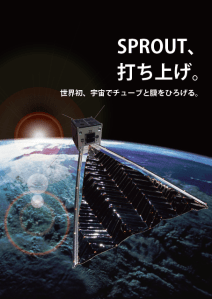
SPROUT in orbit2. Demonstration of the deployment of the combined membrane structure and verification of the design method of the structure SPROUT has a triangular membrane supported by two tubes like framework. They are folded and stored in the satellite before the launch. After the launch, the nitrogen gas is injected into the tubes in space, and they extend, so that the membrane deploys (called “combined membrane structure”).

3. Demonstration of attitude determination and control of a nanosatellite using the sun sensors, gyros, geomagnetic sensor and magnetic torquers.

Callsign: JQ1ZJQ
Size: 214x210x220 mm
Weight: 7.1 kg
Mode: 1200bps AFSK, 9600bps GMSK
CW downlink 437.525 MHz
FM packet downlink 437.525 MHz
Digipeater uplink 437.600 MHz
Digitalker downlink 437.600 MHz
SSTV downlink 437.600 MHz

SPROUT Amateur Radio SSTV Satellite

SPROUT Amateur Radio SSTV Satellite

SPROUT English website http://sat.aero.cst.nihon-u.ac.jp/sprout-e/

SPROUT Japanese website http://sat.aero.cst.nihon-u.ac.jp/sprout/

Nihon-Univ. Miyazaki Laboratory on Facebook
https://www.facebook.com/pages/Nihon-Univ-Miyazaki-Laboratory/406566642818860

Telemetry Software http://sat.aero.cst.nihon-u.ac.jp/sprout-e/2-Software-e.html

Telemetry format http://sat.aero.cst.nihon-u.ac.jp/sprout-e/2-Formats%20of%20telemetry-e.html

SPROUT launch data page
http://sat.aero.cst.nihon-u.ac.jp/sprout-e/2-Launch%20data-e.htmlTLE’s from the North American Aerospace Defence Command (NORAD) are also available at http://celestrak.com/NORAD/elements/tle-new.txt

Adding new satellites to SatPC32, Gpredict and Nova
https://amsat-uk.org/2013/11/23/adding-new-satellites-to-satpc32/

Free Slow Scan TV (SSTV) software MMSSTV http://hamsoft.ca/pages/mmsstv.php

The JE9PEL website has information on other satellites on this launch
http://www.ne.jp/asahi/hamradio/je9pel/jaxalos2.htm

Read the Overview of the L-band SAR Onboard ALOS-2 here.

SPROUT satellite students at Nihon-Univ. Miyazaki Laboratory

SPROUT satellite students at Nihon-University Miyazaki Laboratory

Shin’en2 Satellite Linear Transponder Frequencies

Shin-En2 satellite

Shin’en2 satellite

The IARU Amateur Satellite Frequency Coordination Panel has announced frequencies for the Shin’en2 linear transponder.

Shin’en2 is a 17 kg satellite measuring 490×490×475 mm built by students at Kagoshima University in Japan which will carry a 145 to 435 MHz linear transponder into a deep space orbit.

The aims of the mission are:
• To establish communication technologies with a long range as far as moon.
• To establish a new technology of the ultra-light-weight satellite. Proposing a WSJT 29dBm UHF downlink and a 29dBm 20 kHz linear transponder and a CW beacon all on UHF with a VHF uplink for the transponder. Note it is now understood the transponder will not be operational

The orbit will be quite different from the previous satellites. Shin-En2 will have an elliptic orbit around the Sun and travel to a deep space orbit between Venus and Mars. Its inclination will be almost zero, which means Shin-En2 will stay in the Earth’s equatorial plane.

The distance from the Sun will be between 0.7 and 1.3 AU. An Astronomical Unit (AU) is 149,597,871 km.

Shin’en2 IARU coordinated frequencies:
• 437.505 MHz CW beacon
• 437.385 MHz WSJT telemetry

Originally it was planned to fly an inverting SSB/CW transponder but it is now understood the transponder will not be operational
– 145.940-145.960 MHz uplink LSB
– 435.280-435.260 MHz downlink USB

Shin’en2 is expected to launch in the 4th quarter of 2014 with another amateur radio satellite ARTSAT2:DESPATCH on a H-IIA rocket with the asteroid explorer Hayabusa 2 as the main payload.

Kagoshima University satellite development team
http://tinyurl.com/Kagoshima-Satellite

Shin’en2 English Website
http://www.eee.kagoshima-u.ac.jp/~fuku-lab/sinen,english.html

ARTSAT2:DESPATCH – Art and Ham Radio in Deep Space
https://amsat-uk.org/2013/11/03/art-and-ham-radio-in-deep-space/