SUWS WebSDR for VHF/UHF/Microwave

23cm_WebSDR_Antenna_up_mastThe SUWS WebSDR, a VHF/UHF/Microwave online radio, now has improved antennas for reception of amateur radio satellites and High Altitude Balloons (HAB).

Noel G8GTZ has posted an update on the Southampton University Wireless Society (SUWS) web based software defined radio covering the 144, 432, 1290 and 10368 MHz amateur radio bands. On the UK Microwave Yahoo Group he writes:

A quick update on the status of the SUWS microwave SDR http://websdr.suws.org.uk/

10 GHz – the Octagon PLL LNB based system is working well and now has the correct frequency labels on the scale (rather than the RTL dongle tuning range).  The Octagon does drift up to 30 KHz high with temperature which is not bad considering it is unmodified and mounted on the mast,  and you can get an accurate frequency calibration from GB3SEE which is visible at all times on 10368.850.  We have seen some very interesting propagation effects (both RS and tropo) with GB3CCX and GB3LEX was audible last week during the lift.

1.3 GHz – the SPF pre-amp is now mounted at masthead.  There is some small frequency drift from the RTL dongle but GB3FN is very loud at all times and GB3MHL / GB3DUN are now audible with the any improvement in condx or aircraft scatter (Heathrow lies directly on the path to MHL).

144  MHz and 432 MHz – We are trying a new type of mixed mode helix antennae on both bands to improve satellite and HAB reception and it seems to be working very well – see
http://g8jnj.webs.com/currentprojects.htm

Listen to the SUWS WebSDR at http://websdr.suws.org.uk/

WebSDR for 434 and 1296 MHz https://amsat-uk.org/2013/12/28/websdr-for-434-and-1296-mhz/

UK Microwave Yahoo Group http://groups.yahoo.com/group/ukmicrowaves

FCC Invites Public Comment on 10-10.5 GHz Petition

FCC SealThe ARRL report the FCC has invited public comment on a Petition for Rule Making (RM-11715) that would make a significant portion of the 10.0 to 10.5 GHz band available for wireless broadband services.

The Petition by Mimosa Networks Inc proposes a band plan for 10.0 to 10.5 GHz that, it says, would protect frequencies most often used by radio amateurs. The petition hinges on FCC adoption of rule changes that would put the 10 GHz band under Subpart Z of the Commission’s Part 90 rules. Subpart Z currently sets out regulations governing wireless licensing, technical standards, and operational standards in the 3650 to 3700 MHz band.

“The application of the coordination procedures and requirements provided in Subpart Z will ensure that Amateur Radio operations in the band will not be disrupted,” Mimosa told the FCC. “In addition, as a further safeguard, Mimosa proposes a band plan for the 10.0-10.5 GHz band that would protect frequencies in the band that are most often used by Amateur Radio operators.” The proposed band plan would specify 10.350 to 10.370 GHz as an “Amateur Calling Band,” and 10.450 to 10.500 GHz for Amateur-Satellite operations in the midst of 21 wireless broadband channels and a small guard band.

ARRL Chief Executive Officer David Sumner, K1ZZ, is quoted as saying “Mimosa’s proposed power limit of 55 dBW EIRP is very high, particularly for point-to-multipoint operations, and no mechanism has been proposed for ensuring that harmful interference to amateur operations does not occur.”

Read the full ARRL story at
http://www.arrl.org/news/fcc-invites-public-comment-on-petition-affecting-10-10-5-ghz-band

Petition for Rule Making RM-11715
http://apps.fcc.gov/ecfs/document/view?id=7022310834

Interested parties may comment on RM-11715 using the FCC’s Electronic Comment Filing System (ECFS).
http://apps.fcc.gov/ecfs/hotdocket/list

Satellite changes in French License

REF LogoThe minutes of the March 7 meeting between the French National Society REF and the communications regulator ARCEP have been published.

435-438 MHz is now allocated to the Amateur-satellite service for both Earth-to-Space and Space-to-Earth in Region 1 and territories in Region 2. Due to a previous error in the national frequency table French amateurs did not have Space-to-Earth for this band in their license.

The 2400-2415 MHz band is now allocated to radio stations in the Amateur-satellite service in French territories in Region 2.

Regarding the 1.2 GHz band the REF wondered if the Galileo GPS satellites, which broadcast across 1260 to 1300 MHz, may call into question the allocation of this portion of the band to the Amateur Services. The ARCEP said they would review this matter and provide a response.

The future of 2.4 and 5.7 GHz bands were also discussed. ARCEP said the 2300-2400 MHz band is subject to the European Commission harmonization work for the mobile service and the bands 5350-5470 MHz and 5725-5925 MHz are designed to future expansion of wireless internet. However, no decision has been taken to date. Compatibility studies on these frequencies are underway in the CEPT.

The REF report the ARCEP had shown an interest in the ARISS school contacts which have a high educational value.

French radio amateurs have gained access to 472-479 kHz with 1 watt output in Region 1 and territories in Region 2. Discussions also covered the possibility of an amateur allocation across the whole of 1.8-2.0 MHz and possible future allocations at 5.5 MHz and 70 MHz.

Minutes of the meeting between ARCEP and REF March 7, 2014 in Google English
http://tinyurl.com/REF-ARCEP-Minutes-2014-03-07

REF in Google English http://tinyurl.com/FranceREF

A 2006 Galileo GPS article by Peter Blair G3LTF highlighted the problems this system could cause, see http://www.southgatearc.org/articles/galileo.htm

Amateur radio satellite operation from Isle of Lewis

GS3PYE/P

GS3PYE/P

Camb-Hams will be operating on the amateur radio satellites using the call sign GS3PYE/P from the Isle of Lewis (Grid Square IO68UL, IOTA EU-010) on April 26 to May 3, 2014.

GS3PYE StationThe Camb-Hams have been activating the Scottish Isles each year since 2008 and will be travelling to the Isle of Lewis in the Scottish Outer Hebrides in 2014. Thirteen operators will be active on all bands and many modes from 4m to 80m, 2m & 70cm for Satellites and 2m & 23cm for EME.

The HF bands will be covered by five simultaneous stations, while the 6m & 4m stations will have a great take-off towards the UK and Europe from the island’s northern tip in IO68 square. 2m and 23cm EME will be available with a portable low-ERP Yagi system, mainly focussed on JT modes. 2m and 70cm will be available for portable satellite operations.

Contest operations will take place in the RSGB 70MHz UKAC on April 29.

The group will be active on the major social networks before, during and after the trip. You can check on progress or interact with the operators via their blog at dx.camb-hams.com or through Twitter, Facebook and YouTube [links below]. Previous trips have generated some great audio and video recordings of the GS3PYE/P signal from around the world.

GS3PYE MapPlease email skeds-2014@camb-hams.com to arrange skeds on the more challenging bands and modes. VHF and EME skeds will also be made via ON4KST and N0UK’s EME Chat.

The Camb-Hams were formed in early 2006 as the social and public-facing side of the Cambridgeshire Repeater Group (CRG), which was formed out of the PyeTelecommunications Radio Club.

The Camb-Hams are made up of people from many of, but not exclusively, the various Cambridgeshire radio groups including CUWS (Cambridge University Wireless Society), CDARC (Cambridge and District Amateur Radio Club) and Cambridgeshire RAYNET. It provides a common forum for us all to work together and has been very successful in increasing the activity in the Cambridgeshire area.

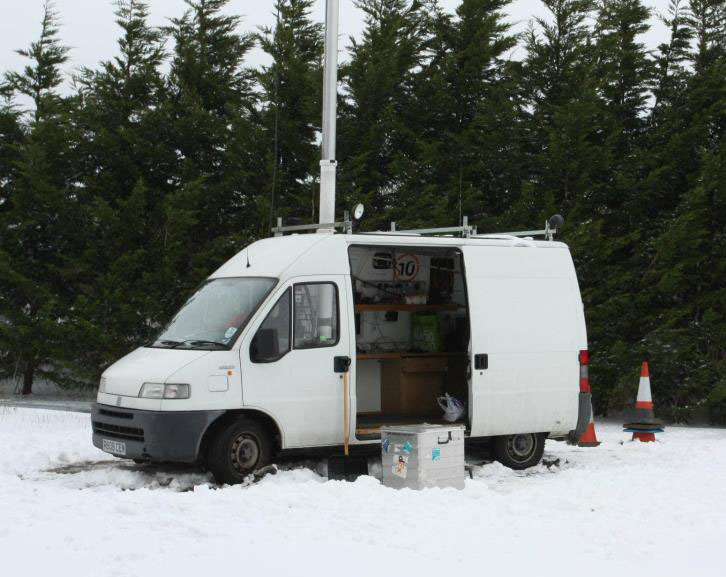
Camb-Hams Amateur Radio Van

Camb-Hams Amateur Radio Van

We meet on-air via the CRG’s VHF and UHF FM Voice repeaters, and at regular monthly Pye and Pint nights held from 19:00-22:00 on the 1st Wednesday of each month at the White Horse, Barton http://www.thewhitehorseinnbarton.co.uk

Our contesting side, using the CRG callsigns G3PYE & G6PYE, aims to provide an opportunity for non-contest operators to have a go, whilst putting a concerted effort into entering a particular contest.

Camb-Hams frequently travel and have ‘DXpeditioned’ to the Scottish Isles of Mull, Harris, Monachs, Arran, Lunga, Staffa and Iona, as well as organising social trips to many of the major European rallies. Since 2010, the Camb-Hams have been active and increasingly successful in the RSGB UKAC, Field Day and AFS contests.

Web http://dx.camb-hams.com/
Twitter http://twitter.com/g3pye
Facebook http://facebook.com/CambHams
YouTube http://youtube.com/CambHams

Attracting newcomers to Ham Radio
http://www.southgatearc.org/news/december2012/attracting_newcomers_to_ham_radio.htm

Keeping New Radio Hams
http://www.southgatearc.org/news/january2013/keeping_new_radio_hams.htm

OSCAR-11 / UoSAT-2 Celebrates 30 Years in Orbit

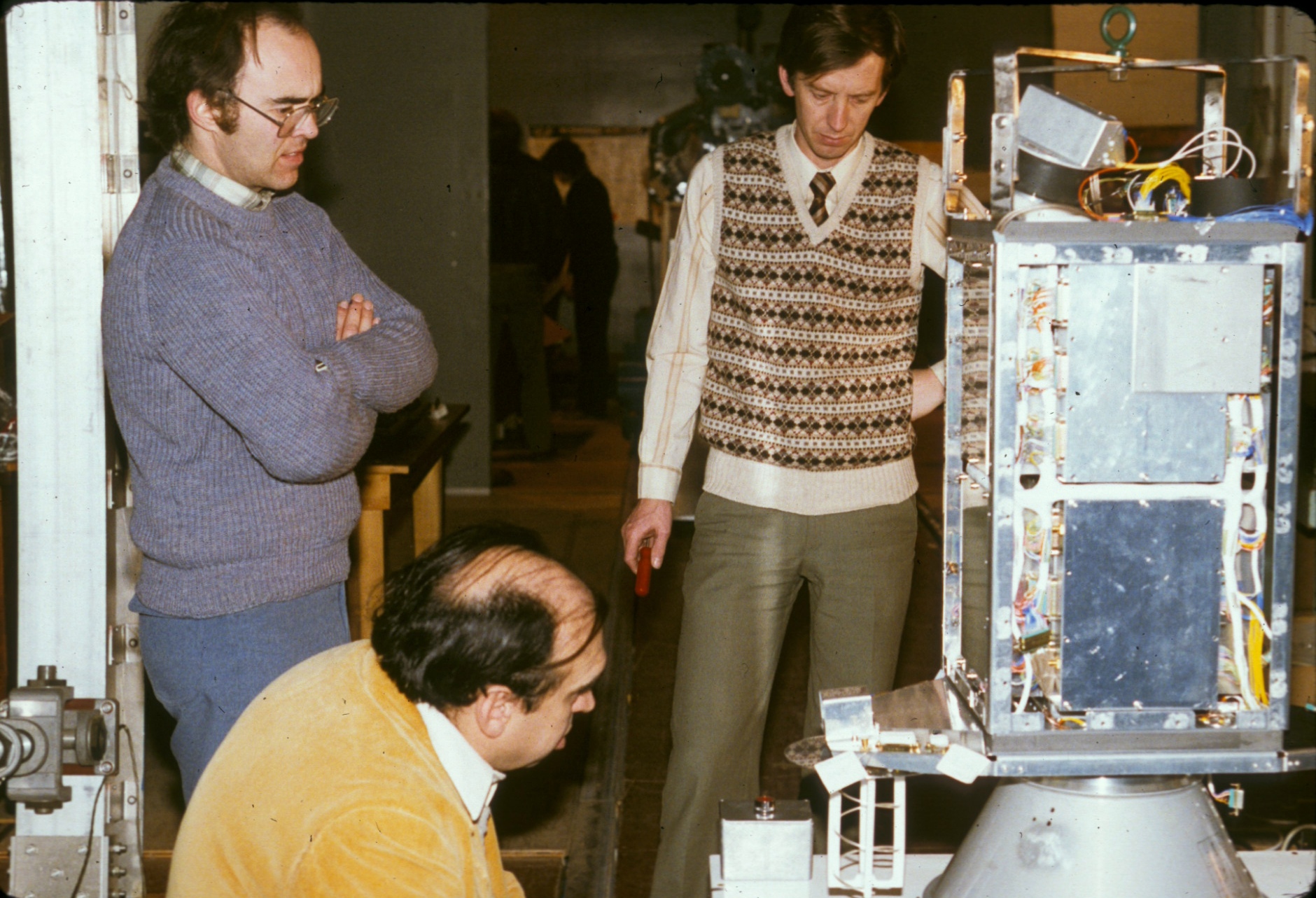
UOSAT-2 / OSCAR-11 with Dave Brock UoS kneeling, Christine Sweeting G6APF and Neville Bean G8NOB

UoSAT-2 / OSCAR-11 with Dave Brock UoS kneeling, Christine Sweeting G6APF and Neville Bean G8NOB

UoSAT-OSCAR-11 has now been in orbit for 30 years and remarkably its signal on 145.826 MHz FM (AFSK 1200 bps ASCII) is still being received.

UOSAT-2 / OSCAR-11 1984 Martin Sweeting G3YJO and Dave Bocks UoS standing

UoSAT-2 / OSCAR-11 Martin Sweeting G3YJO and Dave Bocks UoS standing

UoSAT-2, also known as UoSAT-OSCAR-11 or UO-11, was the second satellite designed and built by a team of engineers at the University of Surrey in Guildford, Surrey, UK and was the successor to UoSAT-1 / UoSAT-OSCAR-9 (see Hobby Electronics August 1981). It was launched from the Western Test Range at Vandenberg Air Base, in Lompoc, California along with LANDSAT-5 on a Delta 3920 rocket on March 1, 1984.

UO-11 was the most rapidly designed OSCAR, going from inception to launch in only five months. It was also the first amateur satellite to carry a digital communications package into Earth orbit, and the first to be controlled by a CPU running software written in the high-level programming language “Forth”.

UOSAT-2_OSCAR- 11UO-11 carries beacons in three amateur radio bands.

The 145.826 MHz beacon transmits FM Audio Frequency Shift Keying (AFSK) 1200 bps ASCII data. It the early years it also transmitted a voice message from the digitalker experiment.

The 435.025 MHz beacon transmitted either 1200 bps FM AFSK or 4800 bps PSK data. This beacon was used to downlink information from the Digital Store and Readout (DSR) Experiment, which includes CCD Earth image data, results from the Particle Wave Experiment, and engineering data from the RCA COSMAC 1802 CPU.

The 2401.5 MHz beacon transmitted FM and PSK signals. Antenna polarization for all three beacon transmitters is left-hand circular (LHCP). Only the 145.826 MHz beacon is now operational.

Read Usenet messages from 1984 about UoSAT-B / UoSAT-2

Martin Sweeting G3YJO listening to the UO-11 Digitalker

Martin Sweeting G3YJO listening to the UO-11 Digitalker

Information compiled by Clive Wallis G3CWV
https://web.archive.org/web/20150413193503/http://g3cwv.co.uk/oscar11.htm

UO-11 page on the DK3WN satellite blog at http://www.dk3wn.info/p/?cat=47

SSTL Blog – Happy 30th Birthday to UoSAT-2
http://www.sstl.co.uk/Blog/March-2014/Happy-30th-Birthday-to-UoSAT-2-

OSCAR-9 and OSCAR-11 TV News Reports
https://amsat-uk.org/2011/10/30/oscar-9-and-oscar-11-tv-news-reports/

BBC Micro ASTRID UoSAT receiver and AMSAT-UK Software Library
https://amsat-uk.org/2011/12/11/bbc-micro-and-amsat-uk-software-library/

UOSAT_OSCAR-11

Galileo GPS closes down 23cm ATV Repeater DB0QI

AMSAT-UK Logo

AMSAT-UK Logo

The new Galileo GPS system that broadcasts across 1260-1300 MHz has resulted in the closure of a German ATV repeater.

The DARC report the Munich ATV repeater DB0QI has been closed down due to it jamming the Galileo Satnav Control Centre.

DB0QI was located 18 km from the Galileo GNSS receiver, another repeater that has been shut down is DB0ITV which was located 55 km from the receiver. It is believed both repeaters were running about 15 watts ERP.

DARC in Google English http://tinyurl.com/GermanyDARC

A 2006 Galileo GPS article by Peter Blair G3LTF highlighted the problems this system could cause, see
http://www.southgatearc.org/articles/galileo.htm

The Amateur Satellite Service has an important allocation at 1260-1270 MHz for Earth-to-Space (Uplink) communications. The Amateur Satellite Service has already seen its allocations at 2.4 and 5 GHz rendered unusable in urban areas due to WiFi and other licence exempt devices. The Amateur Satellite Service does not have any other global spectrum allocations in the key 915 MHz to 6 GHz region.

While the German announcement may relate to a single Galileo command station being used to test the initial satellites it clearly raises concerns about what will happen in a few years time when the full Galileo constellation is deployed and 1260-1300 MHz GPS units are in widespread use.