Raspberry Pi at RSGB Convention

A Raspberry Pi computer board

A Raspberry Pi computer board

Peter Goodhall 2E0SQL, a well known amateur radio satellite operator, will be giving a presentation on the Raspberry Pi computer board at the RSGB Convention this weekend .

Peter Goodhall 2E0SQL operating portable through the satellites

Peter Goodhall 2E0SQL operating portable through the satellites

The popular Raspberry Pi has been used for many different amateur radio applications. Peter’s presentation will be given at 14:30-15:15 on Saturday, October 12.

The RSGB’s Centenary Convention, sponsored by Martin Lynch & Sons, takes place this weekend (Fri eve-Sun) October 11-13 at Horwood House, MK17 0PH just a few miles outside Milton Keynes. Tickets are available on the door.

RSGB Convention Schedule
http://rsgb.org/main/blog/news/rsgb-notices/2013/09/10/centenary-convention-2013-programme/

RSGB Centenary Convention
http://rsgb.org/main/blog/news/rsgb-notices/2013/07/10/rsgb-centenary-convention/

Over a million Raspberry Pi’s have been manufactured in the UK
http://www.theregister.co.uk/2013/10/08/raspberry_pi_sony_plant_million_machine_milestone/

SSB using a Raspberry Pi
http://www.southgatearc.org/news/may2013/ssb_using_a_raspberry_pi.htm

Turning the Raspberry Pi into a 1-250 MHz FM Transmitter
http://www.southgatearc.org/news/march2013/turning_the_raspberry_pi_into_an_fm_transmitter.htm

Vandenberg Falcon 9 Launch

DANDE and CUSat signals received by Dmitry Pashkov UB4UAD

DANDE and CUSat signals received by Dmitry Pashkov UB4UAD

Two satellites, DANDE and CUSat, carrying amateur radio payloads were launched on Sunday, September 29.

Engineers with DANDE nano-satellite prior to shipping - Image credit University of Colorado Boulder

Engineers with DANDE nano-satellite prior to shipping – Image credit University of Colorado Boulder

The SpaceX Falcon 9 rocket launch from California’s Vandenberg Air Force Base marks several firsts for the commercial space transportation company, including the maiden launch of an upgraded version of the Falcon 9 rocket with stretched fuel tanks, more powerful engines and a 5.2-meter payload fairing to enshroud satellites.

It is also the first SpaceX mission from Vandenberg Air Force Base, a launch site on California’s Central Coast, where engineers modified an existing facility used by the U.S. Air Force Titan 4 rocket to be the West Coast home of the Falcon 9.

Canada’s Cassiope space weather research and communications demonstration satellite is riding the Falcon 9 rocket into an elliptical near-polar orbit at an altitude of between 325 km and 1500 km. Secondary passengers aboard include POPACS, DANDE and CUSat.

POPACS satellites - Image credit POPACS consortium

POPACS satellites – Image credit POPACS consortium

POPACS:

The second P in POPACS (Polar Orbiting Passive Atmospheric Calibration Spheres) stands for Passive, meaning that the three spheres do not carry radios on board. They are simple, polished ten-cm-diameter hollow Aluminum spheres, weighing 1kg, 1.5 kg and 2 kg, respectively, that will be radar tracked by the Space Surveillance Network of the U.S. Strategic Command and optically tracked by an international network of students with Go To telescopes.

The purpose of the mission is to measure the way in which the total density of Earth’s upper atmosphere above 325 km varies in response to solar stimuli during the descending phase of Solar Cycle 24 and all of Solar Cycle 25.  The spheres’ expected lifetimes, after deployment into the initial 325 km x 1500 km 80 degree orbit that they will hopefully soon share with DANDE and CUSat, are 10, 12.5 and 15 years, depending, of course on solar activity.

DANDE nano-satellite prior to packaging - Image credit Bruce Davis

DANDE nano-satellite prior to packaging – Image credit Bruce Davis

DANDE:

DANDE stands for “Drag and Atmospheric Neutral Density Explorer.” Measuring drag and neutral particles in the lower atmosphere between 325-400 kilometers, DANDE will be measuring real time density, quantifying variations in altitude and over time, as well as providing in-situ model calibration data. The satellite is a low-cost density, wind, and composition measuring instruments that will provide data for the calibration and validation of operational models and improve our understanding of the thermosphere. Weighing approximately 45 kg, DANDE is classified as a nano-satellite that is about 18 inches in diameter.

The Colorado Space Grant Consortium (COSGC) has housed the project for approximately 7 years, in which about 150 students have been a part of the project through initial concept and design, to the current team of mission operators. There are two instruments on board which allow DANDE to make in-situ measurements rather than being passive or only carrying accelerometers. The subsystem ACC (Accelerometers) contains 6 accelerometer heads arranged in a circle which were built in-house. The NMS subsystem (Neutral Mass Spectrometer) also known as Wind and Temperature Spectrometer will survey the variety and quantity of numerous neutral particles in the Thermosphere. This data will be particularly interesting during periods of high
solar activity do to atmospheric effects seen at these times in the polar regions of Earth.

DANDE Telemetry System Information:
Beacon Downlink Frequency: 436.75 MHz FM
Callsign: dandecosgc
Data Rate: 9600 baud
Modulation: FSK
Transmit Interval: every 15 seconds
RF Power Output: 0.75 W
Antenna Polarization: linear

DANDE http://dande.colorado.edu/
DANDE Beacon Portal http://spacegrant.colorado.edu/beacon/index.php
Bruce Davis Project Dande Blog http://projectdande.blogspot.co.uk/

CUSat - Image credit Cornell University

CUSat – Image credit Cornell University

CUSat:

CUSat is a multi-year effort to design, build, and launch an autonomous in-orbit inspection satellite system. The satellite will allow us test the accuracy and viability of the carrier-phase differential GPS (CDGPS) algorithm. We hope to prove the algorithm accurate to less than 10 cm  by comparing the CDGPS navigation solution to the known distance between GPS antennas. CUSat will use this relative GPS information to help determine and control its attitude. This is the first step towards having a multi-satellite system use the CDGPS algorithm to aid in autonomous inspection. CUSat is the winner of the University Nanosat-4 Program which aims to educate the future aerospace workforce and develop new space technologies.

CUSat Telemetry Information:
Beacon Downlink Frequency: 437.405 MHz FM
Callsign: BOTTOM
Data Rate: 1200 baud
Modulation: AFSK
Transmit Interval: every 1 minute
RF Power Output: 2.2 W
Antenna Polarization: circular

CUSat http://cusat.cornell.edu/
CUSat docs http://cusat.cornell.edu/docs/IARU/
CUSat Pulse Plasma Thruster Satellites Video https://amsat-uk.org/2013/05/29/cusat-ppt-satellites/

Press Kit released by SpaceX
http://www.spaceflightnow.com/falcon9/006/UpgradedF9DemoMission_PressKit.pdf

Dmitry Pashkov UB4UAD website http://ub4uad.ru/?p=1435

Falcon 9 Explosion – Update http://www.zarya.info/blog/?p=1604

[Thanks to ANS, Miranda Link, SpaceFlightNow and Mineo Wakita JE9PEL for the above information]

IARU Amateur Radio Spectrum Requirements

IARU_LogoFollowing the annual meeting of the Administrative Council (AC) of the International Amateur Radio Union (IARU) a revised spectrum requirement document is available.

At 50 MHz the IARU re-iterates the need for a harmonised allocation for the Amateur-Satellite Service to bridge the gap between 28 MHz and 144 MHz.

For the Amateur-Satellite Service 435-438 MHz allocation the IARU say it is desirable to study expansion of the band.

Retention of the Amateur-Satellite Service 1260-1270 MHz is sought and deletion of the “Earth-to-Space only” restriction. WRC-2000 allocated the band 1240-1300 MHz to the radiodetermination-satellite service for space-to-space use. In addition, WRC-2000 allocated the band 1260-1300 MHz to the radiodetermination-satellite service for Space-to-Earth use such as for the European Galileo positioning system. These actions do not change the Amateur and Amateur-Satellite Service allocations but present new sharing situations and potential operating restrictions.

Substitute spectrum for the Amateur Satellite Service allocation at 2400-2450 MHz which is restricted to the ISM segment, is sought.

Regarding the aim of acheiving a global Amateur-Satellite Service allocation at 3400-3410 MHz  the IARU say: WRC-07 identified the band 3400-3500 MHz for IMT applications in certain countries, which poses an additional difficulty for the Amateur Services in achieving improvement in the band 3400-3410 MHz with respect to upgrading the allocation or extending the allocation to Region 1 [Europe and Africa].

The IARU do not seek any changes to the split Amateur-Satellite Service allocations at 5 GHz.

Spectrum Requirements for the Amateur and Amateur-satellite Services
http://www.iaru.org/uploads/1/3/0/7/13073366/spectrum_requirements_2013.pdf

Cuban radio ham to attend AMSAT Symposium

Hector CO6CBF working Joe EI5EV on FO-29  2013-04-03 1440z

Hector CO6CBF working Joe EI5EV on FO-29 2013-04-03 1440z

Are you looking for a good excuse to visit the 2013 AMSAT Symposium in Houston, Texas ?

It is with great pleasure that I announce the return of Hector Martinez, CO6CBF, to the AMSAT Symposium.  Last year, Hector’s presentation on “Cuban style” satellite operation was well-received by the attendees.  Don’t miss this year’s!

Since his visit to Orlando, Hector has been busy in Cienfuegos completing his fundamental university studies.  As the recipient of the “Gold Award,” he was honored for his diligence by the university’s rector.    He now looks forward to continuing his education in a Master’s program.

The AMSAT-NA Board of Directors has graciously extended Hector an invitation to the Symposium following his successful presentation in Orlando last year.  This year’s process to obtain US visa approvals went smoothly and on schedule due to the guidance and experience of Patrick, WD9EWK.

Hector’s travel expenses are guaranteed by private donations – not AMSAT-NA.  If you wish to contribute please contact Clayton, w5pfg at arrl dot net.  You may also contact W5PFG via postal mail at the FCC callbook-listed PO BOX.  Clayton is Hector’s formal sponsor and coordinator for this year’s symposium visit.

I wish to personally thank the AMSAT-NA Board of Directors and especially recognize Patrick, WD9EWK, for supporting Hector’s opportunity to present in Houston this year.

73
Clayton
W5PFG

AMSAT Symposium Nov 1-3, 2013 http://ww2.amsat.org/?page_id=1555

IARU Administrative Council Meeting

IARU_LogoThe Administrative Council (AC) of the International Amateur Radio Union (IARU) held its annual meeting on September 21-22, 2013 in Cancun, Mexico. The AC is responsible for the policy and management of the IARU and consists of the three IARU international officers and two representatives from each of the three IARU regional organizations.

Here is a summary of the discussions and actions:

1.    The consultative process was completed for the election of IARU President and Vice President for the 2014-2019 terms of office. The Secretary was instructed to present to the member-societies, in a Calendar to be issued no later than 9 December 2013, proposals by the International Secretariat with the concurrence by the Administrative Council that Tim Ellam, VE6SH/G4HUA, be elected for a five-year term as IARU President and Ole Garpestad, LA2RR be elected for a five-year term as IARU Vice President.

2.     The Council discussed the issue of some member-societies failing to represent all of the amateurs in their country.  For example, some do not participate in their regional organization activities, some do not pay their regional dues, some are unwilling to handle non-member QSL cards even on a cost-recovery basis and some even fail to respond to inquiries from their regional organizations.  In many of these countries, there are other non-IARU member-societies.  The Administrative Council is studying ways to work with the non-IARU societies to ensure that the interests of all the amateurs are represented in those countries where the IARU member-society fails to do so.  Possible solutions to the situation include establishing communications with the non-IARU societies to allow input from the country’s amateur community on IARU and amateur related issues or by recommending the use of QSL bureaus that will service all the amateurs within a particular country.

3.    The IARU positions for WRC-15 agenda items and future WRC agenda items were reviewed and the strategy for achieving IARU objectives at WRC-15 was discussed.

4.    The Council reviewed and updated the IARU Spectrum Requirements Document.  The document is available on the IARU web site.

5.     The Future Spectrum Committee presented its final report.  The committee report detailed current amateur usage of bands above 148 MHz.  The Council approved a plan to have one person in each region to serve as a contact person in spectrum matters.

6.    The President reported on the IARU acceptance of an ITU invitation to participate in the ITU Spectrum Management Training Program (SMTP) and accepted an appointment on the founding board of advisers for the ITU-D Smart Sustainable Development Model (SSDM).

7.    IARU participation in World Telecom 2013 in Bangkok, Thailand was reviewed.  IARU will have a booth at the event to promote amateur radio.  More information about the Telecom can be found at http://world2013.itu.int/

8.    The Council reviewed and refined a draft paper on emergency communications strategy.

9.     The International Telecommunication Union (ITU) meetings at which IARU representation will be required for the coming year were identified, and plans for representation at these meetings were reviewed.

10.     The Michael J. Owen VK3KI Award was awarded to David Wardlaw, VK3ADW and Wojciech Nietyksza SP5FM.  Both of these individuals have made contributions of time, effort and expertise to the IARU for many years. The award was created by the Administrative Council to recognize an individual or individuals that best exemplify the dedication and hard work of IARU volunteers.

10.     The theme “Amateur Radio: Your Gateway to Wireless Communications” was adopted for the next World Amateur Radio Day, April 18, 2014.

11.     Ken Garg, W3JK was added to the list of IARU Expert Consultants.

12.     The budget for 2014-2016 as presented by the IS was reviewed and adopted. The budget is based upon anticipated financial contributions from the three regional organizations to defray a portion of the expenses, in accordance with previously adopted policy.

13.     Reports of the IARU international coordinators and advisers were received. They are International Beacon Project Coordinator Peter Jennings, AB6WM/VE3SUN; Satellite Adviser Hans van de Groenendaal, ZS6AKV; EMC Adviser Christian Verholt, OZ8CY; International Coordinator for Emergency Communications Hans Zimmermann, F5VKP/HB9AQS; and EMC Coordinator Thilo Kootz, DL9KCE.  The Council reappointed each of the coordinators and advisers to a new three-year term.

Attending the Cancun meeting were IARU President Tim Ellam, VE6SH/G4HUA; Vice President Ole Garpestad, LA2RR; Secretary Rod Stafford, W6ROD; regional representatives Hans Blondeel Timmerman, PB2T, Dennis Green, ZS4BS, Reinaldo Leandro, YV5AM, Ramon Santoyo, XE1KK, Gopal Madhavan, VU2GMN, Geoff Atkinson, VK3TL; and recording secretary David Sumner, K1ZZ.  Also in attendance as observers were Jay Bellows, K0QB representing the IARU International Secretariat and Jose Arturo Molina, YS1MS as Region 2 observer.

The next scheduled in-person meeting of the AC will be held in the vicinity of Varna, Bulgaria, in September 2014 in conjunction with the IARU Region 1 Conference.

Dutch Amateur Radio Satellite User Day – September 28, 2013

Delfi-n3Xt Satellite

Delfi-n3Xt Satellite

On Saturday, September 28, 2013 the very first Amateur Radio Satellite User Day will be held.

Location
The event will  take place at restaurant ”Binnenhof”, in the small town of Paasloo, in the North of the Netherlands, a 90 minute drive by car from Amsterdam.

Join us!
We invite everyone to come over and join us! For both newbies as well as experienced satellite operators it will be an exciting day with interesting presentations as well as exciting activities!
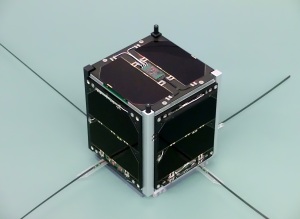
FUNcube-1 flight model - Image credit Wouter Weggelaar PA3WEG

FUNcube-1 flight model – Image credit Wouter Weggelaar PA3WEG

Two Dutch satellite builders will talk about their latest satellites, that both will be launched in November: FUNcube-1 (Wouter Weggelaar – PA3WEG) and Delfi-n3Xt (Jasper Bouwmeester). Both projects will take along with them engineering models: a great opportunity to see yourself how small and advanced Cubesats look like!

Furthermore we have many hands-on sessions planned: take your own radio and antenna to Paasloo, we can help you get started or you can compare yours to that of the others!

Of course this is a fantastic opportunity to ‘meet and great’ each other in person. The OSCAR lunch has a lot of time reserved for that as well. The entire day is free of charge, including coffee and lunch. From those that want to stay for the Barbecue at the end of the day we ask a contribution of 17,50 euro.

HAMSAT VO-52

HAMSAT VO-52

For those that cannot come over to the Netherlands: meet us during one of the on-air hands-on sessions (see the program details below).

Program
10:00     Arrival
Coffee and tea, registration

10:30 – 10:45     Hands-on session VO-52
Listen to, and maybe even make a QSO via, the strongest linear transponder currently in space. We do have a low elevation pass, need to check line-of-sight.  2m/70cm SSB transponder, maximum elevation 11 degrees

10:45 – 11:00     Welcome
Opening of both the “VHF-day” and the “Amateur Radio Satellite User Day”
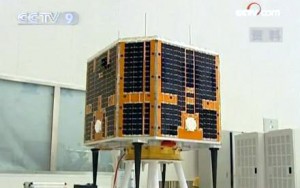
HO-68

HO-68

10:43 – 11:02     Hands-on session HO-68
Listening to the CW downlink signals of this Chinese satellite. Its linear transponder is no longer functional, but its beacon is great fun to experiment with for reception of amateur radio satellites. Examples include testing and comparing different types of antennas. 70 cm CW beacon. Maximum elevation: 49 degrees

11:04 – 11:24     Hands-on session FO-29
Listening to, and maybe make a QSO via, the linear transponder of this satellite. A very distant satellite for portable equipment, but with a little bit of effort and luck we should be able to hear our own signals back on downlink. 2m/70cm SSB transponder. Maximum elevation: 73 degrees.
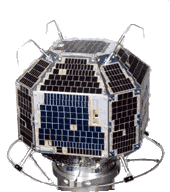
Amateur Radio Satellite FO-29

FO-29

11:30 – 11:35     Welcome Amateur Radio Satellite User Day
Opening of the very first Amateur Radio Satellite User Day in The Netherlands.

11:35 – 12:15     FUNcube-1 – A new satellite revealed (Wouter Weggelaar – PA3WEG)
A presentation by one of the builders, about the technology used in FUNcube-1, a project of a series of organizations, including AMSAT-UK. Due to the delayed launch (now planned for November) FUNcube-1 is not yet in space during the event, but very likely Wouter will bring along the functional engineering-model of FUNcube-1. A presentation you don’t want to miss!

12:15 – 13:00     Amateur Radio Satellites step-by-step, for newbies and experienced operators! (Ivo Klinkert – PA1IVO and Henk Hamoen – PA3GUO)
An introduction into orbits of LEO/HEO-satellites and how to predict their passes. We will also talk about which kind of equipment is needed to transmit via amateur radio satellites. So, a talk on TLE, AOS, LOS, TCA, Kepler and Doppler, RHCP, LHCP, PCs, Antennes, TRX, SDR and Cubesat CW beacons. While this session addresses the basics of satellite communications, we invite the more experienced operators to share their experiences during the presentation as well. For example which software they use, which satellites are favorite, which antennas and rotators are being used… and: which transceivers are most popular.
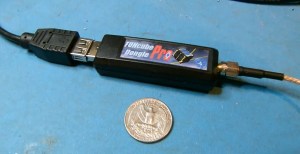
FUNcube Dongle Pro+ Software Defined Radio

FUNcube Dongle Pro+ Software Defined Radio

13:00 – 13:45     Hands-on session FUNcube-1 Engineering model
Most likely it will be possible to make in Paasloo QSO’s via the transponder of the engineering-model of FUNcube-1. A fun exercise or simply a lot of fun with a satellite of which we really control when it is within reach! 2m/70cm SSB transponder.

13:00 – 14:00     OSCAR-lunch
Extended buffet lunch buffet, where the objective is to meet and great your fellow radio amateurs that share the same interest amateur radio satellites. At the same time a demonstration of the famous FUNcube Dongle and equipment like Arrow antennas, LVB-tracker, etc.

13:45 – 14:15     Hands-on session LO-19
Receiving the downlink signals of the satellite. Even though this satellite has gone through some rough situations up there in space, we can still hear a very strong (continues) carrier in the 70cm band. A great opportunity to observe the Doppler-effect and to experience how large this effect is at different stages of a pass. Or: compare again the performance of the different antennas that will be brought by visitors. 70 cm constant carrier. Maximum elevation: 59 degrees

14:15 – 15:00     Delfi-n3Xt (Jasper Bouwmeester – Program Manager TU/d)
An update on the status of the next Dutch satellite of the University of Delft (TU/d), which will be launched in November. Also here a lot of interesting hardware will be shown, including the engineering model of the S-band transmitter, the positioning system and the VHF/UHF antennas.

15:00 – 15:15     Radio Amateurs and scientific satellites (Henk Hamoen – PA3GUO)
How radio amateurs can contribute to scientific research in satellite projects. No QSOs therefore, but rather support of science in space.

15:15 – 15:35     A portable, multi-functional satellite station (Ivo Klinkert – PA1IVO)
A presentation on a portable satellite station for radio communications using low earth orbit (LEO) satellites, multi-mode, including S-band reception.

15:35 – 15:45     How to apply for an ARISS school contact (Bertus Hüsken – PE1KEH)
How to apply for a school contact with the International Space Station (ISS) via ARISS.

15:45 – 16:00     AMSAT-NL (Wouter Weggelaar – PA3WEG, Chairman AMSAT-NL)
How and why AMSAT-NL was founded.

16:00 – 16:15     Future of the “Amateur Radio Satellite User Day” (Ivo – PA1IVO en Henk – PA3GUO)
Evaluation and gathering of ideas for the event next year.

16:15     Closure
BBQ for those that upfront signed up.

18:23 – 18:35     Hands-on session VO-52
For those that can get enough of it! 2m/70cm SSB transponder. Maximum elevation: 30 degrees.

Much more information (for example regarding registration) is available on this website:
http://ivok.home.xs4all.nl/other/SatDay2013.html

See you all in Paasloo!
Ivo Klinkert – PA1IVO and Henk Hamoen – PA3GUO