Video of TV News Report on ISS Contact

Engineers of the future talk to the International Space Station using Amateur Radio

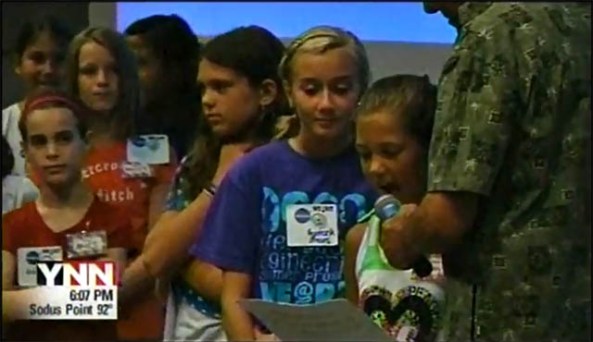
YNN (channel 9) reports on an “out of this world” amateur radio contact between campers attending RIT’s Everyday Engineering Program in Rochester and astronaut Sunita Williams KD5PLB

Sunita was operating the Kenwood TM-D700 ham radio station located in the International Space Station’s Service Module using the callsign NA1SS on 145.800 MHz. The Everyday Engineering Program station at the Rochester Institute of Technology had the callsign W2RIT.

The Women in Engineering Program at Rochester Institute of Technology (WE@RIT) is dedicated to increasing the representation of women engineers and women leaders within the engineering profession. Founded in 2003, WE@RIT strives towards achieving gender parity within the Kate Gleason College of Engineering and hosts a comprehensive series of pre-engineering outreach, recruitment, and community building programs in support of this vision.
http://www.rit.edu/http://www.rit.edu/

Watch RIT on TV News: Chat with International Space Station
http://www.youtube.com/watch?v=wDvQnA4WTxI

Ecuador, heading into space

CubeSat NEE-01 Pegasus

A Chinese rocket due to launch in the 2nd quarter of 2013 will carry CubeSat NEE-01 Pegasus from Ecuador.

Ronnie Nader with Elisse Nader and CubeSat

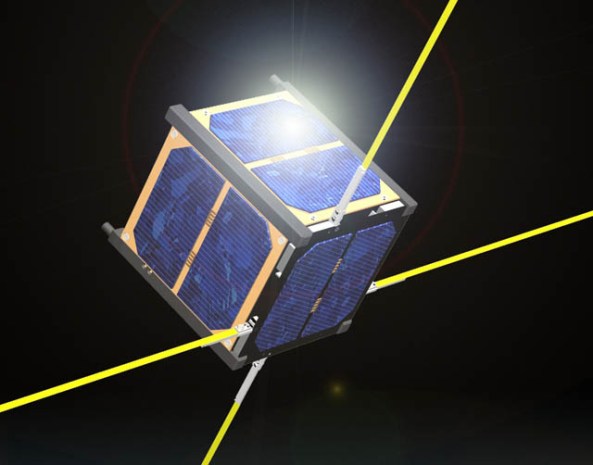
The NEE-01 Pegasus engineering team was led by Cmdr. Ronnie Nader, Ecuador’s first astronaut. The tiny 1U CubeSat (10cm cube) has a large fold-out solar array, a world first, and carries a 902 MHz band 720p HD TV transmitter, another world first for a CubeSat. Also operating in the same band will be a beacon that will send a Morse Code ID, a SSTV image and Ecuador’s national anthem.

The raw aluminum structure of the CubeSat was donated by Professor Bob Twiggs KE6QMD. After launch the 10 by 10 by 10 cm NEE-01 Pegasus will deploy its 75 cm fold-out solar panels, the largest to be flown on a CubeSat.

As part of the educational outreach objectives of the satellite video of the Earth taken by the HD camera will be made available to school students in Ecuador.

The satellite will send two signals that will be received and decoded by the EXA’s HERMES-A ground station in Guayaquil and then uploaded live to the Internet using Facebook and Twitter; the first signal will contain text book questions and the second will contain an image related to the question. If the students are able to answer the question correctly they will be granted access to the video camera on board the spacecraft and will be able to see earth from space as the astronauts see it in their space missions. More advanced students will have access to the pure radio signal so they can try decoding it by themselves.

The satellite featured in the July 15 edition of the El Murcurio newspaper.

Read the El Murcurio newspaper article in Google English http://tinyurl.com/Ecuador-in-Space

NEE-01 Pegasus on Facebook https://www.facebook.com/NEE01PEGASO/

IAC2011 Paper http://exa.academia.edu/RonnieNader/Papers/795135/NEE-01_PEGASUS_The_first_Ecuadorian_Satellite

NEE-01 Pegasus will monitor near-earth objects http://www.uk.amsat.org/6932

Italian Microsat to Deploy Six Amateur Radio Satellites http://www.uk.amsat.org/?p=7717

Middlesex Radio Hams success in UAV competition

HALO UAV in flightStudents from Middlesex University Robotics department obtained their Foundation Licences after a Verulam Amateur Radio Club (VARC) course and went on to win UAVforge.

The amateur radio Foundation training course was part of the preparations by members of the HALO team to take part in the international UAVForge competition in the USA.

This is an international drone competition and involved the team taking on some of the world’s top engineers and universities. They succeeded in becoming the highest scoring team at UAVforge.

The HALO team comprised:
Witold Mielniczek M6HUJ
Mantas Brazinskas M6LTU
Mehmet Ali Erbil M6DUC
Dr Stephen Prior M6ESY

Their HALO Unmanned Aerial Vehicle (UAV) used a Frequency Hopping Spread Spectrum (FHSS) system with a 900 MHz data downlink and a 5.8 GHz video downlink along with a 1280 MHz video feed.

Watch DARPA UAVforge Milestone 3 Live Fly Video – Team HALO HD

This video was shot from HALO and relayed over 3.2 km via a 1280 MHz live video feed using a 2.5 W Video TX with a Yagi antenna positioned 30 m up a tree.

Watch UAVforge 2012 Team HALO Attempt 2

Further information including a photo of some of the Middlesex University radio amateurs can be seen at http://www.mdx.ac.uk/aboutus/news-events/news/uavforge-final.aspx

Team HALO Win UAVForge Competition 2012 http://www.eis.mdx.ac.uk/research/robotics/uncategorized/
team-halo-win-uavforge-competition/

A 2009 paper on Development of a Co-Axial Tri-Rotor UAV http://eprints.mdx.ac.uk/2873/1/Prior_-Development_of_a_Co-Axial
_Tri-Rotor_UAV_-_Middlesex_University_%28compressed%29.pdf

UAVforge http://www.uavforge.net/uavhtml/index.php

Verulam Amateur Radio Club (VARC) http://www.radioclubs.net/verulam/

10 year old Foundation licence holder interviewed on TV about his amateur radio DIY space projects http://www.amsat-uk.org/?p=8821/

CubeSats, Isle of Man and STEM in SatMagazine

Topics covered in the July/August issue of the free publication SatMagazine include CubeSats, the space industry in the Isle of Man and Science, Technology Engineering and Mathematics (STEM).

Erik Mumm’s Insight article Advances In CubeSats Enable New Apps starts on page 56.

The Isle Of Man—Onward, Onward, Onward on page 68 is the third in the series about the space industry in the Isle of Man.

A Video Pathway To Learning starts on page 72 and describes STEM Flix™ which is a new, interactive video series.

Download the July/August 2012 SatMagazine at http://www.satmagazine.com/2012/SM_JulAug2012.pdf

SatMagazine http://www.satmagazine.com/

Reform of the Outer Space Act 1986: Consultation

The UK Space Agency has issued a public consultation seeking views of stakeholders on proposed changes to the Outer Space Act 1986.

This is in response to the Government Growth Review published in March 2011, in which the Government set out its wish to reform the Outer Space Act 1986 by introducing an upper limit on liability for UK operators.

The Outer Space Act covers all UK satellites irrespective of size, from tiny low cost educational CubeSats up to large commercial £500 million satellites.

The key aspects of the consultation are the proposals to waive the capped liability and insurance requirement for in-orbit operation of any satellite that meets the criteria of a CubeSat and to remove the requirement for unlimited indemnity from satellite operators.

The existing Outer Space Act imposes heavy additional costs (>£50,000 per annum) on those wishing to launch small educational CubeSats. The additional costs act as a major deterrent and to-date no such UK CubeSat has been launched.

The public consultation closes August 31, 2012.

Further information at
http://www.bis.gov.uk/ukspaceagency/news-and-events/2012/May/
reform-of-the-outer-space-act-1986-consultation

Unveiling of Florida Student CubeSat SwampSat

The amateur radio SwampSat satellite, built by students at the University of Florida (UF) was recently unveiled.

Its downlink will use 1200 bps AX25 packet radio on 437.385 MHz with 1 watt of RF.

The team are planning on a December 2012 launch on the SpaceX Falcon 9 into a 450 km orbit with an inclination of 45 degrees. [Update: SwampSat launched on Minotaur-1 on November 20, 2013]

Watch SwampSat Unveiling

SwampSat on TV News http://www.amsat-uk.org/?p=8464

SwampSat – Florida’s small satellite programs brings STEM jobs
https://www.facebook.com/media/set/?set=a.10150734814267248.435445.121264742247&type=3

UF shows off its small satellite http://www.gainesville.com/article/20120406/articles/120409715

Gator Amateur Radio Club http://www.gatorradio.org/

University of Florida Small Satellite Design Club (SSDC) http://www.ufsmallsat.com/

//