On September 22 it’s planned to send 1000 student projects built into PongSats (ping pong balls) to the edge of space.
These experiments and projects are made by those in kindergarten, university professors, high school science classes and home schools kids.
PongSats on the Edge of Space – Image credit JP Aerospace
Projects range from plant seeds to filling a PongSat with a marshmallow. At 100,000 feet (30 km) the marshmallow puffs up completely filling the ball. Then it freeze dries. The student gets to hold in her hand the direct results of traveling the top of the atmosphere.
The launch of the PongSats will take place from the Black Rock desert in Nevada. The vehicles that carry them are called High Rack. They are made of foam and carbon fiber. There are four separate telemetry links to the High Rack tracking it during the flight. At the end of the flight the balloon is released and the High Rack descends by parachute.
It will take four High Racks, each with its own balloon to carry the thousand ping pong balls.
Dave Akerman M6RPI has used a Raspberry Pi computer board as the flight computer on a High Altitude Balloon (HAB) and sent back live images from near space at an altitude of almost 40 km.
SSDV picture from a previous PIE balloon – Image credit Dave Akerman M6RPI
The balloon, appropriately called PIE1, was launched from Brightwalton, in Berkshire on July 14, 2012. The images were transmitted on 434.650 MHz (300 bps, 600 Hz shift) in the amateur radio 70cm band using the Slow Scan Digital Video (SSDV) standard.
PIE1 reached an altitude of 39,994 metres and images were received as far away as Northern Ireland (that’s over 500 km, not bad for just 10 mW on 434.650 MHz!).
You can watch a video online of the presentation that Cambridge University Spaceflight gave called “Teddy Bears in Space” at http://www.batc.tv/channel.php?ch=1
In the Archive List category box select AMSAT then click Select Category then in the stream box select Teddys and click on Select Stream
Tim DeBenedictis and Anna Vital with the SkyCube satellite
PC World magazine reports that a fundraising campaign for the satellite, SkyCube, launched on Kickstarter last weekend (July 14) with the goal of raising US$82,500. Kickstarter is an online service popular with entrepreneurs and startups for raising money.
The article says the SkyCube team is led by Tim DeBenedictis, a self-described “space nut” and the man behind the popular Sky Safari smartphone app that provides a guide to the stars.
It will take pictures of Earth with three VGA cameras and deliver 120-character messages to smartphones running a SkyCube app. The messages will be collected on Earth and transmitted to the satellite about once a day, where they will be stored in memory and broadcast every 10 seconds. In addition to the app, anyone with a fairly modest amateur radio-type receiver might also be able to pick up the broadcasts directly.
The PC World article incorrectly says that Chris Phoenix is the projects radio expert, he isn’t, Chris is doing the firmware not RF.
SkyCube will be the first 1U CubeSat to carry an inflatable balloon. When the 3-meter reflective balloon is deployed 90 days after launch it should be visible to observers on the ground. A few weeks after deploying the balloon SkyCube will burn up in the Earth’s atmosphere.
It is understood they are planning to use 915 MHz and hope to launch on a SpaceX Falcon 9 rocket in the first half of 2013. http://www.southernstars.com/skycube/
Radio ham Zac Manchester KD2BHC used Kickstarter to raise $74,586 in donations to fund the development and deployment of over a hundred amateur radio KickSat sprite satellites.
The amateur radio satellite project ArduSat managed to raise donations of $106,330 in just 30 days.
Kickstarter is not just about raising large sums of money, for example Sandy Antunes used Kickstarter to raise $2,780 to buy a ham radio transceiver and antennas to create an amateur radio satellite ground station Calliope
The Planetary Society’s amateur radio spacecraft Lightsail-1 carries a 32m square metre solar sail demonstration.
After launch LightSail-1 will spend a few weeks in orbit during which the team will check out the subsystems. The side panels will then be deployed, exposing a folded sail, and a motor driven sail deployment will extend rigid booms.
With the sail deployed, the primary operation for the spacecraft are performing 90 degree slews to get the sail normal to the sun vector, or edge on with the sun vector.
A combination of ground based sensors and on board sensors will be used to characterize the acceleration due to solar pressure. Imagers on the deployed panels will be used to capture the sail deployment.
It is proposing to have a downlink in the 435 MHz band with a 1.5W output, semi-duplex 9k6 GMSK AX25 with a CW preamble to a single monopole. LightSail-1 is a 3U CubeSat weighing around 4.5 kg. More information will be available at http://polysat.calpoly.edu/LightSail.php
Watch deployment of the solar sail
Watch deployment of the solar panels
Watch antenna deployment in slow motion
The Planetary Society‘s LightSail program will launch three separate spacecraft over the course of several years, beginning with LightSail-1. Lightsail-2 will attempt a longer duration flight to higher Earth orbits, demonstrating that solar sails can increase their orbital energy and taking the next major step toward using solar sails for missions in and beyond Earth orbit.
LightSail-3 will fly to the Sun-Earth Libration Point, L1, where solar sail spacecraft could be permanently placed as solar weather stations, monitoring the geomagnetic storms from the Sun that potentially endanger electrical grids on Earth as well as satellites in Earth orbit.
The Vietnamese TV station VTV1 broadcast a news story about the amateur radio CubeSat F-1, callsign XV1VN, due to be launched to the International Space Station (ISS) on July 21.
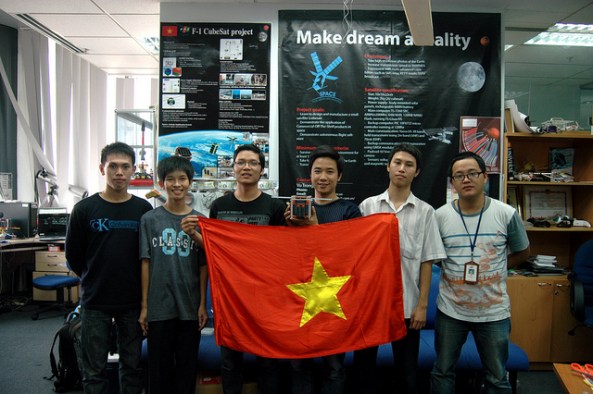
The broadcast shows students from the FPT University in Hanoi who are involved in the project and has an interview with Thu Trong Vu XV9AA.
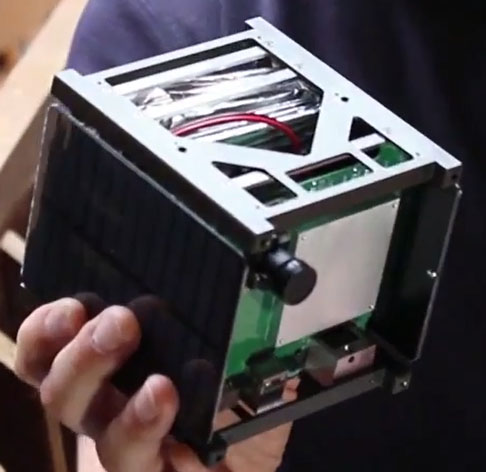
F-1 carries a low-resolution camera (640×480), a 3-axis magnetometer and two Yaesu VX-3R transceivers using 145.980 and 437.485 MHz.
It is planned to launch to the ISS on July 21 in the HTV-3 cargo vessel and be deployed in September by Japanese astronaut Akihiko Hoshide KE5DNI using the ISS Kibo robot arm.
On July 11, Surrey Satellite Technology US LLC (SST-US) signed a memorandum of understanding (MOU) with Virgin Galactic optimizing Surrey’s innovative satellites for Virgin’s new launch vehicle, radically lowering the cost of building and launching small satellites.
This MOU comes on the heels of Virgin Galactic’s announcement of its new ”LauncherOne” program, an unmanned rocket that will be air-launched by SpaceShipTwo’s carrier aircraft, WhiteKnightTwo, and that will be capable of delivering as much as 225 kg to low Earth Orbit. SST-US and Virgin Galactic have agreed to work together to provide SST-US, the world leader in small satellite manufacturing, the information needed to build the most powerful spacecraft that LauncherOne can support, giving satellite customers a powerful and affordable option to put their payloads into space.
SST-US is the US operation of Surrey Satellite Technology Ltd (SSTL), the pioneer in small and cost effective space missions. The collaboration with Virgin Galactic is expected to involve the development by SST-US of new launcher-optimised satellite platforms, the supply of subsystems to the launch vehicle, and advising on market requirements for launch services.
Dr. John Paffet, CEO of SST-US, commented: “Since we launched our first small satellite in the Eighties, we have been changing the economics of space by leveraging innovation. As our platforms have become an integral part of many space programmes, launching satellites at a cost that is synergistic with the mission programme remains a challenge. We look forward to collaborating with Virgin Galactic on this exciting new venture to develop a solution to this need.”
LauncherOne will be a two stage vehicle capable of carrying up to 500 pounds (225 kilograms) to orbit for prices below $10 million. The rocket will be launched from Virgin Galactic’s WhiteKnightTwo, the uniquely capable aircraft also designed to carry SpaceShipTwo aloft to begin her suborbital missions. With more than 85 flights completed to date, WhiteKnightTwo has substantially completed her test flight program.
“Virgin Galactic’s goal is to revolutionize the way we get to space,” Virgin Galactic’s Founder Sir Richard Branson said. “I’m immensely proud of what we have already achieved as we draw near to regular suborbital flights on SpaceShipTwo. Now, LauncherOne is bringing the price of satellite launch into the realm of affordability for schools, non-profits, and start-ups, in addition to companies and space agencies. This provides a completely new resource to the global research community, letting us learn about our home planet more quickly and more affordably.”
Watch LauncherOne – Furthering the Space Frontier
Watch Virgin Galactic’s WhiteKnightTwo and LauncherOne take flight





You must be logged in to post a comment.