RS-39 (Chibis-M) Deploys

RS-39 Chibis-M

RS-39 Chibis-M

RS-39 has CW beacons on 435.315 and 435.215 MHz that can be received directly by schools and colleges for educational outreach purposes. It deployed from Progress M-13M into a 500 km orbit on January 24 at approximately 23:18:30 UT.

On November 2, 2011 cargo ship “Progress M-13M”, which also delivered microsatellite “Chibis-M”, was docked with ISS. The main purpose of “Chibis-M” is the study of physical processes in the vicinity of the lightning, during which the Terrestrial Gamma Ray Flashes (TGFs) are generated. TGFs are likely produced by beams of very energetic electrons, which are accelerated in the intense electric fields generated by large thunderstorm systems.

The deployment of “Chibis-M” in a circular orbit of 500 km will take place during the final phase of “Progress M-13M” operation. According to the plan of the Russian Space Control Centre, undocking of “Progress M-13M” will occur at January 24, 01:59 msk and after two corrections it will be positioned at 500 km orbit. At January 25, 03:14 msk “Chibis-M” will separate. Beside scientific data “Chibis-M” will transmit service telemetry (the housekeeping parameters) in the beacon format on 435.315 or 435.215 MHz CW (Doppler shift +/- 10 kHz) and has the designation of RS-39. The format of data is typical for RS satellites and can be downloaded here.

The telemetry of RS-39 can be easily received directly by schools and colleges for educational outreach purposes. This telemetry will give details of the spacecraft’s health – battery voltages and temperatures of critical units. In combination with orbital data such information will be useful as the curriculum for student lessons.

The team of RS-39 will very much appreciate any reception reports of “Chibis-M”. Special attention is requested for the first orbits as these are outside of control stations for “Chibis-M”. Each report will be confirmed by special QSL card. The email address is amateur-rs39@chibis.cosmos.ru

The RS-39 Chibis-M website managed the by Space Research Institute of the Russian Academy of Sciences (RAS) can be seen in Russian at http://chibis.cosmos.ru/ or in Google English at http://tinyurl.com/RS-39-Chibis-M

As well as measuring electromagnetic parameters of “space weather” in the spectrum 0.1 – 40 kHz the satellite also carries a receiver for the analysis of radio frequency signals in a frequency band of 26-48 MHz. http://www.energia.ru/en/iss/researches/geophis/19.html

RS-39 Morse Code telemetry format http://tinyurl.com/RS-39-Morse-Code-Telemetry

RS-39 Telemetry Decoder http://www.uk.amsat.org/4029

RS-39 Real Time Tracking Map http://chibis.cosmos.ru/cyclogr/prepare1/google/index.html
For Keps click on two gear wheels in top left-hand corner then click on Satellites.

It may be worth checking the AMSAT Bulletin Board (AMSAT-BB) for the very latest news. The 48-hour archive of the AMSAT-BB is at http://www.amsat.org/amsat/archive/amsat-bb/48hour/threads.html or you can join the bulletin board at http://www.amsat.org/amsat-new/tools/maillist/maillist.php
AO, Cubesat Mission Concept Studies

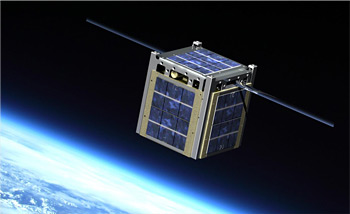
A CubeSat in Space

A CubeSat in Space

(Source: Technology Strategy Board)

CubeSats offer huge potential to accelerate technology development of sensors and instruments in a miniaturised package for deployment in space. New technology concepts for space missions can be demonstrated on CubeSat payloads, delivering a test bed at low cost and significantly reduced timescales.

The UK Space Agency is currently funding a pilot programme, called Ukube1, to demonstrate the capabilities of a CubeSats with a launch towards the end of 2012. If successful, this pilot project could pave the way for a national programme starting in the third quarter of 2012, offering launch opportunities every 12-18 months. The aims of a national programme will also encompass the delivery of educational opportunities and science applications as well as testing new technologies.

Proposals are invited to develop CubeSat preparatory studies for future mission concepts e.g. UKube-2. The concept can address a scientific theme or be of an in-orbit technology demonstration nature (e.g. formation flying), providing a real impact to the UK. All UK based communities (academic, industrial and other) are invited to submit proposals. Applications can be made individually or in partnership with other organisations, however industry and academia will be funded under the rules stipulated in the scope of funding presented below.

Funding is available up to £35K per proposal; the size of award will depend on the requirements of the proposed project and the applicants’ case for support. Proposals should not exceed a grant value of £35K. Funding will be awarded in 2012 and the project cannot exceed 3 months duration. Due to the short nature of these studies and the amount of funding available, we intend funding successful applicants at the onset of the project. It is anticipated the scheme will fund a minimum of 7 proposals; the facility to fund more will depend on the size of awards and will be assessed on a competitive basis as detailed below. The deadline for submission of proposals is 01 February 2012, 12pm.

See TSB website for more information

Building a Distributed Satellite Ground Station Network

There was a presentation on building a distributed satellite ground station network at the Chaos Communication Congress held December 27-30 and the video is now available.

The AMSAT-UK FUNcube Dongle VHF/UHF Software Defined Radio gets a brief mention at 39:26 into the video.

The video kicks off with an appearance by Nick Farr then the presentation by Gregor Jehle (Hadez), Armin Bauer and Andreas Hornig gets underway.

Watch 28C3: Building a Distributed Satellite Ground Station Network – A Call To Arms (en)

Hackers Plan Space Satellites http://www.uk.amsat.org/3172 

Hackerspace Global Grid http://shackspace.de/wiki/doku.php?id=project:hgg

London Hackspace Project: Hoxton Space Centre http://wiki.london.hackspace.org.uk/view/Project:Hoxton_Space_Centre

London Hackspace work on HackSat1 http://www.uk.amsat.org/2482

The DIY Magic of Amateur Radio video http://www.uk.amsat.org/3158

Sounds From Space website looking for additional sounds

 Matthias, DD1US, would like to draw your attention to a collection of audio recordings, the ‘Sounds From Space‘ collection on his website at http://www.dd1us.de. This features a collection which has also a section dedicated to recordings of amateur radio satellite signals.

Please have a look at it. The idea is to give older radio amateurs the chance, to listen to signals of satellites which are already gone and the might have worked in the past, and to younger people interested in ham radio, to get them more excited in satellite communication.

In spite of the fact that the collection now has close to 1000 recordings he is still missing recordings from some amateur radio satellites.
If anyone of you would be willing to contribute recordings to these satellite he would highly appreciate it. He has and always will give full credit to the source of the recordings. Please have a look in your older tapes and recordings!

Here is a list of the most wanted missing satellites:
Amsat Oscar 8
RS-1
RS-2
ISKRA-1
RS-3
RS-4
RS-5
RS-6
RS-8
ISKRA-3
Fuji-OSCAR-12
UOSAT OSCAR 15
WEBER OSCAR 18
UOSAT OSCAR 22
POSAT OSCAR 28
TMSAT OSCAR 31
PANSAT OSCAR 34
UOSAT OSCAR 36
ASUSAT OSCAR 37
WEBER OSCAR 39
SAUDI OSCAR 42
STARSHINE OSCAR 43
MYSAT OSCAR 46
KAGAYAKI (SORUNSAT-1)
ANUSAT
BEVO-1
WASEDA-SAT2
StudSAT

Source: Amsat, Matthias, DD1US and The Sounds From Space website

FUNcube in Electronics Weekly

FUNcube_Graphic_Large

Artists impression of FUNcube in space

The FUNcube amateur radio satellite project is featured on the website of Electronics Weekly.  The printed version of the publication (circulation 36,400) is due out on Wednesday, January 18.

Read the article ‘Radio hams seal launch deal for FUNcube satellite’ http://www.electronicsweekly.com/Articles/13/01/2012/52712/radio-hams-seal-launch-deal-for-funcube-satellite.htm

A free subscription to the digital version of the publication is available via the Electronics Weekly website http://www.electronicsweekly.com/ On the lef-hand side under “SIGN UP TO” click on “Digital Magazine”.


Winter OSCAR News

The Winter issue of OSCAR News has been posted to members.

In this issue:
– It all started here – 50 years ago!
– UKube-1 Update
– Clive Wallis G3CWV column
– RSGB Spectrum Forum Meeting Nov 2011
– FUNcube Report
– Utility of Nearly Geostationary Orbits for Amateur Spacecraft
– Another 50th Anniversary
– News from Bochum
– Winner of Space App Competition
– The AMSAT-UK Survey
– Accurate Time Keeping
– ‘Shorts’