BBC Interview with Professor Colin Pillinger

Professor Pillinger at AMSAT-UK Colloquium - Credit GM8ARV

Professor Colin Pillinger at the AMSAT-UK Colloquium. Picture credit: David Taylor GM8ARV

On Dec. 27, BBC Radio 4 broadcast an interview with Professor Colin Pillinger about the UK Mars exploration mission Beagle 2 which landed on the Red Planet on Christmas Day 2003. An MP3 of the interview is now available.

Eight years ago, planetary scientist Colin Pillinger was still hopeful that the Beagle 2 Lander that he had spent years designing, building and publicising (with the help of Blur and Damien Hirst) might yet be found somewhere on the surface of Mars. But, as more time passed, it became clear that The Beagle 2 Lander would be forever lost in space. Jim al -Khalili talks to Colin Pillinger about studying moon rock and meteorites from Mars whilst running a successful dairy farm; broken space dreams and why, even if a space project fails, useful scientific lessons can still be learned.

During the interview Colin Pillinger says that the biggest lesson learnt was not having had a radio beacon active during the decent phase and therefore not knowing what finally happened.

The interview was first broadacst on BBC Radio 4, at 9:00AM Tuesday, Dec 27, 2011 and a podcast of the show ‘The Life Scientific’ can now be heard at http://downloads.bbc.co.uk/podcasts/radio4/tls/tls_20111227-0930a.mp3

Beagle 2 : The UK led exploration of Mars http://www.beagle2.com/

The 2012 AMSAT-UK International Space Colloquium will be held September 14-16
http://www.uk.amsat.org/colloquium/twelve/

AMSAT-UK publishes a colour A4 newsletter, OSCAR News, which is full of Amateur Satellite information.
Free sample issue at http://www.uk.amsat.org/on_193_final.pdf
Join online at http://tinyurl.com/JoinAMSAT-UK

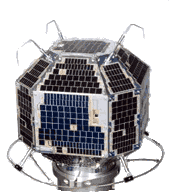
FO-29 Test Successful

Amateur Radio Satellite FO-29

Amateur Radio Satellite FO-29

On the AMSAT bulletin board Masa JN1GKZ reports that the December 23 command test on the 15 year old amateur radio satellite FO-29 was successful.

FO-29 has been inoperative due to eclipse length and the poor condition of the batteries. It carries a 100 kHz wide 145/435 MHz linear transponder for SSB/CW contacts.

Masa wrote:  JTA was on at 1422z. Loud CW telemetry was heard. Unfortunately, the telemetry was shut off by UVC at 1426z.

I put the telemetry MP3 file on the following URL: http://www.ne.jp/asahi/m-arai/gkz/sound/FO29-111223142200-142544z.mp3

The command station announced Dec. 24 sked as starting at 0405z. I guess this is typo. The correct time is 0505z. Transponder will operate until eclipse. East Asia, VK and southern South American stations will chat over FO-29.

FO-29 frequencies and tracking http://www.amsat.org/amsat-new/satellites/satInfo.php?satID=5

John Heath G7HIA mentions FO-29 in his article ‘Getting started on amateur radio satellites’. Download the article:
http://www.uk.amsat.org/2011/05/09/getting-started-on-amateur-radio-satellites/

Working the SSB satellites http://www.uk.amsat.org/2011/12/04/working-the-ssb-satellites/

Seven Student CubeSats Ready For Flight

Artists impression of Vega launch

Artists impression of Vega launch

The first student built amateur radio CubeSats to be sponsored by ESA’s Education Office have passed their Final Acceptance Review and have been declared ready for launch on board the maiden flight of Vega, the new ESA launcher.

The launch window for this historic lift-off opens on 26 January and ends in the first week of February 2012.

The seven university-built picosatellites, each weighing only 1 kilogram, were integrated with the devices that will carry them during launch – the P-PODs, or Poly-Picosatellite Orbital Deployers – between late October and mid November. Before they could be cleared for launch, they had to pass a detailed technical examination known as the Final Acceptance Review.

The single-unit CubeSats, whose development represented a highly valuable, if not unique hands-on learning experience for the university students that were involved – were developed by teams from 6 different European countries:

  • Xatcobeo (a collaboration of the University of Vigo and INTA, Spain)
  • Robusta (University of Montpellier 2, France)
  • E-St@r (Politecnico di Torino, Italy)
  • Goliat (University of Bucharest, Romania)
  • PW-Sat (Warsaw University of Technology, Poland)
  • MaSat-1 (Budapest University of Technology & Economics, Hungary)
  • UniCubeSat GG (Universitá di Roma ‘La Sapienza’, Italy)

As well as the CubeSats Vega will also carry the Amateur Radio microsatellite ALMASat-1.

Frequencies and links for the satellites can be found at http://www.ne.jp/asahi/hamradio/je9pel/esa9cubf.htm

Read the full ESA story at http://www.esa.int/SPECIALS/Education/SEMG1C8XZVG_0.html

2007 – AO-51 to switch to V/S 38k4 to support ALMASat ground station testing
http://www.southgatearc.org/news/march2007/ao51_switch.htm

AMSAT-UK publishes a colour A4 newsletter, OSCAR News, which is full of Amateur Satellite information.
Free sample issue at http://www.uk.amsat.org/on_193_final.pdf
Join online at http://tinyurl.com/JoinAMSAT-UK

Soyuz rocket blasts off for International Space Station A Russian Soyuz rocket, carrying three astronauts, has blasted off to the International Space Station from Kazakhstan.

The rocket carrying Russian cosmonaut Oleg Kononenko RN3DX, Nasa astronaut Don Pettit KD5MDT and the European Space Agency’s Andre Kuipers PI9ISS lifted off under freezing conditions at the Baikonur Cosmodrome in Kazakhstan.

The crew, who will stay at the International Space Station until March, are on a mission to bring the station back up to full manpower after an August cargo launch accident disrupted flights.

The all-veteran crew is scheduled to reach the orbital outpost at 1522 GMT on Friday. They will join station commander Dan Burbank and two Russian cosmonauts who arrived last month, bringing the complex back to its full staff of six.

With the space shuttles’ retirement, Nasa is dependent on Russia to fly crews to the station, a service that currently costs the United States about $350 million (£222 million) a year.

The station, a $100 billion project of the United States, Russia, Europe, Japan and Canada, is a multi-purpose research laboratory for biology, physics, astronomy and other studies that orbits about 240 miles above Earth.

Space Station School Contact Video

A video has been released of the contact between ISS commander Daniel C. Burbank KC5ZSX and students at Hirano Elementary school, Kobe City.

Watch ARISS ham radio contact with Hirano branch of Kobe Youth Nurturing Council, Kobe-city

Further information: http://www.southgatearc.org/news/december2011/ariss_event_1212.htm

Amateur Radio on the International Space Station (ARISS) http://www.ariss.org/

From OSCAR 1 to Mars and Beyond

A video of the presentation about Amateur Radio Space Communications given by Mario Lorenz DL5MLO to hackers at the Chaos Communication Camp 2011 is now available.

The talk  was titled ‘From OSCAR 1 to Mars and beyond – Amateur Space Exploration – The last 50 years, now, and the future’ and the YouTube description reads:

Radio amateurs have been building and operating satellites for almost fifty years now, and we are aiming for more. In this talk, I’ll present who AMSAT is, what we have achieved in the last fifty years, and what we are working on now.

Back in the 1960’s, radio amateurs seized the opportunity of launching a satellite into space. It would not be the only one; we are approaching OSCAR 70 now. Building satellites has always been challenging and involves using technology in creative ways. I’ll cover some of the more fascinating cases, including some lessons learned during the process. In addition to the satellites in earth orbit, we are also aiming for Mars, and I’ll show what are doing to get there.

Watch From OSCAR 1 to Mars and beyond – CCCamp 2011

Hackers Plan Space Satellites http://www.uk.amsat.org/3172 

London Hackspace Project: Hoxton Space Centre http://wiki.london.hackspace.org.uk/view/Project:Hoxton_Space_Centre

London Hackspace work on HackSat1 http://www.uk.amsat.org/2482

The DIY Magic of Amateur Radio video http://www.uk.amsat.org/3158