AMSAT-India Linear Transponder

AMSAT-India 435-145 MHz Linear Transponder

AMSAT-India 435/145 MHz Linear Transponder

At Hamfest India (HFI) 2011, held in Kochi Dec 10-11, a presentation was given on a new Indian linear transponder and a CubeSat communications system.

This was the largest gathering of radio amateurs in India so far. Radio Amateurs and SWLs from all over the country and invited guests from other countries enjoyed the two-day event.

AMSAT-India gave several presentations at the event, among them was one by Ganesan Namachivayam KJ6LRR in which he described a satellite 435/145 MHz linear transponder with a bandwidth of 50 kHz and capable of 1-3 watts PEP output. AMSAT-India plan to develop a smaller linear transponder for CubeSats.

AMSAT-India CubeSat

AMSAT-India CubeSat

Ganesan also described a CubeSat communications system comprising a 435 MHz half-duplex narrow‐band FM transceiver supporting a data rate of 1200-9600 bps. The transmitter produces 1 watt output and can also operate as a Morse Code beacon.

Other presentations included:

  • Real Time Tracking by Mani VU2WMY
  • Working with LEO Sats by Dr. Raveendranath VU2RVJ
  • Telemetry Decoding by Nitin VU3TYG

The slides from the AMSAT-India presentations are at
http://amsatindia.org/presentations/HFI-2011/AI-HFI2011.pdf

Hamfest India (HFI) 2011 http://www.hamfestindia2011.com/

AMSAT India http://www.amsatindia.org/

UK launches National Space Academy

Space is about to touch down in even more classrooms and colleges across the UK, with the launch of the National Space Academy – a network of outstanding teachers and space scientists that will use the inspirational context of space to teach STEM subjects – and geography – to our students and their teachers.
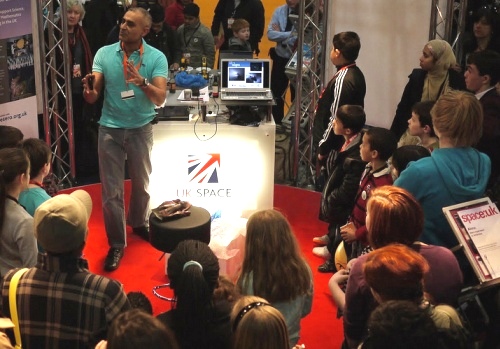
Led by the National Space Centre on behalf of the UK Space Agency, the Science & Technology Facilities Council (STFC), the UK Space Education Office (ESERO-UK), and theEuropean Space Agency, the academy will be launched in February 2012 and will be supported by a range of universities, colleges and sponsors.

The National Space Academy’s network of teachers will work with scientists from theUniversity of Leicester, the University of Nottingham and the STFC Rutherford Appleton Laboratory in Harwell, Oxfordshire. They will deliver student masterclasses, teacher CPD (continued professional development) courses, careers events and a bespoke space engineering course at Loughborough College. The first group of 12 teachers will be spread across England.

InmarsatVEGA SpaceAstrium GEO Information ServicesRolls RoyceLogica, the Garfield Weston Foundation and the Ogden Trust have all committed funds to the National Space Academy.

The National Space Academy will work with existing initiatives such as ESERO-UK, thenetwork of Science Learning CentresSTFC’s Leading Space Education Project, the Institute of Physics, and the network of Science and Discovery Centres to improve the attainment of students in secondary schools and colleges.

Minister for Universities and Science David Willetts said:

Space captures the imagination of people of all ages, and the National Space Academy will use the UK’s world-class expertise in space research and technology to inspire the next generation of scientists and engineers

“Space captures the imagination of people of all ages, and the National Space Academy will use the UK’s world-class expertise in space research and technology to inspire the next generation of scientists and engineers. This will also equip them with the skills and knowledge needed to boost both our leading research base and our economy.”

Professor Sir Martin Sweeting G3YJO, Chairman of the National Space Centre’s Board of Trustees, says:

“The National Space Centre is indebted to its partners and sponsors for their drive and enthusiasm in getting the National Space Academy up and running. The three year pilot programme that was run in association with the East Midlands Development Agency was a great success and showed that students respond very positively to the subject of space as a context for their learning. We have evidence of improved attainment in exam results and teacher effectiveness, and a greater likelihood of students choosing science and engineering-related subject at the next stage in their education”.
Credit: UK Space Agency

BBC Micro and AMSAT-UK Software Library

The 6502 based BBC Microcomputer

The 6502 based BBC Microcomputer

The first 6502 based BBC microcomputers were produced on December 1, 1981. They proved popular with radio amateurs who used them for RTTY, Cambridge Packet Radio, SSTV and running the AMSAT-UK software library.

The Cambridge Packet Radio software was popular in the years before the widespread adopton of the AX.25 standard. The free software enabled users to send and receive packet radio direct from the BBC Micros cassette tape interface without needing a seperate modem. Software for other modes required an additional modem interface such as the IGADUMA which was produced by radio amateurs in Hertfordshire. Continue reading

Danish Euroluna Project on TV

Tor Foss Mortensen of Google X-Prize team Euroluna (OZ9LUNA) appeared in the Danish TV show Aftenshowet.

Euroluna is developing a 2U CubeSat MiniRomit1 which was shown on TV.  Watch Tor i Aftenshowet

Twitter: http://twitter.com/Euroluna

Facebook: http://www.facebook.com/photo.php?pid=708263#!/pages/Euroluna/337261739568?ref=mf

Euroluna: http://www.euroluna.dk/

Google Lunar X PRIZE: http://www.googlelunarxprize.org/

AMSAT-UK publishes a colour A4 newsletter, OSCAR News, which is full of Amateur Satellite information. Free sample issue at http://www.uk.amsat.org/on_193_final.pdf
Join online at http://tinyurl.com/JoinAMSAT-UK
—-

Vega to Launch Amateur Radio Satellites

Artists impression of Vega launch

Artists impression of Vega launch

The inaugural launch of the ESA Vega rocket will carry the amateur radio microsatellite ALMASat-1 and at least six CubeSats.

The satellites will be launched from the ESA spaceport at Kourou in the Caribbean into an elliptical orbit of 1450 by 354 km at an inclination of 71 degrees. They are expected to have a lifetime before re-entry of 4 years.

ESA say the six CubeSats to be launched on Vega in late January 2012 comprise:

Xatcobeo (a collaboration of the University of Vigo and INTA, Spain): a mission to demonstrate software-defined radio and solar panel deployment;
Robusta (University of Montpellier 2, France): a mission to test and evaluate radiation effects (low dose rate) on bipolar transistor electronic components;
e-st@r (Politecnico di Torino, Italy): demonstration of an active 3-axis Attitude Determination and Control system including an inertial measurement unit;
Goliat (University of Bucharest, Romania): imaging of the Earth surface using a digital camera and in-situ measurement of radiation dose and micrometeoroid flux;
PW-Sat (Warsaw University of Technology, Poland): a mission to test a deployable atmospheric drag augmentation device for de-orbiting CubeSats;
MaSat-1 (Budapest University of Technology and Economics): a mission to demonstrate various spacecraft avionics, including a power conditioning system, transceiver and on-board data handling.

ESA indicate that a 7th CubeSat may be delivered in time to be flown.

PW-Sat carries an FM to DSB amateur radio transponder with an FM input on 435.020 MHz and DSB output on 145.900 MHz.

The primary payload on the launch, LARES, will be deployed into an orbit of 1200 km × 1200 km with an inclination of 71 degrees.

Frequencies and links for the CubeSats can be found at http://www.ne.jp/asahi/hamradio/je9pel/esa9cubf.htm

ESA CubeSats delivered for first Vega flight http://www.esa.int/esaMI/Education/SEM3L0WWVUG_0.html

ESA Education – CubeSats http://www.esa.int/esaMI/Education/SEM3N03MDAF_0.html

The IARU amateur satellite frequency coordination pages hosted by AMAT-UK list the frequencies of the amateur radio satellites http://www.amsat.org.uk/iaru/

ALMASat-1 http://www.almasat.org/

Arthur C Clark Interview

In a 1963 edition of the Sky at Night show Arthur C. Clarke, who in 1945 predicted geostationary satellites, is interviewed by Patrick Moore.

The perils of spaceflight prediction
http://www.thespacereview.com/article/1981/1