In a 1963 edition of the Sky at Night show Arthur C. Clarke, who in 1945 predicted geostationary satellites, is interviewed by Patrick Moore.
The perils of spaceflight prediction
http://www.thespacereview.com/article/1981/1
In a 1963 edition of the Sky at Night show Arthur C. Clarke, who in 1945 predicted geostationary satellites, is interviewed by Patrick Moore.
The perils of spaceflight prediction
http://www.thespacereview.com/article/1981/1
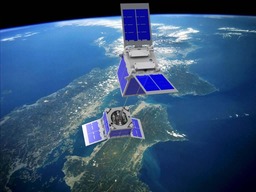
Impression of STARS-II in Orbit
The amateur radio satellite STARS-II has been developed by students at Kagawa University and consists of a Mother satellite and Daughter satellite connected by tether.
STARS stands for Space Tethered Autonomous Robotic Satellite. The mission will include formation flight, tether deployment, attitude control and the mother and daughter satellites will take pictures of each other.
It is proposed to fly a 80mW CW beacon and a 800mW AX25 1200bps telemetry downlink. Total mass is 8 kg.
Coordinated frequencies for CW 437.245 MHz (mother) and 437.255 MHz (daughter). FM downlinks 437.405 MHz (mother) and 437.425 MHz (daughter).
Kagawa satellite development project STARS-II http://stars1.eng.kagawa-u.ac.jp/english/index.html
The Google English translation of the Japanese language STARS-II page has additional information http://tinyurl.com/JapanSTARS-II
STARS-II on the IARU Satellite Frequency Coordination pages hosted by AMSAT-UK
http://www.amsatuk.me.uk/iaru/formal_detail.php?serialnum=170
AMSAT-UK publishes a colour A4 newsletter, OSCAR News, which is full of Amateur Satellite information. Free sample issue at http://www.uk.amsat.org/on_193_final.pdf Join online here

FASTRAC -1 and FASTRAC-2
Sebastián KE5FKV has announced that the AX.25 packet radio digipeater on the amateur radio satellite FASTRAC-1 (FO-69) will be available from 1600 UT on Friday Dec. 2
On the AMSAT bulletin board FASTRAC Student Program Manager Sebastián Muñoz Toro KE5FKV writes:
The FASTRAC satellites have been in operation for more than a year and the team has been able to get a lot of data from them, in great part due to the amazing support from the amateur radio community.
Over the last month the team noticed that one of FASTRAC-1’s on board microcontrollers which controls one of the experiments has not been booting up correctly. The team has done everything possible to correct this issue apart from turning it off which can only happen if the batteries fall below an specific charge level. Since the satellites have been power positive throughout this whole year the only way this can happen is if the satellites transmit more often.
Given that one of FASTRAC goals has always been to eventually provide a platform for amateur radio enthusiasts to use after the primary mission was over, the team has decided to open up FASTRAC-1 to the amateur radio community with the hope as more people use it to digipeat through the satellite, the battery levels will diminish and cause a hard reset of the microcontrollers on board.
The satellite will be configured so that amateur radio operators can use it beginning on Friday, Dec 2 at 10:00 AM CST [1600 UT]. Starting on this date people will be able to digipeat through the satellites. The call sign and frequencies of the satellite are summarized below and an example of digipeating through the satellite is also shown in below.
To increase the chances of causing a hard reset, it is requested that as many amateur radio enthusiasts try to digipeat through the satellite on the weekend of Dec 10. If you are successful at digipeating through the satellites or have any problems doing so please let us know at fastracsats@gmail.com , through our Facebook page http://www.facebook.com/fastracsats or through the forums on our website http://fastrac.ae.utexas.edu/for_radio_operators/users/phpBB3/index.php
Frequency Information for FASTRAC-1
– FASTRAC-1 “Sara Lily” Downlink Frequency: 437.345 MHz
– FASTRAC-1 “Sara Lily” Uplink Frequency (1200 or 9600 baud): 145.825 MHz
– FASTRAC-1 “Sara Lily” Satellite Call Sign: FAST1
Example of Digipeating through FAST1
– cmd: c CALLSIGN via fast1
– cmd: KE5DTW>CALLSIGN,FAST1/1: <<C>>:
– CALLSIGN>KE5DTW,FAST1*/1: <UA>:
– *** CONNECTED to CALLSIGN VIA FAST1
Here the example shows KE5DTW (UT Austin Ground Station) digipeating through FAST1 to connect to CALLSIGN. CALLSIGN represents an arbitrary callsign and should be replaced with the callsign of the station with whom a connection is being attempted. The above example is based on a Kantronics KPC9612+ TNC.
For a PDF version of the announcement please go to the following link:
http://fastrac.ae.utexas.edu/FASTRAC_Digipeating_Announcement.pdf
Thanks a lot,
THE FASTRAC TEAM
Satscape satellite tracking software http://www.satscape.info/
FASTRAC keps for tracking software http://fastrac.ae.utexas.edu/for_radio_operators/users/phpBB3/predictedorbit.php
UISS Packet Software http://users.belgacom.net/hamradio/uiss.htm
AGW Packet Engine http://www.sv2agw.com/ham/agwpe.htm
AGPE Installation and Setup http://www.soundcardpacket.com/2agwget.htm
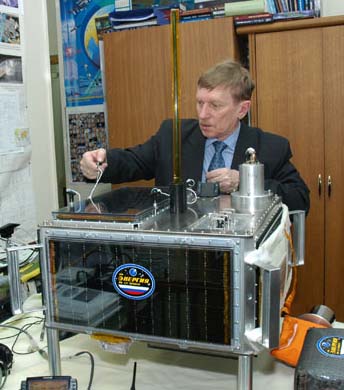
Sergey Samburov RV3DR with ARISSat-1
The latest prediction from Jim N8OQ is that the amateur radio satellite ARISSat-1 will re-enter the Earths atmosphere in January.
On the AMSAT bulletin board Jim says “Using solar data through 2011 Nov. 30 and updating the decay fit. I am getting a re-entry date of 2012 January 12 with a rule-of-thumb error estimate of +/- 10 days or so for ARISSat-1.”
Since deployment in August, ARISSat-1 has descended about 60 km, and is currently losing more than 1.5 km per day. The rapid rate is partially the result of the recent solar activity on the atmosphere, significantly increasing the drag.
AMSAT wishes to collect telemetry data from the satellite as it approaches re-entry and is running a competition to see who can copy the final telemetry frames. Further details of the Catch the Last ARISSat-1 Telemetry Contest at
http://www.uk.amsat.org/2011/11/09/catch-the-last-arissat-1-telemetry/
ARISSat-1 http://www.arissat-1.org/
Online pass predictions (select ARISSat-1) http://www.amsat.org/amsat-new/tools/
Download the Windows and Mac versions of the ARISSatTLM free ground station soundcard demodulator and display software from http://www.arissattlm.org/
ARISSat-1 Frequency Guide http://tinyurl.com/4t497t2

New ISS Commander Daniel Burbank KC5ZSX
Three radio amateurs returned safely to Earth on Monday, having completed nearly six months in space onboard the International Space Station (ISS) Continue reading

International Space Station
The Central Research Institute of Machine Building (TSNIIMASH) in Russia is conducting a series of space plasma experiments in order to evaluate the shape of previously observed “dead” zone, or shadowing due to the firing of an onboard arcjet plasma source.
Radio Amateurs are invited to participate in the Space plasma experiment “Shadow” onboard the International Space Station (ISS) taking place Nov 25-28 and Dec 2-5.
Integration of Electric Thrust (ET) onboard a spacecraft poses a certain set of problems including electromagnetic compatibility of ET. One matter of interest is that highly ionized exhaust plumes of ET may scatter RF-signals producing large “dead” zone for communications. Continue reading


You must be logged in to post a comment.