ISS Slow Scan TV on August 27

RS0ISS SSTV 20131029-1121Z received by Dmitry Pashkov UB4UAD

RS0ISS SSTV 20131029-1121Z received by Dmitry Pashkov then UB4UAD

A test of the Slow Scan Television (SSTV) experiment MAI-75, callsign RS0ISS, took place on the International Space Station (ISS) on Wednesday, August 27 between 1100-1300 GMT on 145.800 MHz FM. Although a strong carrier was heard there were no reports of SSTV tones being received.

The ARISS SSTV Blog Aug 27 says: The SSTV transmissions occurred on schedule and even occurred well after the planned termination time of 13:00 UTC (after 17:00 UTC). The new cable appears to have solved the constant carrier issue but now the audio from the program is not being transmitted. The end result for the day was no images but several well timed carriers that lasted for 180 seconds.

The ARISS SSTV Blog Aug 25 says: After a long hiatus due to hardware issues, the Russian team will try sending SSTV images on Aug 27 from 11:00-13:00 UTC using the Kenwood D710 and a new cable. The transmissions will be on 145.80 MHz and the intended mode is PD180. The interval between transmissions should be about 3 minutes. The images are being planned to be sent for one full orbit during this time period. Regions along the ground track include Europe, Central and Southeast Asia, Eastern Australia and New Zealand, Central South America and then Europe again.

Paul G4IJE, co-developer of the SSTV PD modes, says: If the ISS really does use PD180 mode as reported, don’t forget to either enable “Always show RX viewer” or use the “Picture viewer” (magnifying glass icon) to show the picture at it’s real resolution of 640 x 496. If you just view as normal you will only see 320 x 248 resolution, which kind of defeats the object of using a high resolution mode. Hopefully the image capture on the ISS is at high resolution.

Yuri Gagarin

Yuri Gagarin

A Google English translation of the ISS work plan says: “On Gagarin from Space”. Open gear with ISS RS by amateur radio link to ground receiving stations amateurs around the world images of photographs devoted to the life and work of the first cosmonaut Yuri Gagarin.

The Kenwood TM-D710 was delivered to the ISS in the summer of 2012. ARISS minutes for March 2013 note that: Sergey and the team did some tests including swapping antennas between the D-700 and the D-710, and with both configurations, there was a weak signal with the D-700. The power amplifier appears to be the problem. It seems only the exciter is working. Also, the D-710 has no mike since it was to be used with non-voice modes, and the mike for the D-700 has been modified and can’t be used with the D-710. We will work with our Russian colleagues to solve these issues.

The very strong carrier that was transmitted during the test on Wednesday, August 27 confirmed that the D-710 was radiating power successfully. Overheating issues (convection cooling doesn’t work in zero gravity) meant that the old D-700 transceiver was always run on the lowest power setting – 5 watts. It is presumed that a similar power level was used for the SSTV test.

All you need to do to receive SSTV pictures from the space station is to connected the audio output of a scanner or amateur rig via a simple interface to the soundcard on a Windows PC or an Apple iOS device, and tune in to 145.800 MHz FM. You can even receive pictures by holding an iPhone next to the radio’s loudspeaker.

The ISS puts out a strong signal on 145.800 MHz FM and a 2m handheld with a 1/4 wave antenna will be enough to receive it. The FM transmission uses 5 kHz deviation which is standard in much of the world.

Many FM rigs in the UK can be switched been wide and narrow deviation FM filters so select the wider deviation. Handhelds all seem to have a single wide filter fitted as standard.

Orbit for ISS SSTV on August 27, 2014 1100-1300 GMT

Orbit for ISS SSTV on August 27, 2014 1100-1300 GMT

On Windows PC’s the free application MMSSTV can be used to decode the signal, on Apple iOS devices you can use the SSTV app. The ISS Fan Club website will show you when the space station is in range.

Listen for the ISS SSTV transmissions online using the SUWS WebSDR, further details at https://amsat-uk.org/2014/08/15/suws-websdr-moves-to-new-site/

For more on Slow Scan Television SSTV, see this article SSTV – The Basics
http://www.essexham.co.uk/sstv-the-basics

How to be successful with the ISS Slow Scan Television (SSTV) imaging system
http://www.marexmg.org/fileshtml/howtoisssstv.html

Information on the MAI-75 SSTV experiment
http://www.energia.ru/eng/iss/researches/education-26.html

Free MMSSTV software http://hamsoft.ca/pages/mmsstv.php

iOS SSTV App https://itunes.apple.com/gb/app/sstv/id387910013

IZ8BLY Vox Recoder, enables you to record the signals from the ISS on 145.800 MHz while you’re away at work http://antoninoporcino.xoom.it/VoxRecorder/

ARISS Slow Scan TV (SSTV) Blog and Gallery http://ariss-sstv.blogspot.co.uk/

For real-time tracking and the latest status of amateur radio activity on the space station see the ISS Fan Club http://www.issfanclub.com/

Dmitry Pashkov R4UAB http://r4uab.ru/?p=7237

ISS Work Plan http://www.mcc.rsa.ru/plan.htm

SPROUT Slow Scan TV and Digitalker Active

SSTV image received from SPROUT by Mario LU4EOU on May 31, 2014 at 0408 UT

SSTV image received from SPROUT by Mario LU4EOU on May 31, 2014 at 0408 UT

Slow Scan TV (SSTV) images in Scottie 1 format have been successfully received from the amateur radio satellite SPROUT on 437.600 MHz FM (+/- 9 kHz Doppler shift). The Digitalker has also been active.

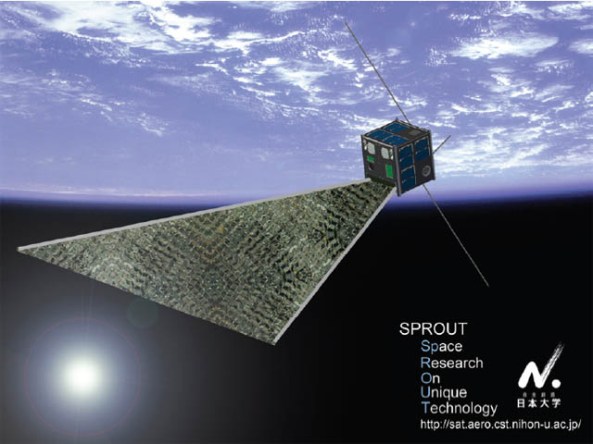
SPROUT, a 20 x 20 x 22 cm amateur radio nano-satellite with a mass of 7.1 kg, launched successfully with the L-band (1236.5 MHz/1257.5 MHz/1278.5 MHz) Synthetic Aperture Radar (SAR) satellite ALOS-2 on May 24, 2014 at 0305 UT. SPROUT is now in a 654 km, 97.9 degree inclination Sun Synchronous Orbit (SSO).

SPROUT (Space Research On Unique Technology) was built by students from Nihon University and its objectives are:

SPROUT Satellite - Credit Nihon-Univ. Miyazaki Laboratory

SPROUT Satellite – Credit Nihon-Univ. Miyazaki Laboratory

1. Operation of satellite by radio amateurs.

A FM Digitalker will enable the satellite to speak to amateurs around the world.

The Voice Message Box will record transmissions from radio amateurs and play them back.

Pre-loaded images from the Message Gallery can be transmitted using Slow Scan TV (SSTV).

Pictures of the Earth can be transmitted by SSTV and radio amateurs can receive it using free software such as MMSSTV. As part of the Earth mapping project the team ask radio amateurs to contribute pictures they have received from the satellite for display on the SPROUT website.

The satellite also has a packet radio Digipeater and Text Message Box function.

SPROUT in orbit2. Demonstration of the deployment of the combined membrane structure and verification of the design method of the structure SPROUT has a triangular membrane supported by two tubes like framework. They are folded and stored in the satellite before the launch. After the launch, the nitrogen gas is injected into the tubes in space, and they extend, so that the membrane deploys (called “combined membrane structure”).

3. Demonstration of attitude determination and control of a nanosatellite using the sun sensors, gyros, geomagnetic sensor and magnetic torquers.

Callsign: JQ1ZJQ
Size: 214x210x220 mm
Weight: 7.1 kg
Mode: 1200bps AFSK, 9600bps GMSK
CW downlink 437.525 MHz
FM packet downlink 437.525 MHz
Digipeater uplink 437.600 MHz
Digitalker downlink 437.600 MHz
SSTV downlink 437.600 MHz

SPROUT Amateur Radio SSTV Satellite

SPROUT Amateur Radio SSTV Satellite

SPROUT English website http://sat.aero.cst.nihon-u.ac.jp/sprout-e/

SPROUT Japanese website http://sat.aero.cst.nihon-u.ac.jp/sprout/

Nihon-Univ. Miyazaki Laboratory on Facebook
https://www.facebook.com/pages/Nihon-Univ-Miyazaki-Laboratory/406566642818860

Telemetry Software http://sat.aero.cst.nihon-u.ac.jp/sprout-e/2-Software-e.html

Telemetry format http://sat.aero.cst.nihon-u.ac.jp/sprout-e/2-Formats%20of%20telemetry-e.html

SPROUT launch data page
http://sat.aero.cst.nihon-u.ac.jp/sprout-e/2-Launch%20data-e.htmlTLE’s from the North American Aerospace Defence Command (NORAD) are also available at http://celestrak.com/NORAD/elements/tle-new.txt

Adding new satellites to SatPC32, Gpredict and Nova
https://amsat-uk.org/2013/11/23/adding-new-satellites-to-satpc32/

Free Slow Scan TV (SSTV) software MMSSTV http://hamsoft.ca/pages/mmsstv.php

The JE9PEL website has information on other satellites on this launch
http://www.ne.jp/asahi/hamradio/je9pel/jaxalos2.htm

Read the Overview of the L-band SAR Onboard ALOS-2 here.

SPROUT satellite students at Nihon-Univ. Miyazaki Laboratory

SPROUT satellite students at Nihon-University Miyazaki Laboratory

SPROUT Amateur Radio Slow Scan TV Satellite

SPROUT Amateur Radio SSTV Satellite

SPROUT, a 20 x 20 x 22 cm amateur radio nano-satellite with a mass of 7.1 kg, launched successfully with the L-band (1236.5 MHz/1257.5 MHz/1278.5 MHz) Synthetic Aperture Radar (SAR) satellite ALOS-2 on May 24, 2014 at 0305 UT. SPROUT is now in a 654 km, 97.9 degree inclination Sun Synchronous Orbit (SSO).

SPROUT Satellite - Credit Nihon-Univ. Miyazaki Laboratory

SPROUT Satellite – Credit Nihon-Univ. Miyazaki Laboratory

SPROUT (Space Research On Unique Technology) was built by students from Nihon University and its objectives are:

1. Operation of satellite by radio amateurs.

A FM Digitalker will enable the satellite to speak to amateurs around the world.

The Voice Message Box will record transmissions from radio amateurs and play them back.

Pre-loaded images from the Message Gallery can be transmitted using Slow Scan TV (SSTV).

Pictures of the Earth can be transmitted by SSTV and radio amateurs can receive it using free software such as MMSSTV. As part of the Earth mapping project the team ask radio amateurs to contribute pictures they have received from the satellite for display on the SPROUT website.

The satellite also has a packet radio Digipeater and Text Message Box function.

SPROUT in orbit2. Demonstration of the deployment of the combined membrane structure and verification of the design method of the structure SPROUT has a triangular membrane supported by two tubes like framework. They are folded and stored in the satellite before the launch. After the launch, the nitrogen gas is injected into the tubes in space, and they extend, so that the membrane deploys (called “combined membrane structure”).

3. Demonstration of attitude determination and control of a nanosatellite using the sun sensors, gyros, geomagnetic sensor and magnetic torquers.

It carries two UHF/VHF radio systems – one for Telemetry, Tracking & Control (TTC) using CW, 1200 bps AFSK and 9600 bps GMSK AX.25 packet and one for amateur operations using 1200 bps AFSK AX.25 packet.

SPROUT plans to launch from the Tanegashima Space Center into a 654 km Sun Synchronous Orbit (SSO) on May 24, 2014.

SPROUT 5 Days to Launch PictureCallsign: JQ1ZJQ
Size: 214x210x220 mm
Weight: 7.1 kg
Mode: 1200bps AFSK, 9600bps GMSK
CW downlink 437.525 MHz
FM packet downlink 437.525 MHz
Digi-peater uplink 437.600 MHz
Digi-talker downlink 437.600 MHz
SSTV downlink 437.600 MHz

SPROUT English website http://sat.aero.cst.nihon-u.ac.jp/sprout-e/

SPROUT Japanese website http://sat.aero.cst.nihon-u.ac.jp/sprout/

Nihon-Univ. Miyazaki Laboratory on Facebook
https://www.facebook.com/pages/Nihon-Univ-Miyazaki-Laboratory/406566642818860

Telemetry Software http://sat.aero.cst.nihon-u.ac.jp/sprout-e/2-Software-e.html

Telemetry format http://sat.aero.cst.nihon-u.ac.jp/sprout-e/2-Formats%20of%20telemetry-e.html

Keplerian elements (TLEs) from SPROUT launch data page
http://sat.aero.cst.nihon-u.ac.jp/sprout-e/2-Launch%20data-e.html

SPROUT
1 00000U 14001A 14144.15446759 .00000000 00000-0 00000-0 0 0013
2 00000 97.8740 241.6718 0035980 58.6810 194.6458 14.85960816 14

After launch TLE’s from the North American Aerospace Defence Command (NORAD) should also be available at http://celestrak.com/NORAD/elements/tle-new.txt

Adding new satellites to SatPC32, Gpredict and Nova
https://amsat-uk.org/2013/11/23/adding-new-satellites-to-satpc32/

Free Slow Scan TV (SSTV) software MMSSTV http://hamsoft.ca/pages/mmsstv.php

The JE9PEL website has information on other satellites on this launch
http://www.ne.jp/asahi/hamradio/je9pel/jaxalos2.htm

Read the Overview of the L-band SAR Onboard ALOS-2 here.

SPROUT satellite students at Nihon-Univ. Miyazaki Laboratory

SPROUT satellite students at Nihon-University Miyazaki Laboratory

Commands for WREN SSTV Released

WREN - Image credit Stadoko

WREN – Image credit Stadoko

It is believed that the SSTV PocketQube WREN is currently in a mode where it beacons on 437.405 MHz for 1.6 seconds then listens for 6 minutes on that frequency for any commands. If none are received it goes to sleep for 2 minutes before transmitting the beacon again.

The WREN team have released the following information on their Facebook page to enable radio amateurs to activate the WREN SSTV transmitter.

BASIC COMMANDS

Commands to WREN are sent by toggling the carrier [of a FM transmitter]:
Carrier on/off: 1=long, 0=short, leave a noticeable silence between the bits.

• Activate/HK: 110011
• wait until answer [should be within 2 seconds]
• Camera ON: 11111
• wait until answer
• Snapshot & Thumbnail receive: 110
• decoder should display thumbnail picture 12*14 pixel can repeat this command until something useable appears
• SSTV send: 110100
• martin-1 SSTV picture comes… in 320×240 pixels color

Wren should answer to the commands within two seconds.
Wait always at least two seconds after having received data before sending to WREN

Notice:
Send the Activate/HK command first, else WREN won´t react to other commands.
When camera is OFF, a snapshot or SSTV command will send WREN into sleep mode. ALWAYS SWITCH CAMERA ON FIRST BEFORE SENDING CAMERA COMMANDS.
WREN´s housekeeping data will show the status of camera power (ON or OFF).

PS: A preliminary commanding software will come soon.
Special wishes for PTT control? VOX, RS232-RTS Pin etc ?

The Telemetry Decoder and an Audio File of the beacon are available at http://we.tl/TkWEuhIlnF

Hope you can catch WREN and have fun commanding it.

Cheers, Paul

WREN on Facebook http://www.facebook.com/StaDoKo

WREN a Ham Radio Slow Scan TV PocketQube Satellite
https://amsat-uk.org/2013/10/24/wren-a-ham-radio-sstv-pocketqube/

Dnepr Yasny launch https://amsat-uk.org/satellites/dnepr-november-2013/

ISS Slow Scan TV Active

RS0ISS SSTV 20131029-1121Z received by Dmitry Pashkov UB4UAD

RS0ISS SSTV 20131029-1121Z received by Dmitry Pashkov UB4UAD

Dmitry Pashkov UB4UAD reports that the Slow Scan Television (SSTV) experiment MAI-75 on the International Space Station (ISS) has been active on 145.800 MHz FM.

The experiment is expected to run for two days, October 28-29, 2013.

Dmitry also reports that on October 31, 2013 SSTV images will be transmitted from the  ISS on 145.800 MHz showing photographic images of the life and work of the first cosmonaut Yuri Gagarin.

ISS SSTV pictures received by Pete Sipple M0PSX can be seen at http://www.essexham.co.uk/news/iss-sstv-images-29-october-2013.html

All you need to do to receive the SSTV pictures from the space station is to  connected the audio output of a scanner or amateur rig via a simple interface to the soundcard on a Windows PC or an Apple iOS device, and tune in to 145.800 MHz FM. You can even receive pictures by holding an iPhone next to the radio’s loudspeaker.

Yuri Gagarin

Yuri Gagarin

The ISS puts out a strong signal on 145.800 MHz FM and a 2m handheld with a 1/4 wave antenna will be enough to receive it. The FM transmission uses 5 kHz deviation which is standard in much of the world.

Many FM rigs in the UK can be switched been wide and narrow deviation FM filters so select the wider deviation. Handhelds all seem to have a single wide filter fitted as standard.

On Windows PC’s the free application MMSSTV can be used to decode the signal, on Apple iOS devices you can use the SSTV app. The ISS Fan Club website will show you when the space station is in range.

For more on Slow Scan Television SSTV, see this article SSTV – The Basics
http://www.essexham.co.uk/sstv-the-basics

How to be successful with the ISS Slow Scan Television (SSTV) imaging system
http://www.marexmg.org/fileshtml/howtoisssstv.html

RS0ISS SSTV 20131029-1118Z received by Dmitry Pashkov UB4UAD

RS0ISS SSTV 20131029-1118Z received by Dmitry Pashkov UB4UAD

Information on the MAI-75 SSTV experiment
http://www.energia.ru/eng/iss/researches/education-26.html

MMSSTV software http://hamsoft.ca/pages/mmsstv.php

IZ8BLY Vox Recoder, enables you to record the signals from the ISS on 145.800 MHz while you’re away at work http://antoninoporcino.xoom.it/VoxRecorder/

ARISS Slow Scan TV (SSTV) Blog and Gallery http://ariss-sstv.blogspot.co.uk/

Dmitry Pashkov UB4UAD
http://tinyurl.com/ISS-SSTV-2013-10-28
http://tinyurl.com/ISS-SSTV-2013-10-31

WREN a Ham Radio Slow Scan TV PocketQube Satellite

Sacha Tholl in the WREN Mission Control Center

Sacha Tholl in the WREN Mission Control Center

The tiny PocketQube satellite WREN, just 5x5x5 cm and weighing 250 grams, aims to transmit amateur radio Slow Scan TV (SSTV) pictures using the Martin-1 format.

WREN - Image credit Stadoko

WREN – Image credit Stadoko

Despite its small size WREN is equipped with a camera, a gyro, a magnetic field sensor, momentum wheels and pulsed plasma microthrusters. The camera is equipped with an image processing system which can find the position of the Sun and the Earth automatically.

The communications uplink and downlink will take place on the IARU coordinated frequency of 437.405 MHz.

WREN is flying inside a larger satellite called UNISAT-5 that will be launched in late November, 2013 on a Dnepr rocket from Dombarovsky near Yasny. UNISAT-5 should deploy WREN after launch.

On September 7, 2013 Paul Kocyla and Sacha J. Tholl presented the working engineering model of the WREN PocketQube satellite to the public at the Maker Faire at Kerkrade in The Netherlands. In this video they are sending live pictures during the faire using amateur radio SSTV, just as WREN will do in orbit.

Watch Satellite Wren, sending Pictures by SSTV at the continium Maker Faire in Kerkrade NL September 7, 2013

The four team members explain in the following video the mission objectives of WREN, believed to be the smallest satellite ever to carry Pulse Plasma Thrusters.

Watch Fly a Satellite in Space…Without Leaving Your Couch

In this video Sacha J. Tholl talks to Chantal Cappelletti, CEO from GAUSS S.R.L., the WREN PocketQube launch provider, and Paride Testani, principal investigator of the UNISAT-5 Project.

Watch How is WREN, the tiniest Satellite with Thrusters (5 cm³, 250gram) getting into Orbit?

Watch The Wren flight model being build and the mission control software updated

First picture transmitted by WREN in Martin-1 SSTV format - Ronghua Wang and Paul Kocyla

First picture transmitted by WREN in Martin-1 SSTV format – Ronghua Wang and Paul Kocyla

WREN Kickstarter http://www.kickstarter.com/projects/1467273745/wren-fly-a-real-spacecraft-by-yourself

WREN vibration testing http://www.kickstarter.com/projects/1467273745/wren-fly-a-real-spacecraft-by-yourself/posts/633161

Facebook http://www.facebook.com/StaDoKo

Paul Kocyla satellite developer http://www.pk-remote.com/

Italian Microsat to Deploy Amateur Radio Satellites
https://amsat-uk.org/2012/05/25/italian-microsat-to-deploy-amateur-radio-satellites/

Satellite tracking information https://amsat-uk.org/beginners/satellite-tracking/

WREN was built by four guys in a garage

WREN was built by four guys in a garage