ISS Slow Scan TV Pictures

RS0ISS SSTV 20130904 1125Z - Image credit Pete Sipple M0PSX

RS0ISS SSTV 20130904 1125Z – Image credit Pete Sipple M0PSX

Pete Sipple M0PSX received these Slow Scan TV images from the International Space Station on September 4-5, 2013.

RS0ISS SSTV 20130905 1228Z - Image credit Pete Sipple M0PSX

RS0ISS SSTV 20130905 1228Z – Image credit Pete Sipple M0PSX

Other images received by Pete during the two-day MAI-75 SSTV experiment on the ISS can be seen at:

04 Sept 2013 http://www.essexham.co.uk/news/iss-sending-sstv-04-sept-13.html

05 Sept 2013 http://www.essexham.co.uk/news/images-from-iss-05-sept-2013.html

Space Station Slow Scan TV Active https://amsat-uk.org/2013/09/04/space-station-slow-scan-tv-active/

Advanced notification of SSTV activity from the ISS is usually posted at http://ariss-sstv.blogspot.nl/

RS0ISS SSTV 20130905 1035Z - Image credit Pete Sipple M0PSX

RS0ISS SSTV 20130905 1035Z – Image credit Pete Sipple M0PSX

Space Station Slow Scan TV Active

RS0ISS SSTV Sept 4, 2013 0950Z - Image credit Dmitry Pashkov UB4UAD

RS0ISS SSTV Sept 4, 2013 0950Z – Image credit Dmitry Pashkov UB4UAD

Dmitry Pashkov UB4UAD has posted two images that he received on 145.800 MHz FM from the International Space Station (ISS) on Wednesday, September 4, 2013.

All you need to do to receive the SSTV pictures from the space station is to  connected the audio output of a scanner or amateur rig via a simple interface to the soundcard on a Windows PC or an Apple iOS device, and tune in to 145.800 MHz FM. You can even receive pictures by holding an iPhone next to the radio’s loudspeaker.

The ISS puts out a strong signal on 145.800 MHz FM and a 2m handheld with a 1/4 wave antenna will be enough to receive it. The FM transmission uses 5 kHz deviation which is standard in much of the world.

Many FM rigs in the UK can be switched been wide and narrow deviation FM filters so select the wider deviation. Handhelds all seem to have a single wide filter fitted as standard.

RS0ISS SSTV Sept 4, 2013 0953Z - Image credit Dmitry Pashkov UB4UAD

RS0ISS SSTV Sept 4, 2013 0953Z – Image credit Dmitry Pashkov UB4UAD

On Windows PC’s the free application MMSSTV can be used to decode the signal, on Apple iOS devices you can use the SSTV app. The ISS Fan Club website will show you when the space station is in range.

For more on Slow Scan Television SSTV, see this article SSTV – The Basics.

How to be successful with the ISS Slow Scan Television (SSTV) imaging system
http://www.marexmg.org/fileshtml/howtoisssstv.html

Information on the MAI-75 SSTV experiment
http://www.energia.ru/eng/iss/researches/education-26.html

IZ8BLY Vox Recoder, enables you to record the signals from the ISS on 145.800 MHz while you’re away at work http://antoninoporcino.xoom.it/VoxRecorder/

For the latest status of amateur radio activity on the ISS and real time tracking see http://www.issfanclub.com/

ARISS Slow Scan TV (SSTV) Blog and Gallery http://ariss-sstv.blogspot.co.uk/

ISS Ham Radio Slow Scan TV Active

ISS Slow Scan TV received by Dmitry Pashkov UB4UAD

ISS Slow Scan TV received by Dmitry Pashkov UB4UAD

The Slow Scan TV (SSTV) experiment MAI-75 on the International Space Station (ISS) was active on July 2-3, on 145.800 MHz FM.

The Russian ham radio call sign is RS0ISS. Two Russian hams, Pavel Vinogradov, RV3BS, and Fyodor Yurchikhin, RN3FI, are aboard the ISS as part of the Expedition 36 crew.

On July 2, Dmitry Pashkov UB4UAD received the picture opposite and on July 3, Joshua Nelson KB1TCI at the International Space University (ISU) GENSO ground station received the picture below.

All you need to do to receive the SSTV pictures from the space station is to  connected the audio output of a scanner or amateur rig via a simple interface to the soundcard on a Windows PC or an Apple iOS device, and tune in to 145.800 MHz FM. You can even receive pictures by holding an iPhone next to the radio’s loudspeaker.

ATV-4 SSTV image received by Joshua Nelson KB1TCI at ISU GENSO ground station

SSTV image of ATV-4 received by Joshua Nelson KB1TCI at the ISU GENSO ground station

The ISS puts out a strong signal on 145.800 MHz FM and a 2m handheld with a 1/4 wave antenna will be enough to receive it. The FM transmission uses 5 kHz deviation which is standard in much of the world.

Many FM rigs in the UK can be switched been wide and narrow deviation FM filters so select the wider deviation. Handhelds all seem to have a single wide filter fitted as standard.

On Windows PC’s the free application MMSSTV can be used to decode the signal, on Apple iOS devices you can use the SSTV app. The ISS Fan Club website will show you when the space station is in range.

For more on Slow Scan Television SSTV, see this article SSTV – The Basics.

ISS SSTV picture of ATV-4 received by Dmitry Pashkov UB4UAD

ISS SSTV picture of ATV-4 received by Dmitry Pashkov UB4UAD

How to be successful with the ISS Slow Scan Television (SSTV) imaging system
http://www.marexmg.org/fileshtml/howtoisssstv.html

Information on the MAI-75 SSTV experiment
http://www.energia.ru/eng/iss/researches/education-26.html

IZ8BLY Vox Recoder, enables you to record the signals from the ISS on 145.800 MHz while you’re away at work http://antoninoporcino.xoom.it/VoxRecorder/

ARISS Slow Scan TV (SSTV) Blog and Gallery http://ariss-sstv.blogspot.co.uk/

Watch this video showing MMSSTV receceiving a SSTV picture  November 9, 2012

For the latest status of amateur radio activity on the ISS and real time tracking see http://www.issfanclub.com/

ANTELSAT a Ham Radio SSTV CubeSat from Uruguay

ANTELSAT CubeSat

ANTELSAT CubeSat

ANTELSAT is a 2U CubeSat class satellite with a 70 cm SSTV downlink and amateur radio AX.25 Digipeater that is planning a Yasny Dnepr launch in November, 2013. It has been developed by ANTEL (the national telecom service provider) and Facultad de Ingeniería de la Universidad de la República (FING), the State Faculty of Engineering.

The purpose is to build and operate the first satellite ever launched into orbit by Uruguay. Its goal is to develop skills in radio and aerospace engineering, to promote enthusiasm in STEM education at all levels, and provide challenging activities for undergraduate students. The spacecraft is planned to transmit colour and infrared images of the surface of the earth, and to provide several services to radio amateurs (AX.25 digipeater, telemetry beacon, uplink signal report, SSTV downlink). The mission is purely experimental and a technology demonstrator of all the satellite subsystems, which have been custom designed locally.

Communications:
– VHF receiver on 2m amateur band, 1200bps AX25 protocol.
– Telecommand uplink.
– Store and forward (digipeater) service uplink.
– UHF transmitter on 70cm amateur band:
– CW beacon.
– Telemetry downlink at 1200 bps AX25 protocol.
– Backup downlink for image data via low resolution SSTV.
– Store and forward service downlink.
– S-band transmitter on 2.4 GHz:
– Downlink for payload image data.
– Telemetry backup link.
– 2 redundant transmitters.

Attitude control:
– Attitude determination via magnetometer and photodetectors.
– Active 3-axis control via magnetorquers.

Brochure: http://iie.fing.edu.uy/investigacion/grupos/lai/files/ANTELSAT_brochure_2012W01.pdf

It is reported that ANTEL contributed nearly $700,000 towards the project
http://tinyurl.com/ANTELSAT-2013

ANTELSAT in Google English http://tinyurl.com/ANTELSAT

IARU Amateur Satellite Frequency Coordination Status http://www.amsat.org.uk/iaru

NEE-01 Pegasus HD TV CubeSat

CubeSat NEE-01 Pegasus

CubeSat NEE-01 Pegasus – Image credit EXA

Pegasus NEE-01 the first of two HD TV CubeSats built in Ecuador is planned to launch on a CZ-2D rocket from the Jiuquan Space Center on Friday, April 26 at 0413 UT.

Ronnie Nader with Elisse Nader and CubeSat

Ronnie Nader with Elisse Nader and CubeSat

An EXA announcement said NEE-01 PEGASUS and NEE-02 KRYSAOR are the first CubeSats designed and developed entirely in Latin America, without help or support from abroad.

“This is a major milestone in our history and the history of the region, now our space technology is qualified for Russian and Chinese launch vehicles and to survive the space environment. The satellites passed the tests without any problems and now we await the launch of the first, the NEE-01 PEGASUS in the first half of May and the second in the latter half of July” said Ronnie Nader, Director of Space Operations EXA and leader of the team that designed and built the satellite.

Both satellites were designed and built by EXA engineers who donated their work voluntarily, the Ecuadorian Government financed the launch and testing.

EXA and the Ecuadorian government are engaging in ​​joint projects to ensure full utilization of the satellites, for both scientific and educational purposes.

NEE-02 Krysaor - Image credit EXA

NEE-02 Krysaor – Image credit EXA

The launch of the NEE-01 had been scheduled for November last year aboard a Russian Dnepr rocket, but the launch was postponed to later this year, and it was decided to launch NEE-01 on a Chinese CZ-2D rocket. The satellites had to meet the launch requirements of both vehicles, which was a skill level higher than previously achieved by the Ecuadorian engineers.

Source of text above: http://www.exa.ec/bp46/ translated by Google.

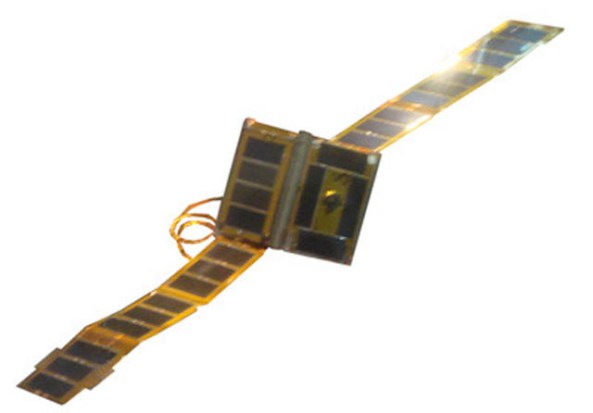
Each CubeSat is just 10x10x10 cm (1U) and they have fold-out solar panels which give a total span of 70 cm. They will each carry a 0.9 watt output 720p HD TV transmitter and a beacon which will send a Morse Code ID, a SSTV image and Ecuador’s national anthem. It is understood that NEE-001 will operate on 910 MHz in the 33cm band, an amateur radio allocation in a number of countries, while NEE-02 will be in the 980 MHz band.

Educational outreach is an important part of the project. EXA is partnering with three schools in Ecuador as part of the ASTERIA Program, in which students will use the satellite in their curricular and extra curricular activities.

The satellite signal will be received and decoded by the EXA HERMES-A ground station in Guayaquil and then uploaded live to the Internet using Facebook and Twitter; the first signal will contain text book questions and the second will contain an image related to the question. If the students are able to answer the question correctly they will be granted access to the video camera on board the spacecraft and will be able to see Earth from space as the astronauts see it in their space missions. More advanced students will have access to the pure radio signal so they can try decoding it by themselves.

There is also a HERMES-B ground station located in Kirch-Brombach, Germany.

Journey to Space!
EarthCam has teamed up with the Ecuadorian Civilian Space Agency to deliver what EarthCam describe as an amazing viewing experience from an orbiting satellite. Mounted on the NEE-01 Pegasus, a live camera invites viewers to take a trip into space and explore the galaxy.
EarthCam – SpaceCam http://www.earthcam.com/world/ecuador/ecsa/

EXA indicates that NEE-02 KRYSAOR is expected to launch on a Dnepr rocket from Dombarovsky near Yasny later this year.

Twitter https://twitter.com/NEE01_PEGASO hash tags #SatélitePegaso #Pegaso

Facebook https://www.facebook.com/NEE01PEGASO

Wiki http://en.wikipedia.org/wiki/NEE-01_Pegasus

Two TV CubeSats from Ecuador https://amsat-uk.org/2013/02/14/two-tv-cubesats-from-ecuador/

NEE-01 Pegasus (Pegaso) website in Google English http://tinyurl.com/NEE-01-Pegasus

Ecuadorian CubeSat will monitor near-earth objects http://www.uk.amsat.org/?p=6932

IAC2011 Paper http://exa.academia.edu/RonnieNader/Papers/795135/NEE-01_PEGASUS_The_first_Ecuadorian_Satellite

January 2014 Ecuadorian Civil Space Company (EXA)—Imagery Involvement + An Important Recovery (Satellites) http://www.satnews.com/story.php?number=1323163133

AMSAT-LU to launch amateur radio FM repeater to an altitude of 30 km

AMSAT-LU SSTV and GPS Payload

View of communications experiment: Below is the plate of the repeater. Top left is the SSTV camera and top right is the GPS receiver module. Image credit LU7AA

On Saturday, March 23 at 1400 UT AMSAT-LU plan to launch a High Altitude Balloon (HAB) carrying a 435.950/145.950 MHz FM repeater, a SSTV transmitter on 145.850 MHz and an APRS transmitter on 144.930 MHz.

The 145.850 MHz SSTV ROBOT-36 mode images will be transmitted in real time showing the view from the balloon. The images can be displayed by using free software such as MMSSTV.

Since 145.850 MHz is the input frequency for the amateur radio satellite SO-50, part of the experiment will be a link between the balloon and the satellite with SO-50 retransmitting the SSTV images on 436.7950 MHz over a far wider area.

At an altitude of 30 km the FM repeater, which uses a 123 Hz CTCSS tone, could have a range of up to 750 km.

AMSAT-LU have issued the following announcement:

Continue reading