Glasgow school wins CanSat launch competition

The UK’s Alpha team from Bearsden Academy in Glasgow were awarded first place in the second European CanSat Competition. 14 secondary school teams, from different ESA member states, participated in the finals of the competition at the Andøya Rocket Range in Norway.

The first prize was awarded to team Alpha, from the UK. Credits: ESA / J Makinen. (JPG, 61 Kb) CanSats are miniature simulation satellites the size of a soda can. The students had to build their own space experiments, fitting all the major subsystems including radio communications on 433/434 MHz and power into just 350ml.

The tiny CanSats were designed to separate from their rocket and conduct their missions as they descended on parachutes to the ground for recovery by the teams. They were launched in pairs from seven small Intruder rockets up to an altitude of about 1km.

Setting up an Intruder rocket for launch. Credits: ESA / J Makinen. (JPG, 68 Kb) Despite very strong winds, all of the CanSats were successfully recovered, with the exception of the Spanish one, which failed to communicate with the ground station.

The UK team received good telemetry data on 434.25 MHz, but were a little disappointed that their miniature rover deployed earlier than planned. The other teams, from Denmark, Belgium, the Netherlands, France, Spain, Austria, Czech Republic, Norway, Romania, Italian, Irish, Greek, Portugese had varying degrees of success.

Once they analysed the results of their missions, the teams were judged by a board composed of technical experts from space agencies and industry. Following the UK team in second place was the Icaromenippus 3D team from the 3rd General Lyceum of Mytilini, Strati Myrivili, Greece, with the Portuguese Azorean Shearwater team from EBS Santa Maria, Vila do Porto in the Azores in third place.

“The standard of the projects was really high and the judges were very impressed by the professional attitude of the students,” said Helen Page, the ESA CanSat Project Coordinator. “They learned an enormous amount about space science, engineering and technology, as well as developing practical skills and experiencing the excitement of a launch campaign at a world-class rocket range.”

Students from the Norwegian team Navican testing their CanSat's parachute. Credits: ESA / J Makinen. (JPG, 72 Kb) The 2012 European CanSat competition was organised by ESA’s Education Office in collaboration with the Norwegian Centre for Space-related Education (NAROM). For more details about the teams involved visit the ESA website.

The Scottish CanSat Competition was organised using the STEM Ambassador Network, a list of the Scottish schools involved and 70cm frequencies is at
http://www.fistraltraining.co.uk/index.php?option=com_content&view=article&id=126&Itemid=75

Scottish CanSat Facebook http://www.facebook.com/pages/Scottish-Cansat-Competition/136524309785701

CanSat website http://cansat.eu/
New Frequencies for AMSAT-UK FUNcube-1

The AMSAT-UK FUNcube-1 satellite is due to launch on a DNEPR rocket from Yasny later this year.

This launch could carry around 11 amateur radio satellites including FUNcube-1 into space. As a result the International Amateur Radio Union (IARU) satellite advisory panel have had to carefully coordinate the planned operating frequencies in order to minimise the risk of interference between FUNcube-1 and other payloads on the same launch.

The IARU Amateur Satellite Frequency Coordination Panel have now confirmed the following frequencies for FUNcube-1 (these frequencies replace those previously announced)

Inverting linear transponder:
Uplink            435.150 – 435.130 MHz
Downlink        145.950 – 145.970 MHz

Telemetry:     145.935 MHz   BPSK

AMSAT-UK have announced that the power of the FUNcube-1 1200 bps BPSK telemetry beacon has been increased to 400 milliwatts. This should provide a strong signal for school students to receive using simple equipment.

Read the leaflet ‘Teach Space with a Real Satellite’ at http://tinyurl.com/TeachSpaceWithFUNcube

Gunter’s Space Page 2012 launches http://space.skyrocket.de/doc_chr/lau2012.htm

IARU Amateur Satellite Frequency Coordination Status http://www.amsat.org.uk/IARU

FUNcube – Launch details and time frame finalised

FUNcube_Graphic_Large

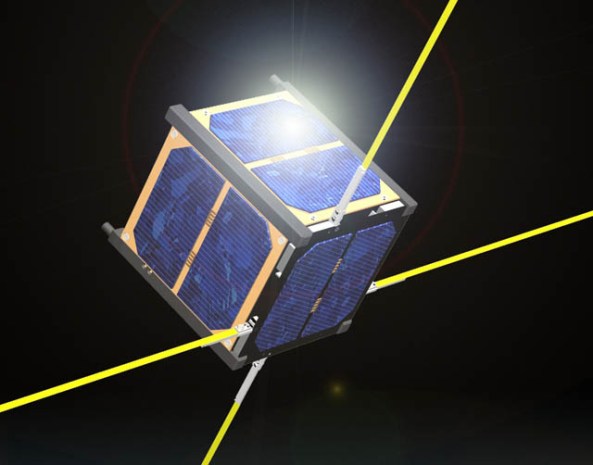
Artists impression of FUNcube in space

An agreement has now been reached with ISIS Launch Services BV, who are based in Delft in the Netherlands, for them to provide a launch of the FUNcube-1 CubeSat.

It is anticipated that FUNcube-1, which has been created by a team of volunteer radio amateurs and other specialists over the past two years, will be launched with a number of other spacecraft from a DNEPR rocket sometime in the third quarter of 2012. The flight is planned to take place from the Yasny launch facility which is in southern Russia near to the Kazakhstan border. The spacecraft needs to be completed by the end of July 2012, ready for shipping from the Netherlands to Russia.

The orbit is still to be defined precisely but it is expected to be nearly circular and approximately sun synchronous. This will ensure that the spacecraft has the necessary solar illumination and that it will appear at regular times for educational outreach activities at schools and colleges.

The FUNcube-1 spacecraft will transmit signals that can be easily received directly by schools and colleges for educational outreach purposes. This telemetry will give details of the spacecraft’s health – battery voltages and temperatures and from this it will be possible to determine its spin rate and attitude by plotting simple graphs. Additionally, experimental data and messages can be displayed in an attractive format and provide stimulation and encouragement for students to become interested in Science, Technology, Engineering and Mathematics (STEM) subjects in a unique way.

AMSAT-UK FUNcube Mission Patch Rev4 20100609

AMSAT-UK FUNcube Mission Patch

The target audience for this project is students at both primary and secondary levels and a simple and cheap “ground station” – actually it looks just like a USB dongle, for schools to use, has already been developed.

In addition to providing educational outreach for schools and colleges around the world, the spacecraft will also provide a U/V linear transponder for radio amateurs during local “night”, at weekends and during holiday periods

The production and testing of the spacecraft itself has already been funded via a legacy and other sources. It will however really help the project if radio amateurs and other interested supporters could contribute something towards the cost of the actual launch itself. With this in mind a special donation scheme has been setup using the Virgin Giving charity donation website http://tinyurl.com/funcubegiving/

All donations of £25 (or equivalent) or more will be specially acknowledged by the spacecraft itself – exact details will follow shortly!

All donations received from UK tax payers can be “Gift Aided” which will add 20% to the value of your donation.

More information about this exciting project will be made available over the coming months at the website http://www.funcube.org.uk/

FUNcube to be on show at the Association for Science Education conference Jan 5-7, 2012