For example, alongside a payload that will allow avionics company Astrium to build more secure satellites by using cosmic radiation to generate true random numbers for use in encryption is myPocketQub, a host for experiments that will allow one user every day for a year to upload software and run it. “It’s an open source approach to doing space experimentation,” says Clark.
The original concept for the cubesat came from Stanford University professor Bob Twiggs, who worked with colleagues at his institution and Cal Poly to develop the hardware.
The basic cube, however, proved too restrictive and even the first launch violated the original standard. One of the satellites was a double height or 2U model; the other, an even taller 3U design. But, by adopting the same 10 x 10cm footprint, a 1U, 2U or 3U probes can be loaded into a spring loaded Poly-PicoSatellite Orbital Deployer (P-POD), which can accommodate up to three cubesats. Standardisation on footprint makes booking a launch far less of an issue: it’s still possible to mix and match cubesat sizes within a single P-POD.
By 2010, more than 30 cubesats had made it into orbit. The form factor is now common enough for launch companies to put P-PODs into their rockets without knowing who will rent that space beforehand. Cubesat developers do not have to aim for a specific launch slot; they can develop their system in the knowledge that someone, somewhere will be willing to send it into space. The ready availability of launchers makes it easier for companies to get involved in space projects: one of the reasons why UKube-1 is seen as a useful first step in building the UK‘s expertise in satellite technology.
Steepest Ascent itself was not created as a space company. “But we want to be able to allow people to do signal processing in space,” says Bowman. “We started our first space contract two and a half years ago, developing a payload. Then came the opportunity to fund a PhD position in space technology. Then we thought ‘what about cube satellites?’ And maybe how to communicate between cubesats: you might fly a swarm and want to communicate between them.
“At about the same time, the space innovation and growth team was being formed by the UK Government. Through that, we met Clyde Space, which was leading the UK project and it had a requirement to develop an onboard computer,” Bowman explains.
The focus on low development time and cost results in different approaches than for conventional satellite development. Whereas many large satellites will employ components that have gone through years of testing to determine their behaviour under the levels of intense radiation encountered beyond the Earth’s atmosphere, cubesat developers will often use standard commercial parts. One such part is Texas Instruments’ MSP430 microcontroller. Originally developed for smart energy meters, the mcu has a reputation for very low power consumption, vitally important to a satellite that will be put into a sun synchronous orbit. Deriving all its power from solar panels, the satellite will enter eclipse for some of the day and the designers need to be sure its batteries will not run dry during that time, so the focus is on low power silicon.
“The MSP430 is kind of the mcu of choice for cubesats. A lot of companies have gone down that route, but they don’t do a space version. A lot comes down to how you use COTS in space,” says Bowman.
Companies such as Steepest Ascent put time into finding ways to avoid the problems caused by cosmic radiation that can knock unhardened electronics completely out of action.
One approach to ameliorating the effects of radiation is to use triple modular redundancy (TMR). Three sets of electronic circuit are used for each function and vote on the output to weed out errors caused by stray alpha particles that may flip a control or memory bit.
However, this is expensive to do across the board.

Steepest Ascent has focused its use of TMR on the core hardware state machines and I/O ports. The company chose to use an fpga from Microsemi’s antifuse based SX family. Antifuse devices are commonly used on satellites because the programming elements are almost immune to radiation, so the protection only needs to focus on latches and registers. TMR is used in some of the SX based circuits to ensure ‘the I/O signals are as clean as possible’, says Bowman.
Focused use of TMR makes it possible to relax the radiation hardness requirements on other parts of the board. For the signal processing portion of the MIC, Steepest Ascent chose to go with another fpga.
“We do a lot of mcu and fpga hybrids and we tend to favour doing dsp on fpgas,” says Bowman. “We can do operations in parallel and can tailor bit widths. If 27bit precision is all you need, you have an overhead trying to use a 32bit dsp for those calculations. We do a lot of work on LTE for wireless communications and, in those technologies, it’s probably going to be an array of fpgas, rather than a dsp. You can achieve teraMAC performance and you could not get that from one dsp.”
For the signal processing fpga, Steepest Ascent picked another Microsemi part – this time, the flash based ProASIC 3L. “ProASIC 3L parts are not quite as radiation tolerant as the SX antifuse parts,” says Bowman. “However, it’s still more than what we need for this project, plus we can also get an ARM core onboard.”
Microsemi licenses the ARM Cortex-M1 microprocessor core so that it can be implemented by its fpga customers.
“The ARM core has a lot more processing power than the MSP430,” says Bowman. “But, at the same time, cubesats have to be very, very power efficient. So the idea was to keep the MSP430 running and power down the fpga when it is not needed.”
Runtime checks will monitor the behaviour of the non-TMR circuits and allow one of the processors to power cycle the other if it starts misbehaving. “We took some other precautions, such as not using PLLs: they don’t like space at all,” says Bowman.
The MIC will use several gigabytes of memory – again based on commercial devices. “It’s a complicated design for cubesats,” says Bowman. “We have spent a lot of time on component selection: it’s a matter of gathering different test reports. However, although many 4Gbit devices have been tested, we are using 8Gbit parts. There is a question of how much you can extrapolate from previous tests. We think we have made a sound choice, but we can’t go and test these devices ourselves.”
At the circuit level, the memories are redundant and powered down between uses. According to Clark, a good rule of thumb among the cubesat fraternity is to use different makes of memory as they are unlikely to share identical failure modes.
The UKube-1 project is pressing ahead with the construction of a flight model that should be ready by the end of January and which will be used in environmental tests. Then the final satellite will be put together and enter its testing phase in July. “We are almost in the home straight: it will all happen in the next four or five months,” says Bowman.
After that, the cubesat will be packed into its P-POD ready to be flung out into space, falling into orbit around 650km above the surface of the Earth. According to Clark, the mission is scheduled to last for just one year, but UKube-1 has been designed to last for at least four.
“The mission is dedicated to payloads and gathering data from them and then it will be about gathering performance statistics. After that we would hand it over to the amateur satellite people. We can learn a lot about the process of operating a satellite like this during that time,” says Bowman.
In the UKube-1 mission, the signal processing functions on the main fpga will be fixed. “In future missions, we would look at reprogramming it more regularly to change the algorithms to suit different payloads,” says Bowman. Missions such as UKube-1 will make it possible to explore how techniques traditionally considered too risky to pursue – such as reprogramming fpgas in orbit – can be exploited in future swarms of low cost satellites.
Author
Chris Edwards
Supporting Information
Downloads
39400P16-18.pdf
Websites
http://www.clyde-space.com
http://www.microsemi.com
http://www.steepestascent.com
Companies
Clyde Space Ltd
Microsemi
This material is protected by Findlay Media copyright
See Terms and Conditions.
One-off usage is permitted but bulk copying is not.
For multiple copies contact the sales team.

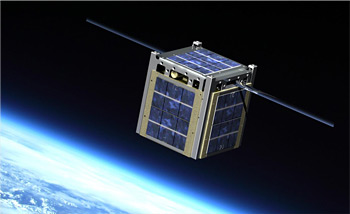
 Towards the end of 2012, a tiny satellite the shape of a cd rack will be blasted into space on top of a converted intercontinental ballistic missile, then be hurled into orbit by a spring-loaded pod. Although dwarfed by communications and military satellites, the launch of the UK Space Agency’s first nanosatellite will mark a milestone: kicking off a satellite industry for the rest of us.

 AMSAT-UK will have a presence at the first ever UK Space Conference taking place at the Univeristy of Warwick on July 4/5th. This is being organised by the UK Space Agency which was formally commenced in April this year.
 AMSAT-UK
You must be logged in to post a comment.