It’s tipped to be India’s heaviest rocket till date weighing 640 tons, it’s also taken 10 years to develop and will hopefully launch Indian astronauts into space. That’s the Indian Space Research Organisation (ISRO) designed and developed GSLV MK3 that has cost Rs 2500 crores and will put India on the multimillion dollar commercial launch market.
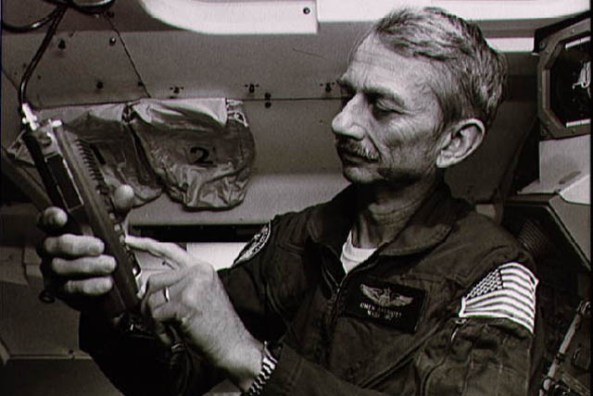
Owen Garriott W5LFL with Motorola two meter FM ham radio on STS-9 Columbia
The first ham radio transmissions by an amateur radio operator in space were made by Owen K. Garriott W5LFL during the STS-9 Columbia mission in 1983. This led to many further space flights incorporating amateur radio as an educational and back-up communications tool.
Watch ARRL – Amateur Radio’s Newest Frontier (STS-9 Columbia) narrated by Roy Neal K6DUE
Narrated by the Commander and crew, the following video contains footage selected by the astronauts, as well as their comments on the mission. Footage includes launch, onboard crew activities, and landing.
Watch Space Shuttle STS-9 Columbia-Spacelab 1 pt1-2 Post Flight Press Conference Film 1983 NASA
Watch Space Shuttle STS-9 Columbia-Spacelab 1 pt2-2 Post Flight Press Conference Film 1983 NASA
STS-9 (also known as STS-41A and Spacelab 1) was a NASA Space Shuttle mission which carried the first Spacelab module into orbit to conduct space-based scientific experiments. It was the sixth mission of the Space Shuttle Columbia, and was Columbia’s last flight until STS-61-C in January 1986. It was also the last time the old STS numbering was used until STS-26 (in the aftermath of the Challenger disaster of STS-51-L). Under the new system, STS-9 would have been designated as STS-41-A.
STS-9 launched successfully from Kennedy Space Center at 11 am EST on 28 November 1983.
The shuttle’s crew was divided into two teams, each working 12-hour shifts for the duration of the mission. Young, Parker and Merbold formed the Red Team, while Shaw, Garriott and Lichtenberg made up the Blue Team. Usually, the commander and the pilot team members were assigned to the flight deck, while the mission and payload specialists worked inside the Spacelab.
Over the course of the mission, seventy-two scientific experiments were carried out, spanning the fields of atmospheric and plasma physics, astronomy, solar physics, material sciences, technology, life sciences and Earth observations. The Spacelab effort went so well that the mission was extended an additional day to 10 days, making it the longest-duration shuttle flight at that time.
The Spacelab 1 mission was highly successful, proving the feasibility of the concept of carrying out complex experiments in space using non-NASA persons trained as payload specialists in collaboration with a POCC. Moreover, the Tracking and Data Relay Satellite, now fully operational, was able to relay vasts amounts of data through its ground terminal to the POCC.
During orbiter orientation, four hours before re-entry, one of the flight control computers crashed when the RCS thrusters were fired. A few minutes later, a second crashed in a similar fashion, but was successfully rebooted. Young delayed the landing, letting the orbiter drift. He later testified: “Had we then activated the Backup Flight Software, loss of vehicle and crew would have resulted.” Post-flight analysis revealed the GPCs failed when the RCS thruster motion knocked a piece of solder loose and shorted out the CPU board.
Columbia landed on Runway 17 at Edwards Air Force Base on 8 December 1983, at 3:47 pm PST, having completed 166 orbits and travelled 4.3 million miles (6.9×10⁶ km) over the course of its mission. Right before landing, two of the orbiter’s three auxiliary power units caught fire due to a hydrazine leak, but the orbiter nonetheless landed successfully. Columbia was ferried back to KSC on 15 December. The leak was later discovered after it had burned itself out and caused major damage to the compartment…
Commander: John W. Young
Pilot: Brewster H. Shaw, Jr.
Mission Specialists: Owen K. Garriott, Robert A. R. Parker
Payload Specialists: Byron K. Lichtenberg (MIT), Ulf Merbold (Germany)
Dates: November 28 to December 8, 1983
Vehicle: Columbia OV-102
Payloads: Spacelab-1
Landing site: Runway 17 dry lakebed at Edwards AFB, CASpace Shuttle
Alexandru Csete OZ9AEC has previously written about interference from FM stations on the HO-68 linear transponder. He now reports that other satellites with linear transponders (designed for SSB/CW use only) also suffer from local FM traffic by people who haven’t got a clue that they are transmitting in the satellite uplink segment of the 2 meter band (145.8-146.0 MHz).
This recording was made on Saturday, May 5, 2012 using the AMSAT-UK FUNcube Dongle and Gqrx SDR. It shows very strong FM transmissions on the FO-29 linear transponder which could be from Spain or Portugal. The topic appears to be chocolate. Alexandru says – If you know who these people are, be sure to send them a QSL card!
The use of FM on a linear transponder satellite reduces the lifetime of both the batteries and the transponder itself.
ARTSAT PROJECT-1: INVADER is an amateur radio “Art Satellite” currently being developed as a part of the “ARTSAT: Art and Satellite Project” which aims at a practical use of a satellite for art and design. Invader is a 1U CubeSat being developed by students at Tama Art University.
ARTSAT have just released their App for the iPhone or iPod Touch (iOS 5 or greater).
The Cubesat “Image The Future” ITF-1 build by students at the University of Tsukuba has had the frequency of 437.525 MHz coordinated by the IARU Amateur Satellite Frequency Cooordination panel.
IFT-1 recently underwent thermal vacuum testing.
It is planned to be launched on a H-IIA rocket in the fiscal year 2013. The orbit will be 400 by 350km with an inclination of 65 degrees.
The formal name ITF-1 comes from the initial letter of the university slogan “Imagine The Future”. The satellite also has a popular name YUI which means “bond” in Japanese, it came from the project’s concept‚ “Creating the Worldwide Human Community”.
Ministry of Science, Technology & Productive Innovation
Contact Person
norberto.wente.dk.nospam
Headline Details: CubeBug-1 is the first technology demonstration mission for a new cubesat platform design (mechanics, hardware and software) intended to be released as Open Source and Open Hardware for its use in Amateur projects, University projects and research labs. This projectis sponsored by the Argentinian Ministry of Science, Technology and Productive Innovation. As payload on this first mission, some custom designed components will be tested: an ARM based on-board computer, a nano-reaction wheel with its driver circuit and a low resolution camera, all based on COTS components. Planning to use half duplex communications on UHF with 9k6 GMSK data. CubeBug-1 is a 2U cubesat and isexpected to be launched as part of a group of cubesats in a DNEPR rocket launch planned for September 2012 from Yasny into a 607km 98 degree polar orbit. After the technology demonstration part of the mission is over, the satellite will enter a mode that will include services to the Amateur radio community, including a Digipeater, science data downloads from the payload (including images if possible), etc.
Application Date:
01 May 2012
Freq coordination completed on
The IARU Amateur Satellite Frequency Coordination Status pages are hosted by AMSAT-UK as a service to the world wide Amateur Satellite Community


 AMSAT-UK
You must be logged in to post a comment.