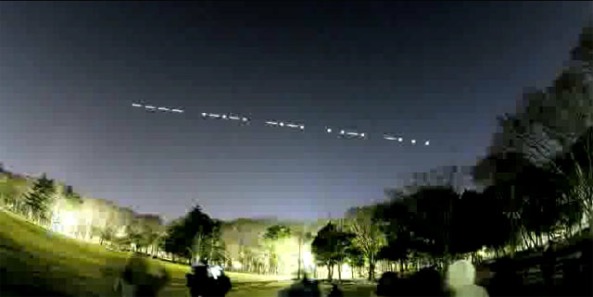
FITSAT-1 to Write Morse Code Across The Night Sky

FITSAT-1 plans to use LED’s to signal in Morse code

The Amateur Radio CubeSat FITSAT-1 will carry an Optical Communications experiment that aims to write Morse Code across the night sky.

Kibo Robot Arm CubeSat Deployment

Kibo Robot Arm CubeSat Deployment

This innovative satellite also plans to transmit 115.2 kbps digital data in the Amateur Satellite Service 5.8 GHz band using a transmitter capable of 2 watts output.

FITSAT-1 (aka NIWAKA) is a 1U CubeSat (10*10*10cm) developed by students at the Fukuoka Institute of Technology (FIT).

In July 2012 it should be carried to the International Space Station (ISS) in the HTV-3 cargo vessel.  FITSAT-1 will then be deployed from the ISS around September by Japanese astronaut Akihiko Hoshide KE5DNI using the Kibo robot arm.

The main mission will be to demonstrate high speed data transfer from a satellite, it can transmit a VGA-size (640×480 pixel) JPEG photograph in only 5 to 6 seconds.

Takushi Tanaka JA6AVG and FITSAT

Takushi Tanaka JA6AVG and FITSAT

The second mission is to determine if a satellite can be made to appear as an “artificial star” using high-output LEDs in flash mode. The light from this flash will be received by the ground station, which has a telescope with photo-multiplier linked to a 5.8GHz parabola antenna. This is a basic experiment to investigate the possibility of optical communication with satellites.

A UHF AX25 1k2baud transceiver will be carried for telemetry and telecommand purposes and a UHF CW beacon will also be provided. It will be deployed along with the satellites RAIKO and WE-WISH, F-1 and TechEdSat into a 350x350km 51.6deg inclination orbit.

The following downlink frequencies have been coordinated by the IARU Satellite Frequency Coordination Panel: CW 437.250 MHz, FM 437.445 MHz, High speed data 5840.00 MHz.

FITSAT-1 information, pictures and deployment movie http://www.fit.ac.jp/~tanaka/fitsat.shtml

Kibo Robot Arm http://kibo.jaxa.jp/en/about/kibo/rms/

IARU Satellite Frequency Coordination Panel pages hosted by AMSAT-UK http://www.amsat.org.uk/iaru/

PrintSat – An Amateur Radio 3D Printer CubeSat

The image shows the building of a CubeSat with Additive Manufacturing with the WINDFORM XT. Image Credit Windform

Students at Montana Sate University (MSU) are planning to build their new amateur radio satellite PrintSat with nano-carbon-impregnated plastic using a 3D printer.

David Klumpar KD7MFJ of MSU said 3D printing “will further lower the costs and speed the development of very small satellites, enabling future scientific missions comprised of dozens of satellites flying in formation.”

Jim White WD0E, president of Colorado Satellite Services, explained that “Additive manufacturing (also called 3-D printing) has evolved in the past few years to be a very inexpensive and fast way to make mechanical parts. With PrintSat, the entire structure of the small satellite will be printed. As the first use of additive manufacturing for a satellite, we plan to show it’s not only cheaper and faster, but that we can make parts that cannot be made in traditional ways.”

When in orbit PrintSat will measure and report on the characteristics of the Windform XT2.0 printed material and plating during its mission life in order to verify the utility of additive manufacturing for spacecraft structures and mechanisms.

PrintSat plans to use the same frequencies as RAMPART and use GMSK 9k6 Ax.25 packet radio. It is aiming for a May 2103 launch from the Wallops Flight Facility into a 500km 40 degree inclination orbit.

Other satellites planning to fly on the same launch include Blacknight-1, Spa-1 Trailblazer, Phonesat, Kysat- II, Rampart, NPS-SCAT, Copper, TJSat, Tethersat, Lunar orbiter/lander CubeSat, Swampsat, Cape-2, Dragonsat-1 and Ethersat.

Montana State University Space Science and Engineering Laboratory https://ssel.montana.edu/

Windform XT2.0 http://www.windform.it/windform-xt-2-0-en.html

IARU Amateur Satellite Frequency Coordination Status Pages http://www.amsat.org.uk/iaru

Raspberry Pi used for Amateur Radio Satellite Software

Dave Johnson, G4DPZ, AMSAT-UK/AMSAT-NA, running GPredict on his Raspberry Pi

AMSAT-UK and AMSAT-NA member Dave Johnson, G4DPZ, has been using the Raspberry Pi to run amateur radio satellite software.

The £22 ($35) Model B Raspberry Pi is a credit-card sized ARM-based computer board that plugs into a TV and a keyboard. Based around the 700 MHz ARM11 processor the board has 256 MB SDRAM, two USB ports, Ethernet with composite and HDMI video outputs. Low-level peripherals are GPIO pins, SPI, I²C, I²S and UART.

It was developed in Cambridgeshire by a UK registered charity, the Raspberry Pi Foundation, which exists to promote the study of computer science and related topics, especially at school level, and to put the fun back into learning computing.

Dave’s Raspberry Pi runs Debian Squeeze with Xwindows and is accessed using VNC over his shack network.

The first amateur radio application he got running was the GPredict satellite tracking software, thanks go to Alex Csete OZ9AEC for making such a portable implementation. Dave found the sofware and updates of the Keplerian Two Line Elements from the Internet worked perfectly.

GPredict free real-time satellite tracking and orbit prediction http://gpredict.oz9aec.net/

Raspberry Pi http://www.raspberrypi.org/

You can buy the Raspberry Pi through Premier Farnell/Element 14 http://www.farnell.com/ and RS Components http://rswww.com/  Both distributors sell all over the world.

Raspberry Pi – the road to compliance
http://www.electronicsweekly.com/blogs/electronics-legislation/2012/05/raspberry-pi—the-road-to-com.html

BBC video: 7-10 year olds get to grips with the Raspberry Pi http://www.bbc.co.uk/news/technology-18301670

Raspberry Pi emulator for Windows http://sourceforge.net/projects/rpiqemuwindows/

AMSAT-UK FUNcube Dongle receiving HORYU-2 Satellite (video)

Decoding using FUNcube Dongle, MixW2 and the HORYU-2 Data Analysis software

Published on Jun 3, 2012 by

HORYU-2 Telemetry Competition http://www.uk.amsat.org/7474

Listen to HORYU-2 on the Web http://www.uk.amsat.org/7594

Further information on HORYU-2 is at http://www.uk.amsat.org/7404

HORYU-2 CW Telemetry Decoder by DK3WN http://tinyurl.com/SatSoftwareDK3WN/

AMSAT-UK FUNcube Yahoo Group http://groups.yahoo.com/group/FUNcube

UK Space Environments Conference

iCubeSat 2012 presentations and video

The 1st Interplanetary CubeSat Workshop presentations and videos can be found Here

At the end of a busy week, we have finally finished processing all the presentations and video captured from the live streaming. You can view all the talks, posters and supporting sessions by clicking on the items of interest listed in the updated program here. High quality video will follow next week as soon as we receive the master tapes.

http://icubesat.files.wordpress.com/2012/06/20120530_exhibitionhallluncheating_ja.png