Sir Arthur Clarke Awards – Nominations Sought

Arthurs 2011 Winners – Image Credit British Interplanetary Society

The British Interplanetary Society are seeking nominations for this years Sir Arthur Clarke Awards.

In recognition of notable or outstanding contributions made to all space activities, the Sir Arthur Clarke Awards have been presented annually since 2005.  In the past the Award Ceremony has been an integral part of the UK Space Conference, but as the Conference is now held every other year, to avoid conflicting with the Farnborough Air Show, it has been decided to go ahead with this year’s “Arthurs” Awards to provide complete continuity.  The Award Ceremony will take place at a lunch in the House of Lords in October.

Though primarily designed to reward UK teams and individuals for their achievements over the past year, 2011-2012, the Awards will include International and Lifetime Achievement categories.

Further information and online nomination form at
http://www.bis-space.com/2012/07/25/6282/sir-arthur-clarke-awards-nominations-open

British Interplanetary Society http://www.bis-space.com/
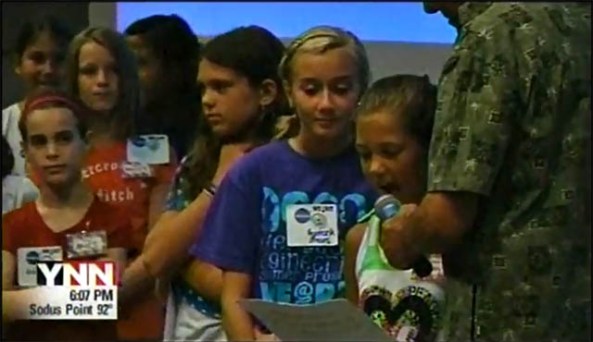
Video of TV News Report on ISS Contact

Engineers of the future talk to the International Space Station using Amateur Radio

YNN (channel 9) reports on an “out of this world” amateur radio contact between campers attending RIT’s Everyday Engineering Program in Rochester and astronaut Sunita Williams KD5PLB

Sunita was operating the Kenwood TM-D700 ham radio station located in the International Space Station’s Service Module using the callsign NA1SS on 145.800 MHz. The Everyday Engineering Program station at the Rochester Institute of Technology had the callsign W2RIT.

The Women in Engineering Program at Rochester Institute of Technology (WE@RIT) is dedicated to increasing the representation of women engineers and women leaders within the engineering profession. Founded in 2003, WE@RIT strives towards achieving gender parity within the Kate Gleason College of Engineering and hosts a comprehensive series of pre-engineering outreach, recruitment, and community building programs in support of this vision.
http://www.rit.edu/http://www.rit.edu/

Watch RIT on TV News: Chat with International Space Station
http://www.youtube.com/watch?v=wDvQnA4WTxI

Working the ISS

Wendy Quinn W1DY explains how to go about hearing and talking to the International Space Station (ISS).

The video shows the ISS frequencies used in most of the world, uplink 144.490 MHz, downlink 145.800 MHz, however, in IARU Region 1 (Europe/Africa) the uplink is 145.200 MHz. So just tune to 145.800 MHz and activate the standard -600 kHz repeater shift.

Watch ISS

The current location of the ISS and the status of its amateur radio stations can be found at http://www.issfanclub.com/

Listening to the International Space Station http://www.uk.amsat.org/3491

ArduSat – The Arduino CubeSat Satellite (full scale model)

Digital designs for real, physical objects. A Universe of Things!

Full Instructions can be found here

This is a full scale (moderately simplified) 3D printer-ready copy of the ArduSat, the wildly successful Kickstarter.com satellite for personal space exploration (received $106,330 funding, 3X their original goal!).

I am a supporter of the project, and have worked closely with Joel Spark (provided the original stl files) of the ArduSat team to create the first 3D print of this online. My daughter will be doing a week of ArduSat space science in 2013 when this launches (proud
Dad).


Amateur Radio Lunar Rover

Google X-Prize Team – Part-Time Scientists

It’s 43 years since Apollo 11 landed on the moon. Now a group of volunteer hackers and engineers are about to send a privately-built amateur radio rover to the Moon.

Part Time Scientists Lunar Rover

Writing on ZD-Net Simon Bisson tells how the Part-Time Scientists team aim to win the Google Lunar X-Prize by landing their lunar rover on the Moon.

Simon says the Part-Time Scientists are putting together a cloud-linked global communications network [COMRAY] to handle radio links to their lander and rover (using amateur radio bands), there’s still too much lag in the system to deliver a hands-on driving experience. The rover needs to have some smarts in order to process information about its environment, while still handling input from a driver on Earth.

Read Simon Bisson’s article Home-brew hackers cook up Europe’s return to the Moon
http://www.zdnet.com/europes-return-to-the-moon-7000001306/

Watch Part-Time Scientists testing their Lunar Rover

Part-Time Scientists http://www.ptscientists.com/

Deep Space Communications Array (COMRAY) (Project Leader Michael Doornbos N4LNX of Evadot) http://www.comray.net/

Google Lunar X-Prize http://www.googlelunarxprize.org/

Tethersat-1 & 2 to test Electrodynamic Tether Propulsion

Illustration of the EDT concept – image Wiki


The amateur radio satellite Tethersat is a 3U CubeSat that splits into two joined by a 1 km tether to test electrodynamic tether propulsion.

Both spacecraft will use 9600 bps AX25 GFSK packet downlinks on UHF. A launch is planned on ORS-3 in July 2013 from the Wallops Flight Facility on Wallops Island, Va.

Electrodynamic tether propulsion propulsion has the potential to make space travel significantly cheaper. It is a simplified, very low-budget magnetic sail. It can be used either to accelerate or brake an orbiting spacecraft. When direct current is pumped through the tether, it exerts a Lorentz force against the magnetic field, and the tether accelerates the spacecraft.

Potentially this technique could be used to raise the orbit of a satellite from 600 to 1000 km using a Ward Spiral maneuver. See the 2009 paper Tethered Satellite Dynamics, Mission Design and Applications by Chadwick Healy http://ccar.colorado.edu/asen5050/projects/projects_2009/healy/

Wiki http://en.wikipedia.org/wiki/Electrodynamic_tether

IARU Satellite Frequency Coordination Panel status http://www.amsat.org.uk/iaru