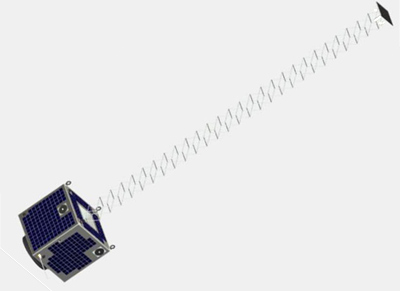
DLR rejects amateur radio P5-/Mascot-2 project

AMSAT-DL have released a statement regarding the P5-/Mascot-2 project:

Discussions with the German Ministry of Economics and the German  space agency DLR spanned more than 5 years. Amongst others, we met with  State Secretary for Space and Aerospace Hinze, DLR chairman Prof. Wörner and the DLR  Program Board.  In 2009 AMSAT-DL,  in collaboration with the DLR Institute for Space Systems in Bremen, conducted two complex Concurrent Engineering  studies. They were jointly presented to the DLR program board in Köln-Porz in  2010.

Continue reading

Amateur Radio CubeSats Launched from Vandenberg

CSSWE - University of Colorado Boulder

CSSWE – University of Colorado Boulder

On September 13, 2012 at 2139 UT an Atlas V rocket launched a combination of 11 satellites from Vandenberg Air Force Base in California for the US Government and NASA ELaNa university CubeSats.

Nick Pugh K5QXJ reports hearing CSSWE on 435.345 MHz.

Continue reading

HamRadioNow – “AMSAT Mission to MARS?*”

In this HamRadioNow video AMSAT President, Barry Baines WD4ASW, gives an update on what AMSAT is up to now and planning for the future.

Continue reading

HamRadioNow – "AMSAT Mission to MARS?*"

In this HamRadioNow video AMSAT President, Barry Baines WD4ASW, gives an update on what AMSAT is up to now and planning for the future.

Continue reading

Microwave Spectrum Issues at EME 2012

This video was made by volunteers from the British Amateur TV Club (BATC) at the EME 2012 conference in Cambridge. In the presentation Murray Niman G6JYB, and Gudmund Wannberg SM2BYA, review world wide spectrum issues and in particular the loss of part of the 2300 MHz band in Sweden.

The spectrum issues faced by moon-bounce (EME) operators are similar to those affecting the Amateur-satellite Service.

Continue reading

Plasma Powered Amateur Radio Satellite PROITERES Launched

The Japanese amateur radio satellite PROITERES was launched Sunday, September 9 at 0423 UT on PSLV-C21 from the Indian Space Research Organisation (ISRO) Satish Dhawan space centre. The satellite SPOT6 was on the same launch into a 654 km × 643 km, 98.28º inclination orbit. The rocket was fitted with the mini Redundant Strapdown Inertial Navigation System (mRESINS).

PROITERES was built by a team of students and faculty members of Osaka Institute of Technology (OIT) and the spacecraft aims to demonstrate powered flight using a Pulsed Plasma Thruster (PPT) engine.

Mike Rupprecht DK3WN reported hearing PROITERES, callsign JL3YZK, on 437.485 MHz at 07:36 UT.

Continue reading