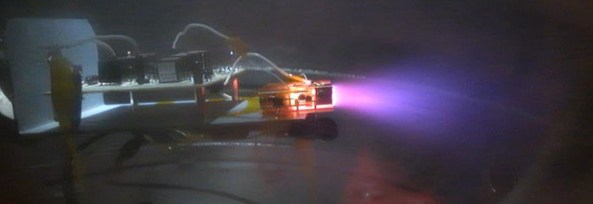
STRaND-1 CubeSat Plasma Propulsion Test Firing
BBC TV have been filming at the Surrey Space Centre (SSC) and Surrey Satellite Technology Limited (SSTL) for an item on the STRaND-1 CubeSat mission for Stargazing Live.
STRaND-1 CubeSat Plasma Propulsion Test Firing
BBC TV have been filming at the Surrey Space Centre (SSC) and Surrey Satellite Technology Limited (SSTL) for an item on the STRaND-1 CubeSat mission for Stargazing Live.

Image of ISS taken by the FITSAT-1 CubeSat after deployment
On December 22 members of AMSAT-DL succeeded in receiving 18 images from the 5840 MHz high-speed downlink of the amateur radio satellite FITSat-1.
In total 22 images were transmitted in the test and 18 were received at the amateur radio facility at Bochum.
The FITSAT-1 CubeSat was developed by students at the Fukuoka Institute of Technology (FIT) in Japan. As well as the high-speed data downlink on 5840.0 MHz the satellite carries several amateur radio payloads: a CW beacon on 437.250 MHz, a telemetry beacon on 437.445 MHz and an optical Morse code LED experiment.

(C) Tsuyoshi Watanabe Ebina City, Kanagawa Japan 1:24:23-1:24:25JST, 12 Dec 2012
Takahashi e160, Diameter short focus telescope 16cm (F=530mm, F3.3)
Nikon D800E, ISO12800, 2 seconds exposure
Further transmissions from the optical LED beacon on the amateur radio CubeSat FITSAT-1 are planned for January 10-15. Weather permitting the satellite beacon should be visible using binoculars.
2013, Flashing LED Schedule (times GMT):
10th Jan. 23:57:30 – 23:59:30 New Delhi India (10Hz Green 2min)
11th Jan. 13:52:30 – 13:54:30 San Francisco USA (10Hz Green 2min)
12th Jan. 22:00:30 – 22:02:30 Bangalore India (10Hz Green 2min)
13th Jan. 14:41:30 – 14:43:30 Melbourne Australia (10Hz Red 2min)
14th Jan. 11:03:30 – 11:05:30 Oklahoma USA (10Hz Green 2min)
15th Jan. 22:27:30 – 22:29:30 Wulumuqi China (10Hz Green 2min)
The FITSAT-1 CubeSat was developed by students at the Fukuoka Institute of Technology (FIT) in Japan. As well as the optical LED experiment the satellite carries several amateur radio payloads: a CW beacon on 437.250 MHz, a telemetry beacon on 437.445 MHz and a high-speed data downlink on 5840.0 MHz.
Information on how to see the optical beacon signal can be found on the Visual SAT-Flare Tracker 3D site at
http://www.satflare.com/track.php?q=fitsat#MAP
FITSAT-1 website http://www.fit.ac.jp/~tanaka/fitsat.shtml
FITSAT-1 Optical Beacon video
http://www.southgatearc.org/news/december2012/fitsat1_optical_beacon_video.htm
Further information and pictures of FITSAT-1 and the other CubeSats deployed from the ISS on October 4, 2012 is at http://www.uk.amsat.org/?page_id=10967
 Did you ever wonder how Nanosatellites are being launched ?
Well, Meidad Pariente has edited a video produced by the Aalto-1 team that explains how such a task is performed.
Both the edited and original videos are shown.
Aalto-1 is a student CubeSat project of Aalto University, Finland that plans to operate at VHF-UHF and there will also be an S-band transmitter. Up to 8 watts of power will be available from the Solar panels.
 AMSAT-UK
You must be logged in to post a comment.