Fifteen-year-old Abigail Harrison has a big dream, to be the first astronaut to Mars.
She is currently using the crowd funding website RocketHub to raise money to fund a trip to Baikonur in Kazhakstan to watch her mentor, Astronaut Luca Parmitano KF5KDP, blast-off to the International Space Station at the end of May.
Almost two years ago, on the way home from the final launch of STS 134 Endeavour space shuttle, Abby met and interviewed Italian astronaut Luca Parmitanoo. Luca agreed to become her mentor, and for the last couple of years, he has stayed in touch and offered advice.
On Friday, April 26 Abby took part in a Google+ hangout with Luca KF5KDP, she writes:
The interview was facilitated by the Public Insight Network which is a part of American Public Media. I was so excited to have this opportunity with Luca before he launches on May 28, 2013 to live on the International Space Station (ISS) for six months. We had an awesome chat about both of our passions for space and STEM (science, technology, engineering, and math) as well as about Luca’s exciting work on the ISS this year.
We also discussed my exciting opportunity to serve as Luca’s Earth Liaison. In the chat, Luca talked about meeting me for the first time, saying, “I like passionate people. Any kind of passion. Any kind of interest in anything that keeps you inspired…I saw a lot of myself in Abby.” He emphasized his excitement and the importance of my job as Earth Liaison and that he was happy his experience could be used to inspire kids throughout the world.
AMSAT has sold the popular G6LVB Tracker (as seen in photo)for several years.This year, we will have a new version which replaces the amber LCD display with an OLED (Organic Light Emitting Diode) display.
Amsat LVB Tracker
The new display offers a high visibility contrast with a wide angle of view. It will be available in blue, green and amber.
LVB Trackers will be available with the recommended serial (RS-232) I/O. The recommended minimum donation will remain $200. An FTDI USB/Serial module is available as an option for an additional $25. A picture showing the old and new displays may be found on amsat.org.
Current LVB Tracker owners may update their own units. The OLED displays used are manufactured by Newhaven, NHD-0216KZW series, and are available from Mouser and other online parts suppliers. The OLED displays have less depth so the PEM fasteners need to be shortened for correct fit and viewing thru the front of the case. The LVB Tracker firmware will also require updating. Current owners may send their LVB Tracker to WB8CXO for retrofit if they don’t wish to do the modifications themselves.
Upgrading existing trackers will be $50 + shipping. Contact WB8CXO@AMSAT.ORG for details.
AMSAT would like to acknowledge the many contributors to this effort. Mike Young, WB8CXO who has supported the Tracker and whose initiative was essential to this development. John Drago, W8FAA modified the LVB Tracker firmware to support the OLED display. Ken Baker from Ridge Machine manufactured the PEM fastener cutting jig. Steve Belter, N9IP, Mark Hammond, N8MH and John Papay, K8YSE did beta testing. And finally Gould Smith, WA4SXM, LVB Tracker project manager for his continuous guidance and support.
The UK communications regulator Ofcom has published a call for inputs relating to spectrum use by licence exempt devices in the 2.4 GHz band. 2400-2450 MHz is an ITU Amateur and Amateur Satellite Service allocation.
The Ofcom announcement says:
This band is close to radio spectrum in the 2300 MHz band, which the Ministry of Defence (MoD) plans to release for new civil uses.
The MoD has therefore commissioned work to audit licence exempt uses in the 2400 MHz band, in particular to identify the full range of possible uses of this spectrum. The call for inputs introduces two audit reports that explore licence exempt use in the 2400 MHz band.
It also invites stakeholders to identify any other uses that may need to be considered to understand any technical coexistence.
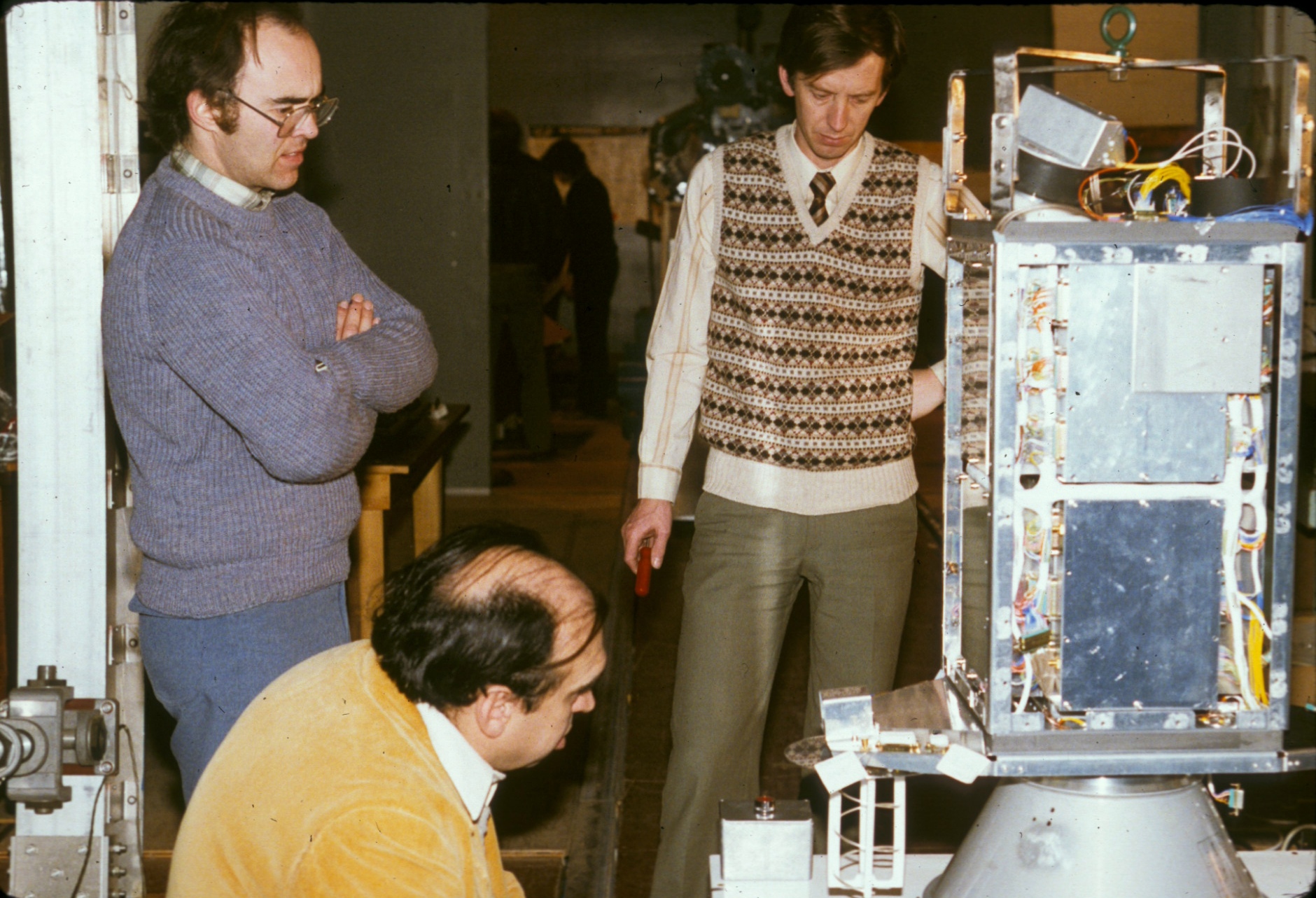
UoSAT-2 / OSCAR-11 with Dave Brock UoS kneeling, Christine Sweeting G6APF and Neville Bean G8NOB
Mike Rupprecht DK3WN reports receiving a good signal from the amateur radio microsatellite UoSAT-OSCAR-11 on 145.826 MHz FM (AFSK 1200 bps ASCII), see his blog at http://www.dk3wn.info/p/?p=33395
UoSAT-2 / OSCAR-11 Martin Sweeting G3YJO and Dave Bocks UoS standing
UoSAT-2, also known as UoSAT-OSCAR-11 or UO-11, was the second satellite designed and built by a team of engineers at the University of Surrey in Guildford, Surrey, UK and was the successor to UoSAT-1 / UoSAT-OSCAR-9 (see Hobby Electronics August 1981). It was launched from the Western Test Range at Vandenberg Air Base, in Lompoc, California along with LANDSAT-5 on a Delta 3920 rocket on March 1, 1984.
OSCAR-11 was the most rapidly designed OSCAR, going from inception to launch in only five months. It was also the first amateur satellite to carry a digital communications package into Earth orbit, and the first to be controlled by a CPU running software written in the high-level programming language “Forth”.
OSCAR-11 carries beacons in three amateur radio bands.
The 145.826 MHz beacon transmits FM Audio Frequency Shift Keying (AFSK) 1200 bps ASCII data. It the early years it also transmitted a voice message from the digitalker experiment.
The 435.025 MHz beacon transmitted either 1200 bps FM AFSK or 4800 bps PSK data. This beacon was used to downlink information from the Digital Store and Readout (DSR) Experiment, which includes CCD Earth image data, results from the Particle Wave Experiment, and engineering data from the RCA COSMAC 1802 CPU.
The 2401.5 MHz beacon transmitted FM and PSK signals. Antenna polarization for all three beacon transmitters is left-hand circular (LHCP). Only the 145.826 MHz beacon is now operational.
UKSEDS & ICSEDS Project Officer, TeeJay Taiwo, prepares his rockets for his license assesment. Photo credit: Kishan, ICSEDS
UKSEDS report that last Sunday, members of Imperial College Students for the Exploration and Development of Space (ICSEDS) traveled to Elsworth, Cambridgeshire, for their first launch trip.
The aim was to launch two 434 MHz High Altitude Balloons (HABs) and several model rockets built over the course of the year.
The two HABs were the culmination of ICSEDS very own space race, with teams Alpha and Omega competing to design and launch a HAB able to take photographs of the curvature of the Earth for the lowest cost. Team Alpha chose to use a second hand HTC Desire smartphone, providing them with a camera, GPS tracker, battery, and processor in one package. Meanwhile Team Omega built their payload from scratch, using two Arduinos and a variety of sensors to track their balloon’s location, altitude and capture images.
UKSEDS report that radio amateur Steve Randall G8KHW taught ICSEDS members how to fill the balloons.
Vega VV02 lift-off from Kourou on May 7, 2013 at 02:06 UT
Estonia’s first CubeSat ESTCube-1, amateur radio callsign ES5E, was launched from Kourou in the Caribbean on May 7 at 0206 UT on an ESA Vega rocket into a 704 km orbit. Also on the same launch were Vietnam’s VNREDSat-1A and ESA’s Proba‑V satellites.
ESTCube-1 – Image credit University of Tartu
This Vega mission required five upper-stage boosts and lasted about twice as long as its first launch, in February 2012.
The three solid-propellant stages performed flawlessly and, after two burns of the liquid-propellant upper stage, Proba‑V was released into a circular orbit at an altitude of 820 km, over the western coast of Australia, some 55 minutes into flight.
After releasing Proba-V, the upper stage performed a third burn and the top half of the egg-shaped Vega Secondary Payload Adapter was ejected. After a fourth burn to circularize the orbit at an altitude of 704 km, VNREDSat-1A was released 1 hour 57 minutes into flight. ESTCube‑1 was ejected from its dispenser three minutes later.
ESTCube-1 was built by students at the University of Tartu. The main mission of the satellite is to test electric solar wind sail technology, a novel space propulsion technology that could revolutionize transportation within the solar system. It will deploy a 10 meter conductive electrodynamic tether and the force interacting with the tether will be measured.
ESTCube-1 at press conference in Tallinn before shipping January 21, 2013 – Image credit University of Tartu
The technology is based on the electrostatic interaction between the electric field generated by the satellite and the high-speed particles being ejected from the Sun. A spacecraft utilizing this method would first deploy a set of electrically charged wires, which allow to generate an electric field over a large area. This area effectively forms a “sail” that can be pushed by the charged particles by being diverted by it and therefore transferring momentum to the craft.
The team also aim to capture images of Estonia for outreach purposes.
 Fifteen-year-old Abigail Harrison has a big dream, to be the first astronaut to Mars.




 AMSAT-UK
You must be logged in to post a comment.